Skip to main content
College Algebra
나의 코스
배우기
시험 준비
AI 튜터
학습 가이드
교과서적 해결책
플래시카드
탐험해 보세요
앱을 사용해 보세요
나의 코스
배우기
시험 준비
AI 튜터
학습 가이드
교과서적 해결책
플래시카드
탐험해 보세요
앱을 사용해 보세요
뒤로
College Algebra: Functions and Graphs
카드를 뒤집기 위해 탭할 수 있습니다.
What does it mean for a function to be increasing on an interval?
카드를 뒤집기 위해 탭할 수 있습니다.
👆
What does it mean for a function to be increasing on an interval?
A function is
increasing
on an interval if the function values go up from left to right over that interval.
진행 상황 추적
컨트롤 버튼이 '내비게이션' 모드로 변경되었습니다.
1/22
추천 영상
3:43
Finding the Domain of an Equation
5427
views
106
rank
3
comments
1:30
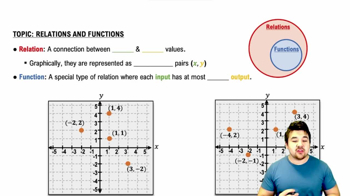
Relations & Functions Example 1
6524
views
319
rank
5:20
Relations and Functions
12513
views
534
rank
2
comments
이 집합의 용어 (22)
하이드의 정의
What does it mean for a function to be increasing on an interval?
A function is
increasing
on an interval if the function values go up from left to right over that interval.
What does it mean for a function to be decreasing on an interval?
A function is
decreasing
on an interval if the function values go down from left to right over that interval.
What does it mean for a function to be constant on an interval?
A function is
constant
on an interval if the function values do not change (neither increase nor decrease) from left to right over that interval.
Define a relative (local) maximum of a function.
A function has a
relative maximum
at a point if the y-value there is larger than all other y-values near that point.
Define a relative (local) minimum of a function.
A function has a
relative minimum
at a point if the y-value there is smaller than all other y-values near that point.
What is x-axis symmetry in a relation?
A relation has
x-axis symmetry
if for every point (x,y), the point (x,-y) is also on the graph.
What is y-axis symmetry in a relation?
A relation has
y-axis symmetry
if for every point (x,y), the point (-x,y) is also on the graph.
What is origin symmetry in a relation?
A relation has
origin symmetry
if for every point (x,y), the point (-x,-y) is also on the graph.
Algebraic test for x-axis symmetry?
Replace y with -y in the equation. If the equation remains unchanged, the relation has x-axis symmetry.
Algebraic test for y-axis symmetry?
Replace x with -x in the equation. If the equation remains unchanged, the relation has y-axis symmetry.
Algebraic test for origin symmetry?
Replace x with -x and y with -y in the equation. If the equation remains unchanged, the relation has origin symmetry.
Algebraic definition of an even function?
A function f is
even
if \(f(-x) = f(x)\) for all x in its domain.
Algebraic definition of an odd function?
A function f is
odd
if \(f(-x) = -f(x)\) for all x in its domain.
Can a function have x-axis symmetry?
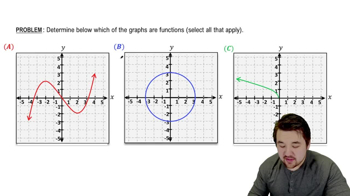
Virtually no functions have x-axis symmetry because that would fail the vertical line test.
What happens when you add or subtract even functions?
The result is always an even function.
What happens when you add or subtract odd functions?
The result is always an odd function.
What is a piecewise function?
A function defined by two or more different expressions over different parts of its domain.
What is the difference quotient of a function f?
The difference quotient is \(\frac{f(x+h) - f(x)}{h}\), where \(h \neq 0\).
Why is the difference quotient important?
It measures the average rate of change of the function over the interval from x to x+h and is foundational for derivatives.
How to determine intervals where a function is increasing or decreasing from a graph?
Look for intervals where the graph moves upward (increasing) or downward (decreasing) as you move left to right.
How to identify relative maxima and minima from a graph?
Relative maxima are peaks where the graph changes from increasing to decreasing; minima are valleys where it changes from decreasing to increasing.
How to determine if a function is even, odd, or neither from its graph?
Check for y-axis symmetry (even), origin symmetry (odd), or lack of both (neither).
 뒤로뒤로
뒤로뒤로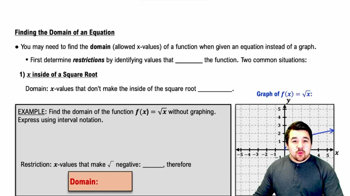
 3:43
3:43