Skip to main content
College Algebra
나의 코스
배우기
시험 준비
AI 튜터
학습 가이드
교과서적 해결책
플래시카드
탐험해 보세요
앱을 사용해 보세요
나의 코스
배우기
시험 준비
AI 튜터
학습 가이드
교과서적 해결책
플래시카드
탐험해 보세요
앱을 사용해 보세요
뒤로
College Algebra: Inequalities and Interval Notation
카드를 뒤집기 위해 탭할 수 있습니다.
How do you represent the solution to x > 3 in interval notation?
카드를 뒤집기 위해 탭할 수 있습니다.
👆
How do you represent the solution to x > 3 in interval notation?
The solution is represented as \((3, \infty)\).
진행 상황 추적
컨트롤 버튼이 '내비게이션' 모드로 변경되었습니다.
1/20
추천 영상
05:18
Interval Notation
6978
views
158
rank
1
comments
03:42
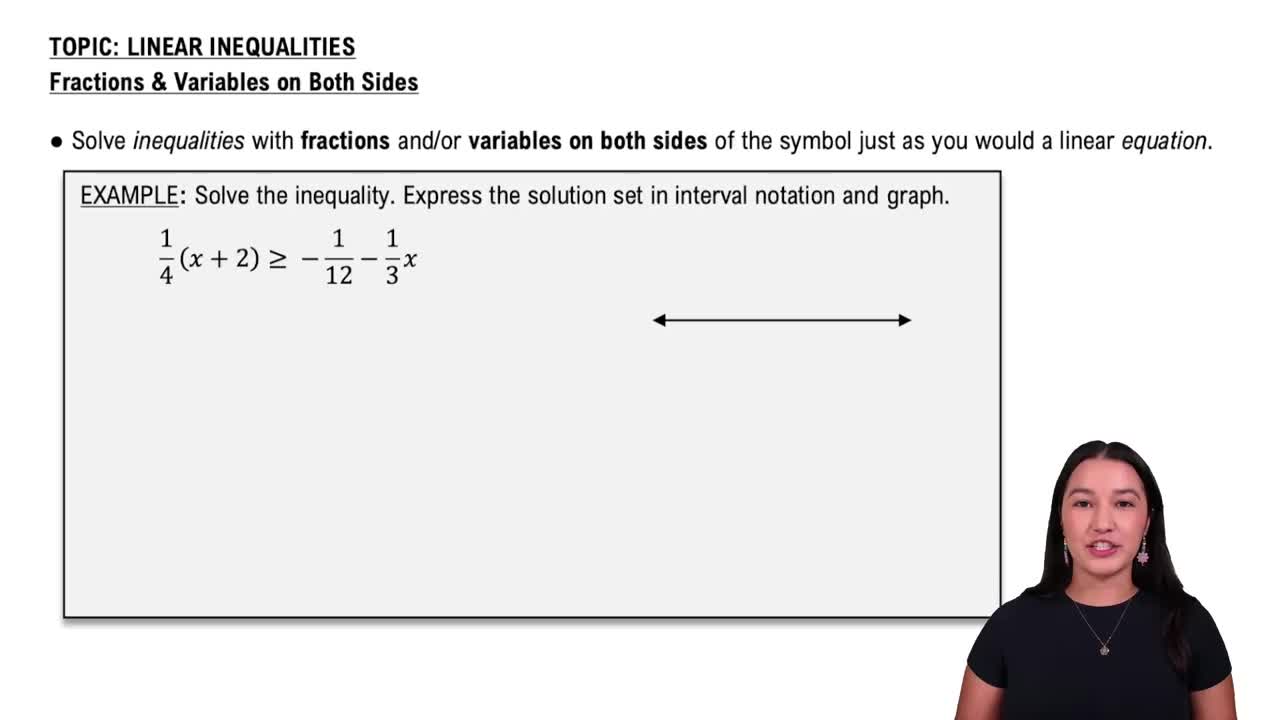
Linear Inequalities with Fractions & Variables on Both Sides
3022
views
64
rank
1
comments
06:07
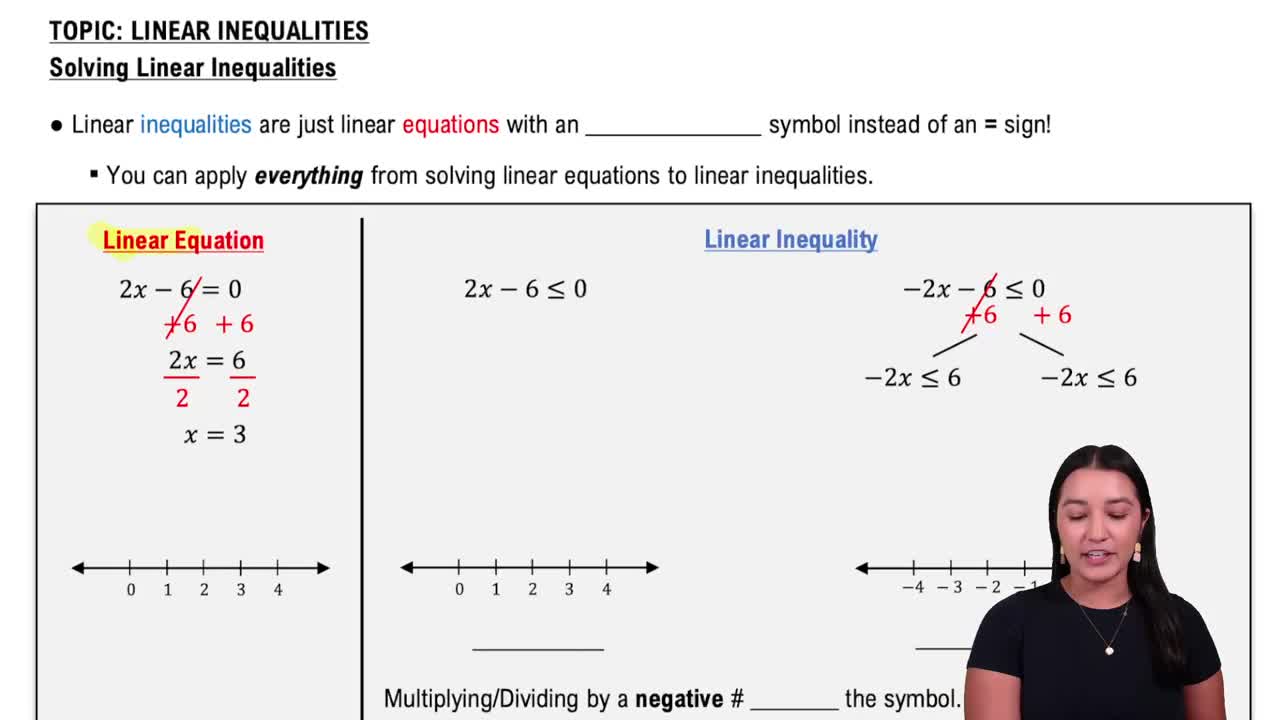
Linear Inequalities
3531
views
79
rank
이 집합의 용어 (20)
하이드의 정의
How do you represent the solution to x > 3 in interval notation?
The solution is represented as \((3, \infty)\).
How do you represent the solution to x ≤ -2 in interval notation?
The solution is represented as \((-\infty, -2]\).
What symbols are used for open and closed intervals in interval notation?
Parentheses ( ) denote open intervals (endpoints not included), and brackets [ ] denote closed intervals (endpoints included).
How do you write infinite intervals in interval notation?
Use the infinity symbol \(\infty\) with a parenthesis, e.g., \((a, \infty)\).
What is a compound inequality?
A compound inequality has two parts joined by 'AND' or 'OR'.
How do you solve a compound inequality?
Solve each part separately, then find the union (OR) or intersection (AND) of the solutions.
What does the word 'OR' represent in compound inequalities?
'OR' represents the union of solution sets, symbolized by \(\cup\).
What does the word 'AND' represent in compound inequalities?
'AND' represents the intersection of solution sets, symbolized by \(\cap\).
How do you solve and graph the inequality 4 ≤ x ≤ 10?
The solution is all x such that x is between 4 and 10, inclusive, written as \([4, 10]\).
How do you solve and graph the inequality x < 6 or x ≥ 10?
The solution is the union of x less than 6 and x greater than or equal to 10, written as \((-\infty, 6) \cup [10, \infty)\).
What is the solution set for the inequality |x| < 3?
The solution is all x between -3 and 3, written as \((-3, 3)\).
How do you interpret the inequality |x| > 3?
The solution is x less than -3 or x greater than 3, written as \((-\infty, -3) \cup (3, \infty)\).
What interval notation represents the intersection of [1, 3] and (2, 6)?
The intersection is (2, 3], written as \((2, 3]\).
What interval notation represents the union of [1, 3] and (2, 6)?
The union is [1, 6), written as \([1, 6)\).
How do you solve the linear inequality -2x - 3 < 41?
Add 3 to both sides: -2x < 44, then divide by -2 (reverse inequality): x > -22.
How do you solve the linear inequality 2 - 3x ≥ 5?
Subtract 2: -3x ≥ 3, divide by -3 (reverse inequality): x ≤ -1.
What is the solution to the compound inequality 4x - 1 < 11 and 2x - 3 ≥ -1?
Solve each: 4x < 12 → x < 3; 2x ≥ 2 → x ≥ 1; solution is x in [1, 3).
How do you solve the compound inequality 5 < 2x - 5 < 11?
Add 5: 10 < 2x < 16; divide by 2: 5 < x < 8; solution is (5, 8).
What is the solution to the absolute value inequality |2x + 6| ≤ 8?
Solve -8 ≤ 2x + 6 ≤ 8; subtract 6: -14 ≤ 2x ≤ 2; divide by 2: -7 ≤ x ≤ 1.
What is the solution to the absolute value inequality |4 - x| < 5?
Solve -5 < 4 - x < 5; subtract 4: -9 < -x < 1; multiply by -1 (reverse): -1 < x < 9.
 뒤로뒤로
뒤로뒤로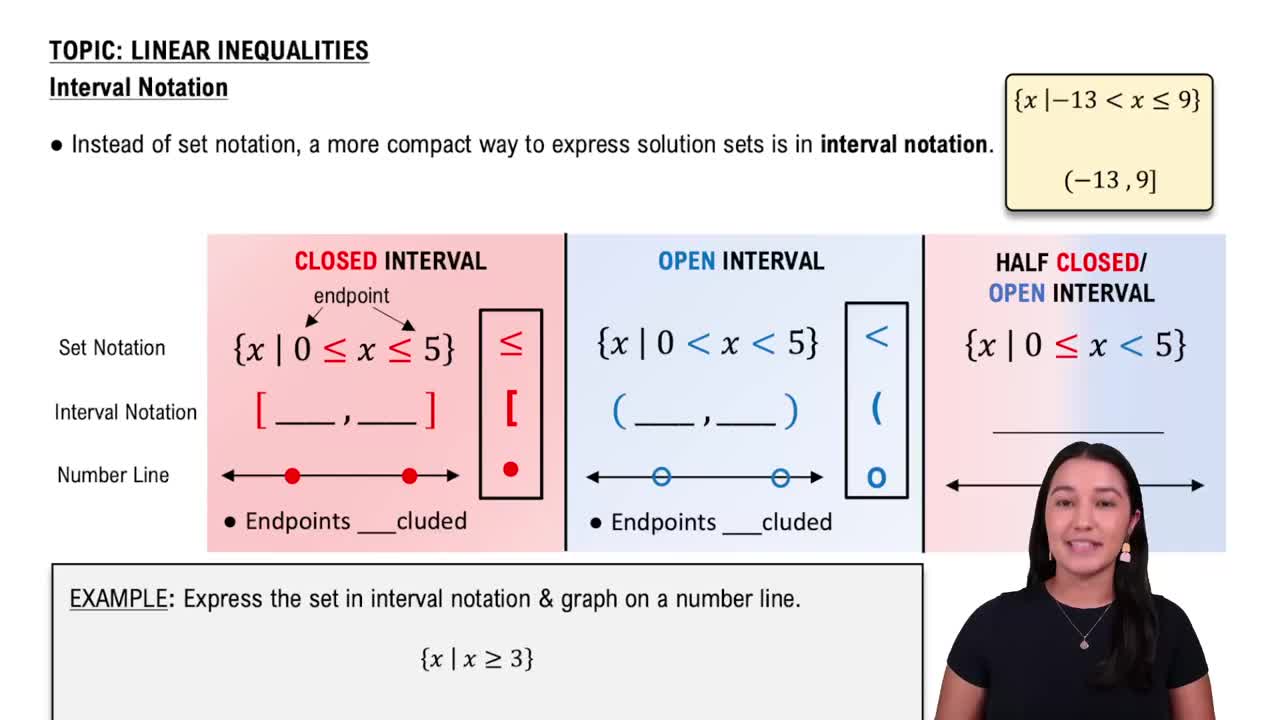
 05:18
05:18