 뒤로
College Algebra: Logarithms
 5:14

이 집합의 용어 (20)
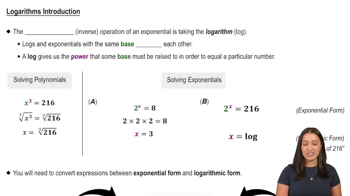
A logarithm answers the question: to what exponent must the base be raised to get a given number? Formally, \(\log_b a = c\) means \(b^c = a\).
The common logarithm has base 10 and is written as \(\log a\). It answers: 10 raised to what power equals a?
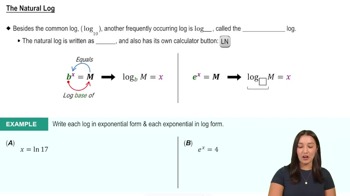
The natural logarithm has base \(e\) (Euler's number) and is written as \(\ln a\). It answers: \(e\) raised to what power equals a?
Product property: \(\log_b (xy) = \log_b x + \log_b y\)
Quotient property: \(\log_b \left(\frac{x}{y}\right) = \log_b x - \log_b y\)
Power property: \(\log_b (x^r) = r \log_b x\)
To change the base of a logarithm: \(\log_b a = \frac{\log_c a}{\log_c b}\), where c is any positive base.
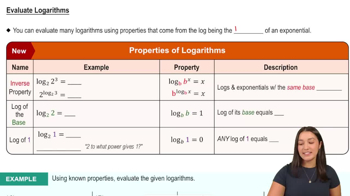
Exponentials and logarithms are inverses: \(b^{\log_b x} = x\) and \(\log_b (b^x) = x\).
The domain of logarithmic functions is all positive real numbers: \((0, \infty)\).
The range of logarithmic functions is all real numbers: \((-\infty, \infty)\).
Rewrite the logarithmic equation in exponential form or use properties to isolate the variable, then solve.
For any base \(b > 0, b \neq 1\), logarithm of 1 is zero: \(\log_b 1 = 0\).
For any base \(b > 0, b \neq 1\), logarithm of the base is one: \(\log_b b = 1\).
Logarithmic functions have a vertical asymptote at \(x=0\) and increase slowly to the right if \(b>1\).
If \(b>1\), the graph increases; if \(0
Logarithmic form: \(\log_b a = c\) converts to exponential form: \(b^c = a\).
Exponential form: \(b^c = a\) converts to logarithmic form: \(\log_b a = c\).
The base \(b\) must be positive and not equal to 1: \(b>0, b \neq 1\).
Take the logarithm of both sides to bring down exponents and solve for the variable.
Rewrite 8 as \(2^3\), so \(2^x = 2^3\). Then \(x=3\).