Skip to main content
College Algebra
나의 코스
배우기
시험 준비
AI 튜터
학습 가이드
교과서적 해결책
플래시카드
탐험해 보세요
앱을 사용해 보세요
나의 코스
배우기
시험 준비
AI 튜터
학습 가이드
교과서적 해결책
플래시카드
탐험해 보세요
앱을 사용해 보세요
뒤로
College Algebra Midterm Key Concepts and Problems
카드를 뒤집기 위해 탭할 수 있습니다.
Evaluate 2(x + 3) − 12 when x = −4
카드를 뒤집기 위해 탭할 수 있습니다.
👆
Evaluate 2(x + 3) − 12 when x = −4
Substitute x = −4: 2(−4 + 3) − 12 = 2(−1) − 12 = −2 − 12 = −14.
진행 상황 추적
컨트롤 버튼이 '내비게이션' 모드로 변경되었습니다.
1/24
추천 영상
VideoThumbView.guidedCourse
03:11
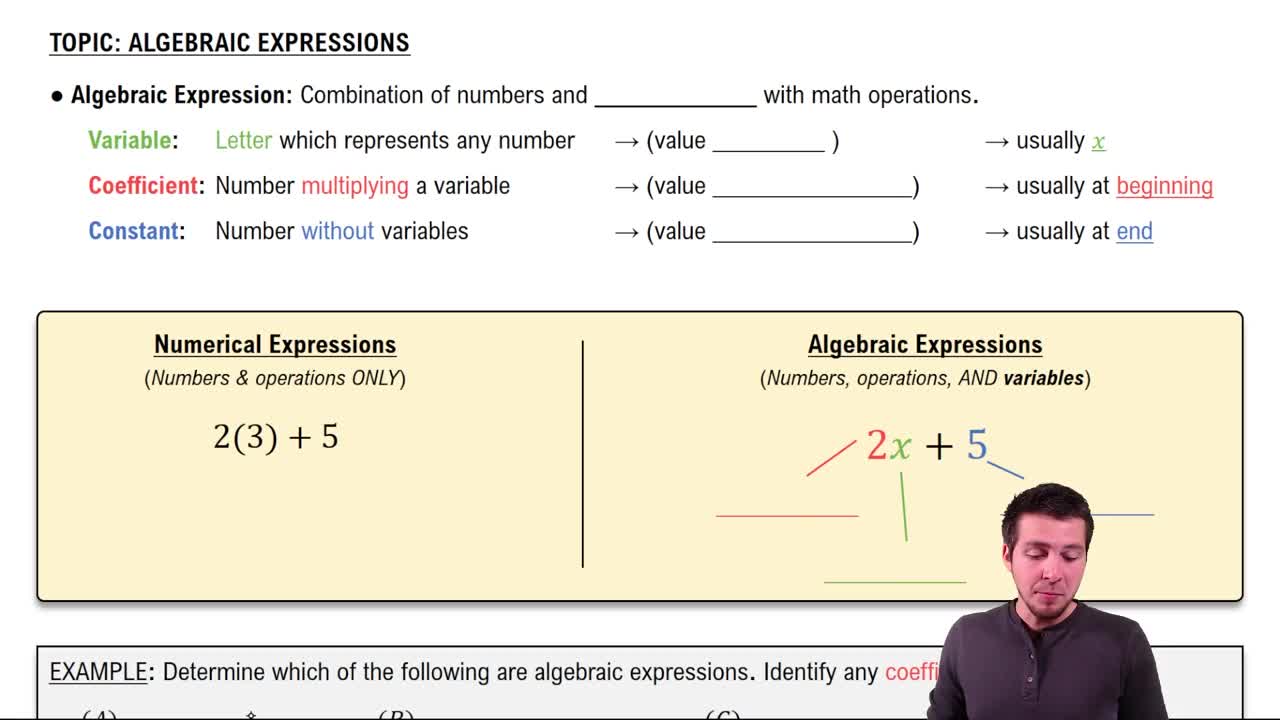
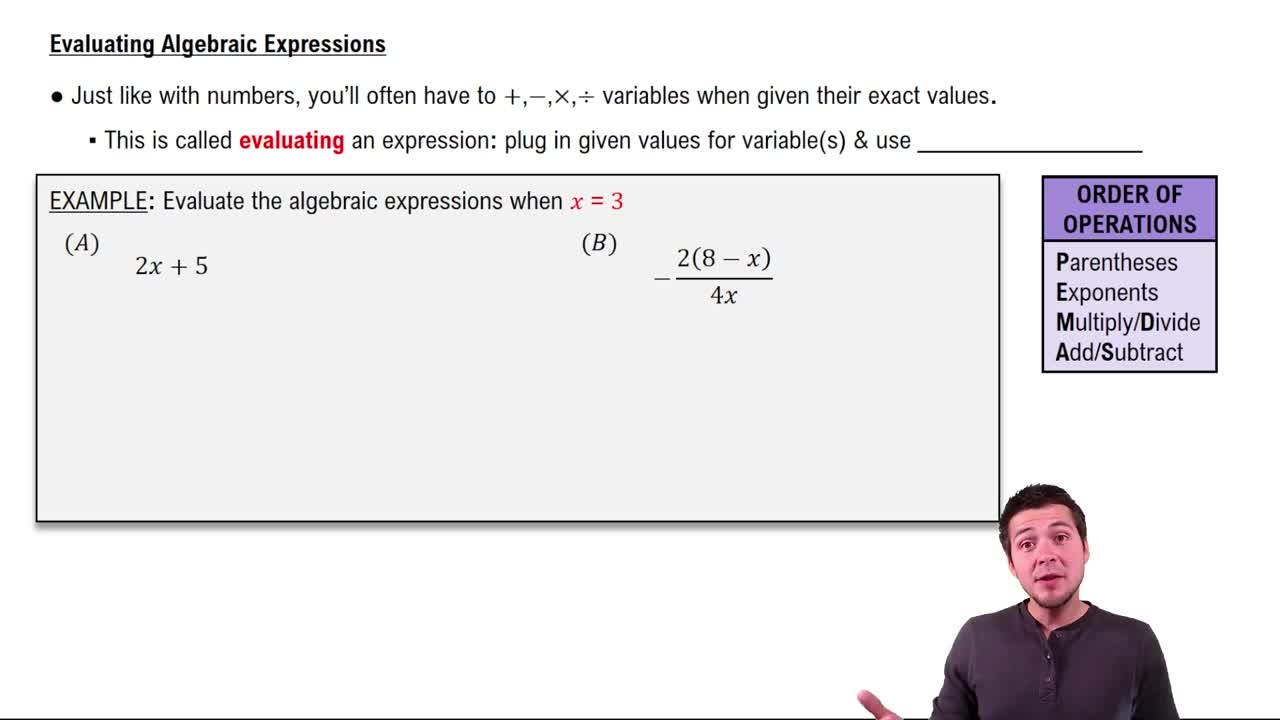
Evaluating Algebraic Expressions
14925
views
778
rank
10
comments
VideoThumbView.guidedCourse
05:09
Introduction to Algebraic Expressions
26253
views
1172
rank
8
comments
VideoThumbView.guidedCourse
1:51
Introduction to College Algebra Channel
21028
views
687
rank
1
comments
이 집합의 용어 (24)
하이드의 정의
Evaluate 2(x + 3) − 12 when x = −4
Substitute x = −4: 2(−4 + 3) − 12 = 2(−1) − 12 = −2 − 12 = −14.
Write 3.1642 × 10^6 in standard notation
Move decimal 6 places right: 3,164,200.
Simplify 8x^3 / (2x)^2
Rewrite denominator: (2x)^2 = 4x^2. Then 8x^3 / 4x^2 = 2x.
Subtract (13w³ + 2w² − 3) − (6w² + 5w − 3)
Result: 13w³ + 2w² − 3 − 6w² − 5w + 3 = 13w³ − 4w² − 5w.
Multiply (b − 2)(b² − 4b + 4)
Use distributive property: b³ − 4b² + 4b − 2b² + 8b − 8 = b³ − 6b² + 12b − 8.
Factor 16x² − 81
Difference of squares: (4x − 9)(4x + 9).
Factor y² + 12y + 36
Perfect square trinomial: (y + 6)².
Find the y-intercept for 2x − 5y = 6
Set x=0: −5y=6 → y=−6/5.
Distance between (5, −3) and (−2, 8)
Distance = √[(−2−5)² + (8+3)²] = √[49 + 121] = √170.
Midpoint between (5, −3) and (−2, 8)
Midpoint = ((5−2)/2, (−3+8)/2) = (1.5, 2.5).
Interval notation for {x | x ≤ 10}
Interval: (−∞, 10].
Solve |3x − 2| ≥ 4
3x − 2 ≥ 4 or 3x − 2 ≤ −4 → x ≥ 2 or x ≤ −2/3.
Equation of line through (−4, 2) and (5, −3)
Slope m = (−3−2)/(5+4) = −5/9; equation: y − 2 = (−5/9)(x + 4).
Add (3 − 2i) + (4 − i)
Sum: (3+4) + (−2i − i) = 7 − 3i.
Multiply (14 − 3i)(8 + 5i)
Product: 14×8 + 14×5i − 3i×8 − 3i×5i = 112 + 70i − 24i − 15i² = 112 + 46i + 15 = 127 + 46i.
Solve 4x² − 4x = 1
Rewrite: 4x² − 4x − 1 = 0; use quadratic formula.
Find domain of g(x) = 8 − x
Domain: all real numbers (−∞, ∞).
Compute (f ○ g)(4) for f(x) = 3x² − 10, g(x) = 2x + 5
g(4) = 2(4) + 5 = 13; f(13) = 3(13)² − 10 = 3(169) − 10 = 497.
Find inverse of f(x) = 0.5√(x − 3)
Swap x and y: x = 0.5√(y − 3); solve for y: y = 4x² + 3.
Determine if f(x) = −3x² + 4 is one-to-one
No, because it is a quadratic (parabola) failing the horizontal line test.
Write quadratic function in standard form: y = x² + 2x − 8
Complete the square: y = (x + 1)² − 9.
Use Rational Root Theorem on f(x) = 4x⁴ + 8x³ + 21x² + 17x + 4
Possible rational roots are ± factors of 4 over factors of 4: ±1, ±2, ±4, ±1/2, ±3/4, etc.
Find vertical asymptote(s) of f(x) = (x + 4) / (x² − 2x − 3)
Denominator zeroes: x² − 2x − 3 = (x − 3)(x + 1) = 0 → x = 3, −1 vertical asymptotes.
Find slant asymptote of g(x) = (x² + 3x − 3) / (x − 1)
Divide numerator by denominator: quotient is x + 4; slant asymptote y = x + 4.
 뒤로뒤로
 03:11