Skip to main content
College Algebra
나의 코스
배우기
시험 준비
AI 튜터
학습 가이드
교과서적 해결책
플래시카드
탐험해 보세요
앱을 사용해 보세요
나의 코스
배우기
시험 준비
AI 튜터
학습 가이드
교과서적 해결책
플래시카드
탐험해 보세요
앱을 사용해 보세요
뒤로
Polynomial and Rational Inequalities - College Algebra
카드를 뒤집기 위해 탭할 수 있습니다.
What is the first step in solving a polynomial inequality?
카드를 뒤집기 위해 탭할 수 있습니다.
👆
What is the first step in solving a polynomial inequality?
Express the inequality in the form \(f(x) < 0\) or \(f(x) > 0\), where
f
is a polynomial function.
진행 상황 추적
컨트롤 버튼이 '내비게이션' 모드로 변경되었습니다.
1/20
추천 영상
VideoThumbView.guidedCourse
05:29
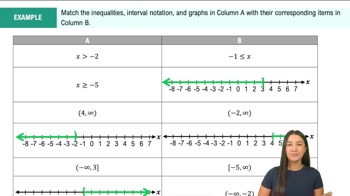
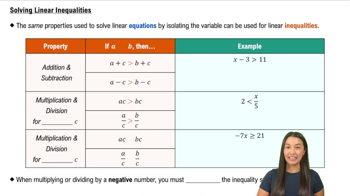
Solving Linear Inequalities
4
views
VideoThumbView.guidedCourse
07:09
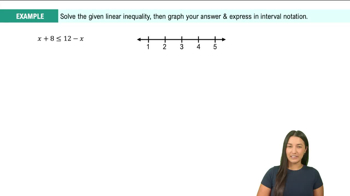
Introduction to Linear Inequalities Example 1
6
views
VideoThumbView.guidedCourse
02:42
Solving Linear Inequalities Example 2
4
views
이 집합의 용어 (20)
하이드의 정의
What is the first step in solving a polynomial inequality?
Express the inequality in the form \(f(x) < 0\) or \(f(x) > 0\), where
f
is a polynomial function.
How do you find the boundary points when solving polynomial inequalities?
Solve the equation \(f(x) = 0\). The real solutions are the boundary points.
What is the purpose of locating boundary points on a number line in polynomial inequalities?
Boundary points divide the number line into intervals to test the sign of
f(x)
in each interval.
How do you determine the sign of
f(x)
in each interval when solving polynomial inequalities?
Choose a test value in each interval and evaluate
f
at that number. Positive value means \(f(x) > 0\), negative means \(f(x) < 0\).
How do you write the solution set for polynomial inequalities?
Select the intervals where the inequality is true. Include boundary points if the inequality is ≤ or ≥.
What is the equivalent form of the inequality \(2x^2 + x - 15 > 0\) used in the example?
It is equivalent to \((2x - 5)(x + 3) > 0\) after factoring.
What are the boundary points for the polynomial inequality \(2x^2 + x - 15 = 0\)?
The boundary points are
x = -3
and
x = 5/2
.
What intervals are created by the boundary points
-3
and
5/2
?
The intervals are \((-\infty, -3)\), \((-3, 5/2)\), and \((5/2, \infty)\).
How do you solve a rational inequality like \(\frac{x+1}{x+3} \geq 0\)?
Set numerator and denominator equal to zero to find boundary points, then test intervals between these points.
What are the boundary points for the rational inequality \(\frac{x+1}{x+3} \geq 0\)?
Boundary points are
x = -1
(numerator zero) and
x = -3
(denominator zero, undefined).
How do you handle boundary points where the function is undefined in rational inequalities?
Exclude points where the denominator is zero from the solution set.
What intervals are created by the boundary points
-3
and
-1
in the rational inequality example?
The intervals are \((-\infty, -3)\), \((-3, -1)\), and \((-1, \infty)\).
What is the solution set for the rational inequality \(\frac{x+1}{x+3} \geq 0\)?
The solution is \([-1, \infty)\) excluding
x = -3
where undefined.
What is the general procedure for solving polynomial and rational inequalities?
1. Express inequality as \(f(x) < 0\) or \(f(x) > 0\). 2. Find boundary points by solving \(f(x) = 0\). 3. Test intervals between boundary points.
How do you interpret the solution intervals on a number line?
Intervals where the test value satisfies the inequality are included in the solution set.
What should you do if the inequality includes ≤ or ≥?
Include the boundary points where \(f(x) = 0\) in the solution set.
Why is it important to exclude points where the denominator is zero in rational inequalities?
Because the function is undefined at those points, so they cannot be part of the solution.
What is the significance of test values in solving inequalities?
Test values determine the sign of the function in each interval, helping identify where the inequality holds true.
How do you simplify the inequality \(\frac{x+1}{x+3} \geq 0\) before solving?
Rewrite as \(\frac{x+1}{x+3} - 0 \geq 0\) and identify numerator and denominator zeros.
What is the role of factoring in solving polynomial inequalities?
Factoring helps find the roots of the polynomial, which are the boundary points for testing intervals.
 뒤로뒤로
 05:29