Skip to main content
College Algebra
나의 코스
배우기
시험 준비
AI 튜터
학습 가이드
교과서적 해결책
플래시카드
탐험해 보세요
앱을 사용해 보세요
나의 코스
배우기
시험 준비
AI 튜터
학습 가이드
교과서적 해결책
플래시카드
탐험해 보세요
앱을 사용해 보세요
뒤로
Transformations of Graphs in College Algebra
카드를 뒤집기 위해 탭할 수 있습니다.
What is a vertical shift in graph transformations?
카드를 뒤집기 위해 탭할 수 있습니다.
👆
What is a vertical shift in graph transformations?
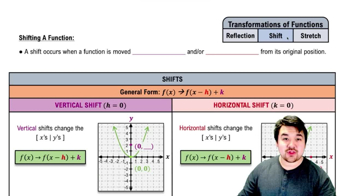
A vertical shift moves the graph up or down by adding or subtracting a constant outside the function, as in \(f(x)+k\).
진행 상황 추적
컨트롤 버튼이 '내비게이션' 모드로 변경되었습니다.
1/19
추천 영상
6:02
Stretches & Shrinks of Functions
2767
views
33
rank
4
comments
5:34
Shifts of Functions
2649
views
76
rank
4:22
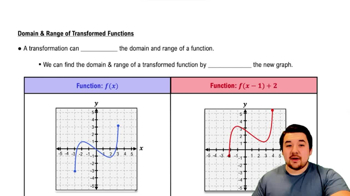
Domain & Range of Transformed Functions
2145
views
33
rank
이 집합의 용어 (19)
하이드의 정의
What is a vertical shift in graph transformations?
A vertical shift moves the graph up or down by adding or subtracting a constant outside the function, as in \(f(x)+k\).
How does a horizontal shift affect a graph?
A horizontal shift moves the graph left or right by adding or subtracting a constant inside the function's input, as in \(f(x-h)\).
What does vertical stretching or compressing mean?
Multiplying the function by a constant >1 stretches it vertically; multiplying by a constant between 0 and 1 compresses it vertically.
How does horizontal stretching or compressing work?
Replacing \(x\) with \(bx\) compresses the graph horizontally if \(b>1\), and stretches it if \(0<b<1\).
What effect does multiplying a function by -1 have?
Multiplying by -1 reflects the graph across the x-axis, flipping it upside down.
What is the result of replacing \(x\) with \(-x\) in a function?
It reflects the graph across the y-axis, creating a mirror image horizontally.
How do you write the transformation for shifting a graph 3 units up?
Add 3 outside the function: \(f(x)+3\).
How do you represent shifting a graph 2 units to the right?
Replace \(x\) with \(x-2\): \(f(x-2)\).
What transformation does \(y=2f(x)\) represent?
A vertical stretch by a factor of 2, making the graph twice as tall.
What does \(y=f(\frac{x}{3})\) do to the graph?
It horizontally stretches the graph by a factor of 3.
How does \(y=-f(x)\) transform the graph?
It reflects the graph across the x-axis.
What is the effect of \(y=f(-x)\) on a graph?
It reflects the graph across the y-axis.
How do you combine multiple transformations?
Apply transformations in order: horizontal shifts and stretches inside the function first, then vertical stretches/compressions and shifts outside.
What is the general form for a transformed function combining shifts and stretches?
\(y=a f(b(x-h))+k\), where
a
is vertical stretch/compression,
b
horizontal stretch/compression,
h
horizontal shift, and
k
vertical shift.
How does changing the sign of
a
in \(y=a f(x)\) affect the graph?
If
a
is negative, the graph reflects across the x-axis.
What happens to the graph of \(f(x)\) when \(b>1\) in \(f(bx)\)?
The graph compresses horizontally by a factor of \(\frac{1}{b}\).
What is the effect of \(0<b<1\) in \(f(bx)\)?
The graph stretches horizontally by a factor of \(\frac{1}{b}\).
How do you identify a vertical compression from a function transformation?
When the multiplier outside the function is between 0 and 1, the graph compresses vertically.
What is the effect of adding a constant inside the function argument, like \(f(x+4)\)?
It shifts the graph horizontally 4 units to the left.
 뒤로뒤로
뒤로뒤로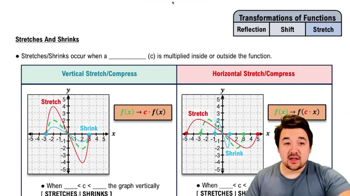
 6:02
6:02