In Exercises 1–8, add or subtract as indicated and write the result in standard form. (7 + 2i) + (1 - 4i)
검증된 단계별 안내
1
Identify the real and imaginary parts of each complex number: \((7 + 2i)\) and \((1 - 4i)\).
Add the real parts together: \(7 + 1\).
Add the imaginary parts together: \(2i - 4i\).
Combine the results from the previous steps to form a new complex number.
Write the result in standard form \(a + bi\), where \(a\) is the real part and \(b\) is the imaginary part.
비슷한 문제에 대한 검증된 영상 답변:
이 영상 해법은 위 문제에 도움이 된다고 튜터들이 추천한 것입니다.
영상 길이:
1m
영상 재생:
0 댓글
주요 개념
질문에 올바르게 답하기 위해 반드시 이해해야 하는 핵심 개념들은 다음과 같습니다.
Complex Numbers
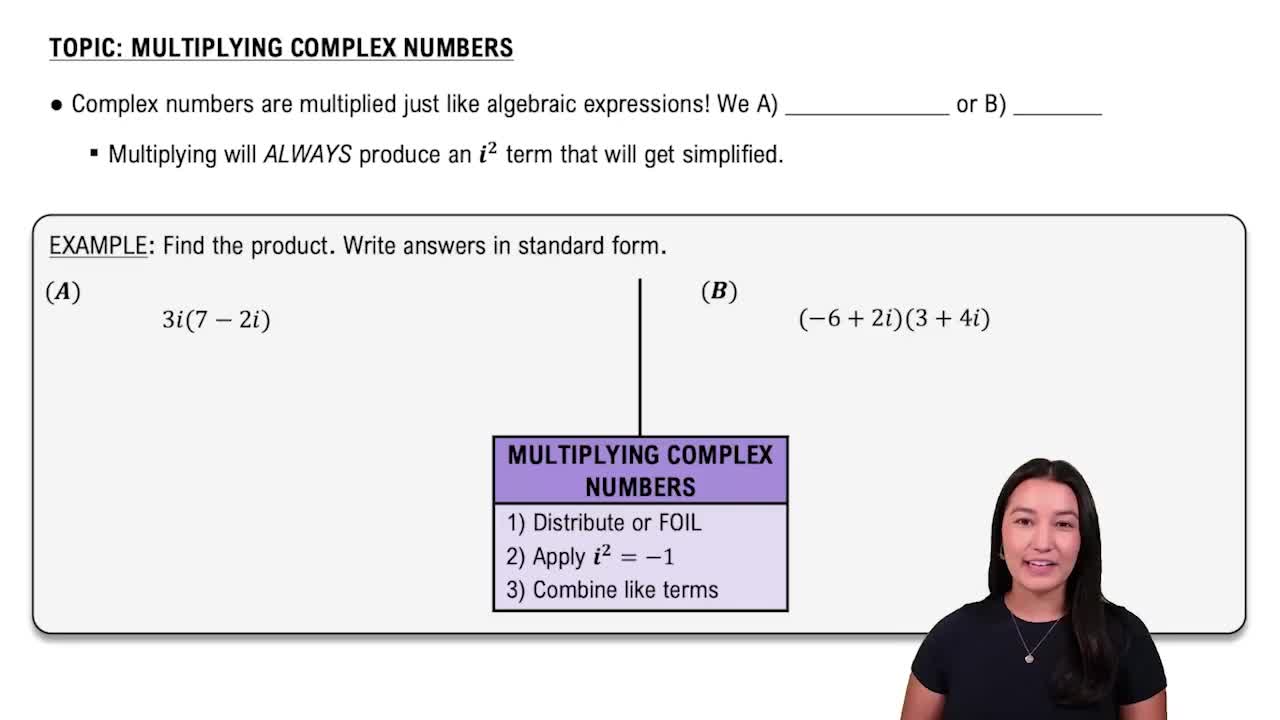
Complex numbers are numbers that have a real part and an imaginary part, expressed in the form a + bi, where a is the real part, b is the imaginary part, and i is the imaginary unit defined as the square root of -1. Understanding complex numbers is essential for performing operations such as addition and subtraction.
To add complex numbers, you combine their real parts and their imaginary parts separately. For example, when adding (7 + 2i) and (1 - 4i), you add 7 and 1 to get 8, and 2i and -4i to get -2i, resulting in the sum 8 - 2i.
The standard form of a complex number is a + bi, where a and b are real numbers. It is important to express the result of operations on complex numbers in this form to clearly identify the real and imaginary components, facilitating further calculations and interpretations.


 검증된 단계별 안내

 04:22