Find f−g and determine the domain for each function. f(x) = √x, g(x) = x − 4
Ch. 2 - Functions and Graphs

3장, 문제 40
Find , , , and . Determine the domain for each function.
,
검증된 단계별 안내1
To find \( (f+g)(x) \), add the functions: \( f(x) + g(x) = \sqrt{x} + (x - 5) \). Simplify the expression to get \( \sqrt{x} + x - 5 \). The domain of \( f(x) = \sqrt{x} \) is \( x \geq 0 \), and the domain of \( g(x) = x - 5 \) is all real numbers. Therefore, the domain of \( f+g \) is \( x \geq 0 \).
To find \( (f-g)(x) \), subtract the functions: \( f(x) - g(x) = \sqrt{x} - (x - 5) \). Simplify the expression to get \( \sqrt{x} - x + 5 \). The domain is the same as \( f+g \), which is \( x \geq 0 \).
To find \( (fg)(x) \), multiply the functions: \( f(x) \cdot g(x) = \sqrt{x} \cdot (x - 5) \). This simplifies to \( x\sqrt{x} - 5\sqrt{x} \). The domain is \( x \geq 0 \) because \( \sqrt{x} \) is only defined for non-negative \( x \).
To find \( \left(\frac{f}{g}\right)(x) \), divide the functions: \( \frac{f(x)}{g(x)} = \frac{\sqrt{x}}{x - 5} \). The domain is \( x \geq 0 \) and \( x \neq 5 \) because the denominator cannot be zero.
Summarize the domains: \( f+g \) and \( f-g \) have domain \( x \geq 0 \), \( fg \) has domain \( x \geq 0 \), and \( \frac{f}{g} \) has domain \( x \geq 0 \) and \( x \neq 5 \).

비슷한 문제에 대한 검증된 영상 답변:
이 영상 해법은 위 문제에 도움이 된다고 튜터들이 추천한 것입니다.
영상 길이:
2m주요 개념
질문에 올바르게 답하기 위해 반드시 이해해야 하는 핵심 개념들은 다음과 같습니다.
Domain of a Function
The domain of a function refers to the set of all possible input values (x-values) for which the function is defined. Understanding the domain is crucial because it determines the values that can be used in the function without resulting in undefined expressions, such as division by zero or taking the square root of a negative number.
추천 영상:
가이드 코스
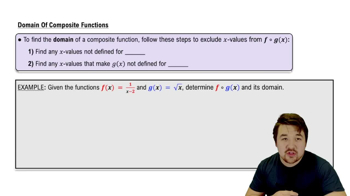
Domain Restrictions of Composed Functions
Square Root Function
The square root function, denoted as f(x) = √x, is defined only for non-negative values of x. This means that the input must be greater than or equal to zero (x ≥ 0) to yield a real number output. Recognizing this restriction is essential when determining the domain of functions involving square roots.
추천 영상:
가이드 코스
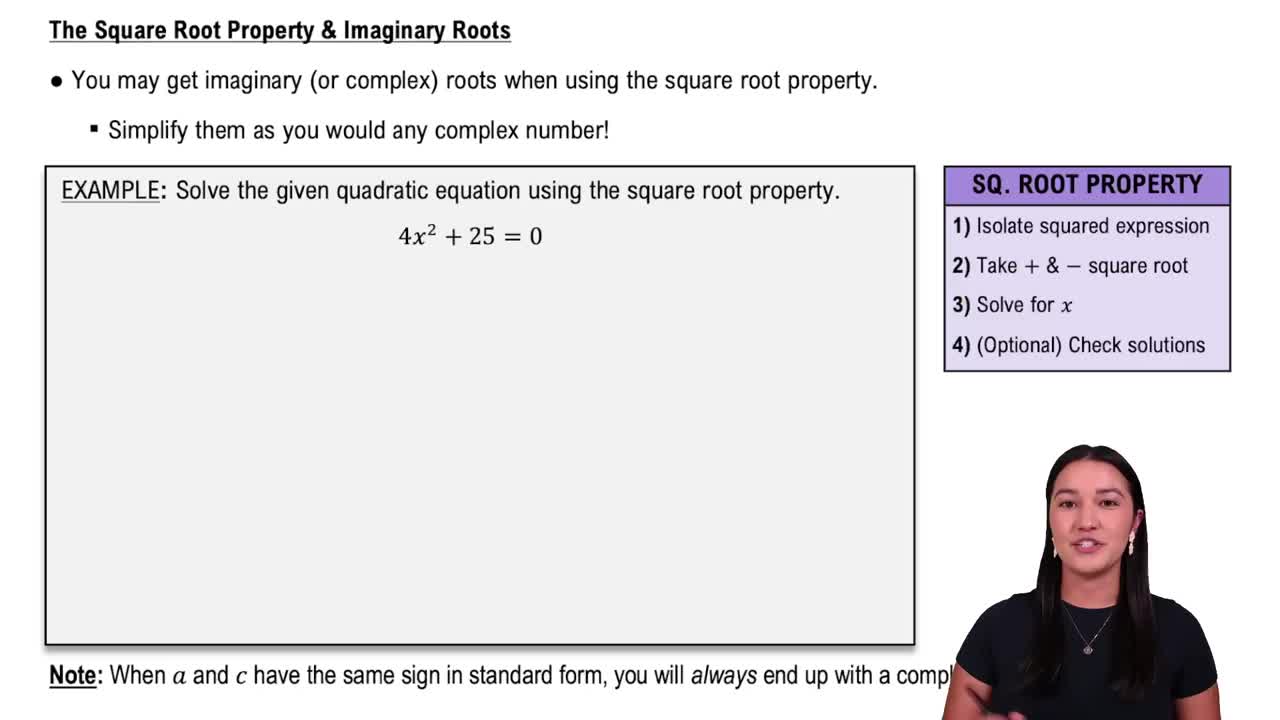
Imaginary Roots with the Square Root Property
Linear Function
A linear function, such as g(x) = x - 5, is defined for all real numbers. This means there are no restrictions on the input values, and the domain is all real numbers (−∞, ∞). Understanding the nature of linear functions helps in identifying their domains and how they interact with other functions in operations like addition or subtraction.
추천 영상:
가이드 코스
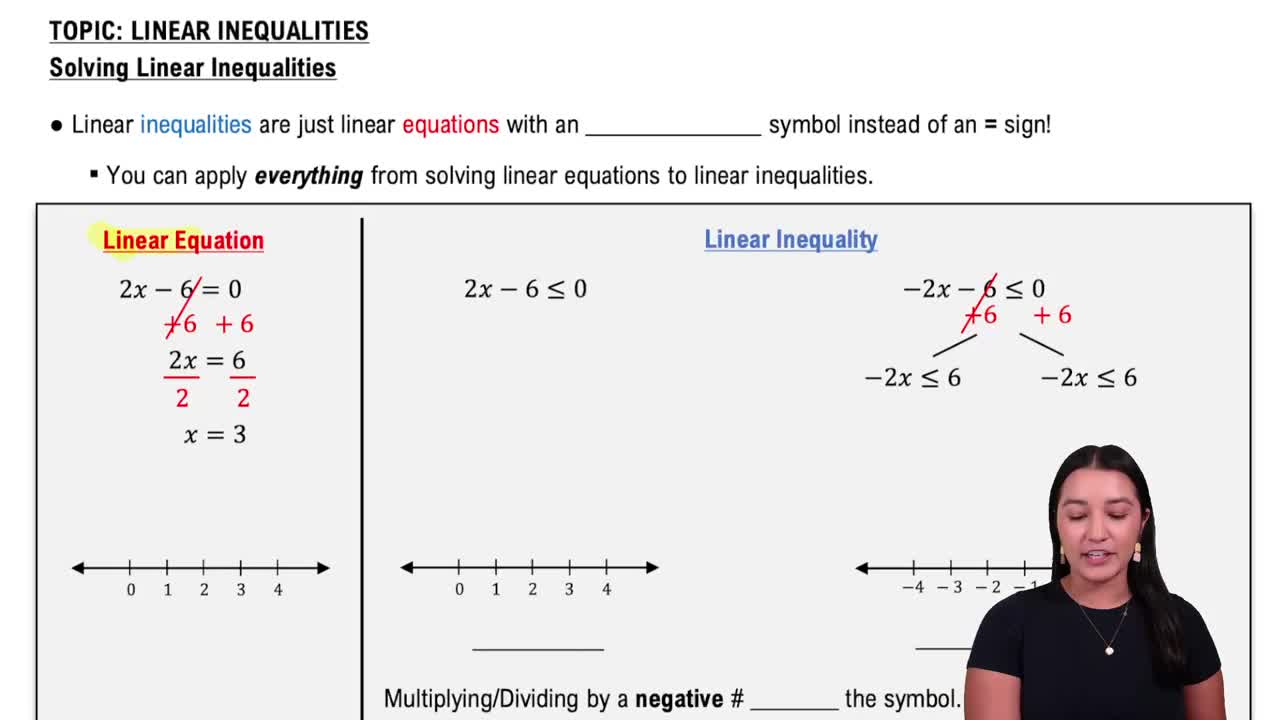
Linear Inequalities
관련 실천
교과서 질문
898
views
교과서 질문
In Exercises 41–44, use the given conditions to write an equation for each line in point-slope form and slope-intercept form. Passing through (-3, 2) with slope - 6
1162
views
교과서 질문
Find f/g and determine the domain for each function. f(x) = √x, g(x) = x − 4
1112
views
교과서 질문
Find fg and determine the domain for each function. f(x) = √x, g(x) = x − 4
1181
views
교과서 질문
In Exercises 39–48, give the slope and y-intercept of each line whose equation is given. Then graph the linear function. f(x) = -2x+1
132
views
교과서 질문
Graph the given functions, f and g, in the same rectangular coordinate system. Select integers for x, starting with -2 and ending with 2. Once you have obtained your graphs, describe how the graph of g is related to the graph of f. f(x) = -2x, g(x) = -2x-1
625
views