Graph both equations in the same rectangular coordinate system and find all points of intersection. Then show that these ordered pairs satisfy the equations. x² + y² = 16, x-y = 4
Ch. 2 - Functions and Graphs

3장, 문제 67
In Exercises 67-74, find a. (fog) (x) b. the domain of f o g. f(x) = 2/(x+3), g(x) = 1/x
검증된 단계별 안내1
Step 1: Understand the composition of functions. The notation (fog)(x) represents the composition of f and g, meaning f(g(x)). To find this, substitute g(x) into f(x).
Step 2: Substitute g(x) = 1/x into f(x) = 2/(x+3). Replace every instance of 'x' in f(x) with g(x). This gives f(g(x)) = 2/((1/x) + 3).
Step 3: Simplify the expression for f(g(x)). Combine the terms in the denominator ((1/x) + 3) by finding a common denominator. This results in f(g(x)) = 2/(1/x + 3) = 2/((1 + 3x)/x).
Step 4: Further simplify f(g(x)) by dividing 2 by the fraction (1 + 3x)/x. This results in f(g(x)) = 2x/(1 + 3x).
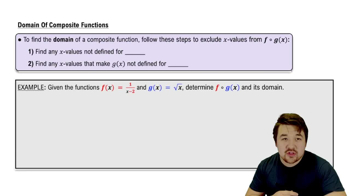
Step 5: Determine the domain of f o g. The domain is the set of all x-values for which the composition is defined. For f(g(x)) = 2x/(1 + 3x), ensure that the denominator (1 + 3x) ≠ 0 and g(x) = 1/x is defined (x ≠ 0). Therefore, the domain excludes x = 0 and x = -1/3.

비슷한 문제에 대한 검증된 영상 답변:
이 영상 해법은 위 문제에 도움이 된다고 튜터들이 추천한 것입니다.
영상 길이:
3m주요 개념
질문에 올바르게 답하기 위해 반드시 이해해야 하는 핵심 개념들은 다음과 같습니다.
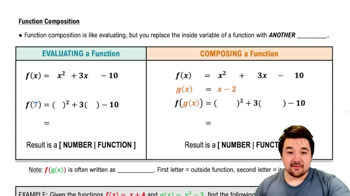
Function Composition
Function composition involves combining two functions, where the output of one function becomes the input of another. In this case, (f o g)(x) means applying g first and then applying f to the result. Understanding how to correctly perform this operation is essential for solving the problem.
추천 영상:
가이드 코스
Function Composition
Domain of a Function
The domain of a function is the set of all possible input values (x-values) for which the function is defined. For the composition of functions, the domain must consider the restrictions of both functions involved. Identifying these restrictions is crucial to determine the overall domain of the composed function.
추천 영상:
가이드 코스
Domain Restrictions of Composed Functions
Rational Functions
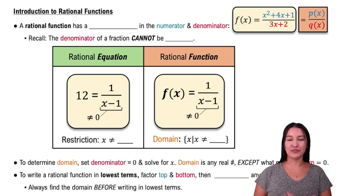
Rational functions are ratios of polynomials, and they often have restrictions based on the values that make the denominator zero. In this problem, both f(x) and g(x) are rational functions, so understanding how to identify and handle these restrictions is key to finding the correct domain for the composition.
추천 영상:
가이드 코스
Intro to Rational Functions
관련 실천
교과서 질문
980
views
교과서 질문
In Exercises 64–66, begin by graphing the square root function, f(x) = √x. Then use transformations of this graph to graph the given function. r(x) = 2√(x + 2)
1558
views
교과서 질문
In Exercises 59-66, a. Rewrite the given equation in slope-intercept form. b. Give the slope and y-intercept. c. Use the slope and y-intercept to graph the linear function. 4y+ 28 = 0
107
views
교과서 질문
Use intercepts to graph each equation. 6x-9y-18 = 0
1212
views
교과서 질문
Begin by graphing the standard quadratic function, f(x) = x². Then use transformations of this graph to graph the given function. h(x) = -2(x+2)²+1
711
views
교과서 질문
In Exercises 65–70, use the graph of f to find each indicated function value. f(4)
607
views