In Exercises 77–92, use the graph to determine a. the function's domain; b. the function's range; c. the x-intercepts, if any; d. the y-intercept, if any; and e. the missing function values, indicated by question marks, below each graph.
Ch. 2 - Functions and Graphs

3장, 문제 87
Find a. (f ○ g)(x); b. the domain of (f ○ g). f(x) = (x + 1)/(x - 2), g(x) = 1/x
검증된 단계별 안내1
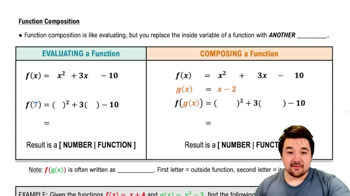
Step 1: Understand that the composition (f \(\circ\) g)(x) means f(g(x)), which is the function f applied to the output of g(x). So, first substitute g(x) into f(x).
Step 2: Write the expression for (f \(\circ\) g)(x) by replacing every x in f(x) with g(x). Since f(x) = \(\frac{x + 1}{x - 2}\) and g(x) = \(\frac{1}{x}\), we have (f \(\circ\) g)(x) = f\(\left\)(\(\frac{1}{x}\)\(\right\)) = \(\frac{\frac{1}{x}\) + 1}{\(\frac{1}{x}\) - 2}.
Step 3: Simplify the complex fraction by finding a common denominator for the numerator and denominator separately, then simplify the overall expression.
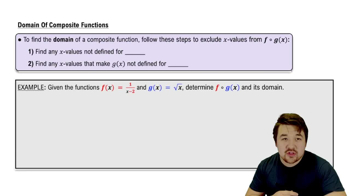
Step 4: Determine the domain of (f \(\circ\) g)(x) by considering the domain restrictions of both g(x) and f(g(x)). First, find where g(x) is defined (denominator \(\neq\) 0), then find where f is defined when its input is g(x) (denominator of f(g(x)) \(\neq\) 0).
Step 5: Combine the domain restrictions from both functions to write the domain of (f \(\circ\) g)(x) in interval or set notation, excluding values that make any denominator zero or cause undefined expressions.

비슷한 문제에 대한 검증된 영상 답변:
이 영상 해법은 위 문제에 도움이 된다고 튜터들이 추천한 것입니다.
영상 길이:
3m주요 개념
질문에 올바르게 답하기 위해 반드시 이해해야 하는 핵심 개념들은 다음과 같습니다.
Function Composition
Function composition involves applying one function to the result of another, denoted as (f ○ g)(x) = f(g(x)). It requires substituting the entire output of g(x) into the function f. Understanding this process is essential to correctly find (f ○ g)(x).
추천 영상:
가이드 코스
Function Composition
Domain of a Function
The domain of a function is the set of all input values (x) for which the function is defined. When composing functions, the domain of (f ○ g) includes all x-values in the domain of g for which g(x) is in the domain of f. Identifying restrictions like division by zero is crucial.
추천 영상:
가이드 코스
Domain Restrictions of Composed Functions
Rational Functions and Restrictions
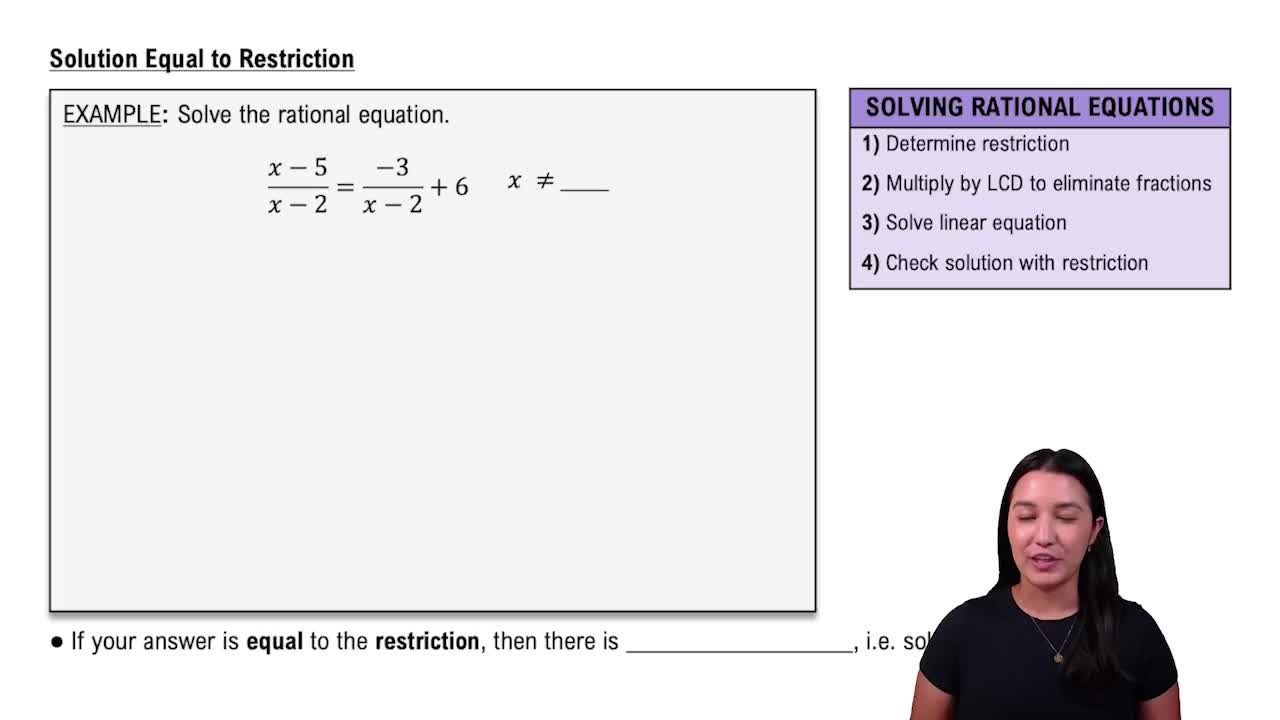
Rational functions are ratios of polynomials, which can have restrictions where the denominator equals zero. For f(x) = (x + 1)/(x - 2) and g(x) = 1/x, values that make denominators zero must be excluded from the domain to avoid undefined expressions.
추천 영상:
가이드 코스
Restrictions on Rational Equations
관련 실천
교과서 질문
130
views
교과서 질문
Use the graphs of f and g to solve Exercises 83–90.
Find the domain of ƒ + g.
1268
views
교과서 질문
Begin by graphing the absolute value function, f(x) = |x|. Then use transformations of this graph to graph the given function. h(x) = |x + 3| - 2
791
views
교과서 질문
Begin by graphing the absolute value function, f(x) = |x|. Then use transformations of this graph to graph the given function. h(x) = -|x+3|
1612
views
교과서 질문
Use the graphs of f and g to solve Exercises 83–90.
Find(g/f)(3)
1295
views
교과서 질문
In Exercises 77–92, use the graph to determine a. the function's domain; b. the function's range; c. the x-intercepts, if any; d. the y-intercept, if any; and e. the missing function values, indicated by question marks, below each graph.
107
views
