In Exercises 11–26, determine whether each equation defines y as a function of x. x = y²
Ch. 2 - Functions and Graphs

3장, 문제 17
The functions in Exercises 11-28 are all one-to-one. For each function, a. Find an equation for f-1(x), the inverse function. b. Verify that your equation is correct by showing that f(ƒ-1 (x)) = = x and ƒ-1 (f(x)) = x. f(x) = x³ +2
검증된 단계별 안내1
Start with the given function: \(f(x) = x^3 + 2\). To find the inverse function \(f^{-1}(x)\), first replace \(f(x)\) with \(y\): \(y = x^3 + 2\).
Swap the variables \(x\) and \(y\) to begin solving for the inverse: \(x = y^3 + 2\).
Isolate the cubic term by subtracting 2 from both sides: \(x - 2 = y^3\).
Take the cube root of both sides to solve for \(y\): \(y = \sqrt[3]{x - 2}\). This expression represents the inverse function \(f^{-1}(x)\).
To verify the inverse, compute \(f(f^{-1}(x))\) by substituting \(f^{-1}(x)\) into \(f(x)\) and simplify to check if it equals \(x\). Then compute \(f^{-1}(f(x))\) by substituting \(f(x)\) into \(f^{-1}(x)\) and simplify to check if it equals \(x\).

비슷한 문제에 대한 검증된 영상 답변:
이 영상 해법은 위 문제에 도움이 된다고 튜터들이 추천한 것입니다.
영상 길이:
2m주요 개념
질문에 올바르게 답하기 위해 반드시 이해해야 하는 핵심 개념들은 다음과 같습니다.
One-to-One Functions
A one-to-one function assigns each input a unique output and vice versa, ensuring that no two different inputs produce the same output. This property is essential for a function to have an inverse, as the inverse must also be a function.
추천 영상:
가이드 코스
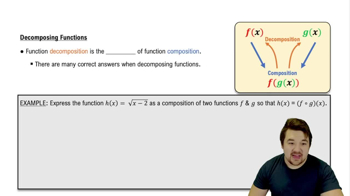
Decomposition of Functions
Inverse Functions
The inverse of a function reverses the roles of inputs and outputs, meaning if f(x) maps x to y, then f⁻¹(y) maps y back to x. Finding the inverse involves solving the original function's equation for x in terms of y.
추천 영상:
가이드 코스
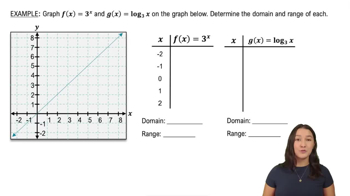
Graphing Logarithmic Functions
Verification of Inverse Functions
To verify that two functions are inverses, you must show that composing them in either order returns the original input: f(f⁻¹(x)) = x and f⁻¹(f(x)) = x. This confirms the functions undo each other's operations.
추천 영상:
가이드 코스
Graphing Logarithmic Functions
관련 실천
교과서 질문
82
views
교과서 질문
Use the graph to determine (a) the function's domain, (b) the function's range, (c) the x-intercepts, if any, (d) the y-intercept, if there is one, (e) intervals on which the function is increasing, decreasing or constant, (f) the missing function values, indicated by question marks, below each graph.
440
views
교과서 질문
Find the domain of each function. f(x) = √(x - 3)
1303
views
교과서 질문
Use the graph of y = f(x) to graph each function g.
g(x) = f(x) - 1
925
views
교과서 질문
Find the average rate of change of the function from x1 to x2. f(x) = √x from x1 = 4 to x2 = 9
69
views
교과서 질문
Find the distance between each pair of points. If necessary, express answers in simplified radical form and then round to two decimal places. (7/3, 1/5) and (1/3, 6/5)
898
views