Write an equation that expresses each relationship. Then solve the equation for y. x varies jointly as y and z and inversely as the square of w.
Ch. 3 - Polynomial and Rational Functions

4장, 문제 17
Use the vertex and intercepts to sketch the graph of each quadratic function. Give the equation of the parabola's axis of symmetry. Use the graph to determine the function's domain and range. f(x)=(x−4)2−1
검증된 단계별 안내1
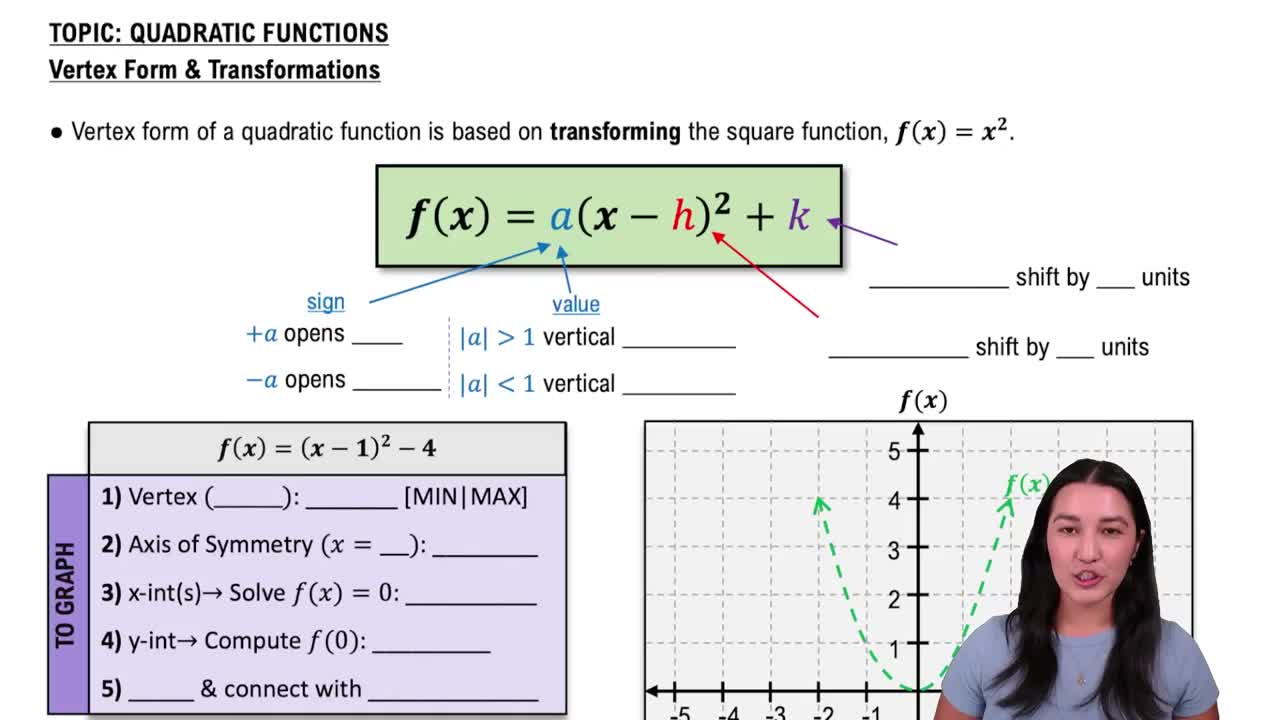
Identify the vertex of the parabola from the function f(x) = (x - 4)^2 - 1. The vertex form of a quadratic function is f(x) = a(x - h)^2 + k, where (h, k) is the vertex. Here, h = 4 and k = -1, so the vertex is (4, -1).
Write the equation of the axis of symmetry. The axis of symmetry is a vertical line that passes through the vertex, so its equation is x = h. For this function, the axis of symmetry is x = 4.
Find the y-intercept by evaluating f(0). Substitute x = 0 into the function: f(0) = (0 - 4)^2 - 1 = 16 - 1 = 15. So, the y-intercept is (0, 15).
Find the x-intercepts by setting f(x) = 0 and solving for x. Set (x - 4)^2 - 1 = 0, then solve the equation: (x - 4)^2 = 1, which gives two solutions for x.
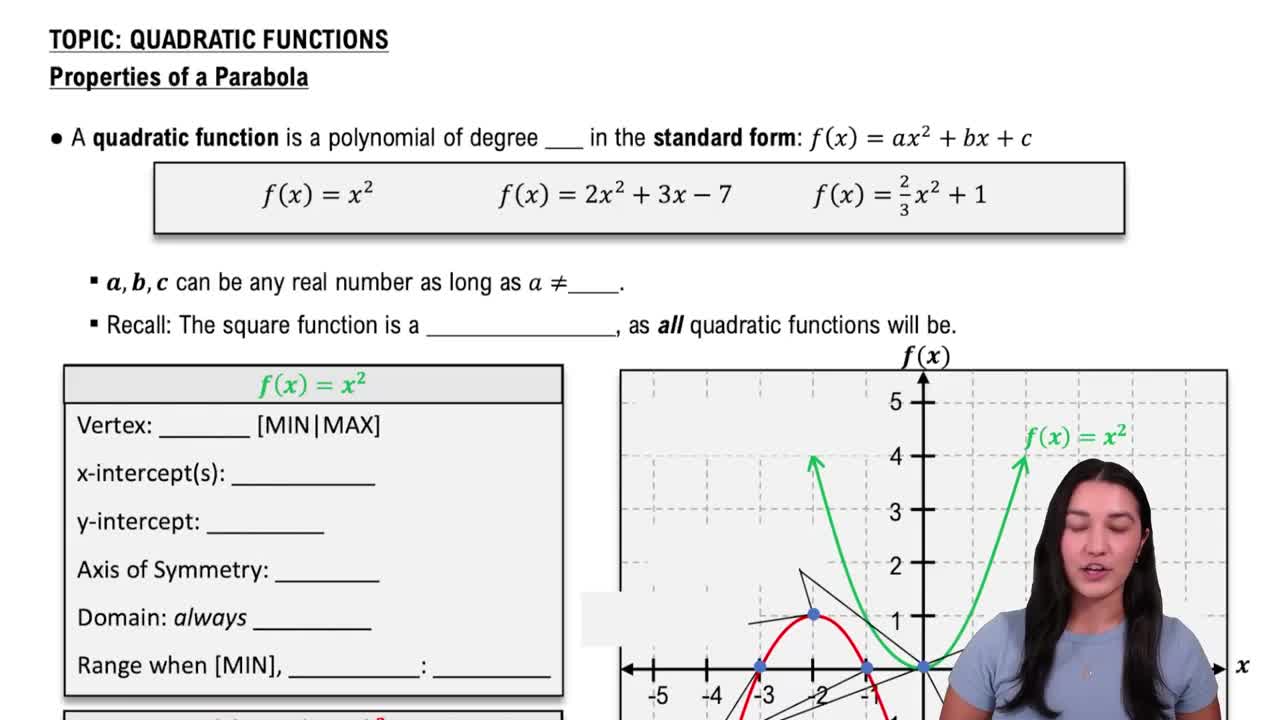
Determine the domain and range of the function. The domain of any quadratic function is all real numbers, so domain: (-∞, ∞). The range depends on the vertex and the direction of the parabola. Since the parabola opens upward and the vertex is the minimum point at y = -1, the range is [ -1, ∞ ).

비슷한 문제에 대한 검증된 영상 답변:
이 영상 해법은 위 문제에 도움이 된다고 튜터들이 추천한 것입니다.
영상 길이:
5m주요 개념
질문에 올바르게 답하기 위해 반드시 이해해야 하는 핵심 개념들은 다음과 같습니다.
Vertex of a Quadratic Function
The vertex of a quadratic function is the point where the parabola changes direction, representing either its maximum or minimum value. It is given by the coordinates (h, k) in the vertex form f(x) = a(x - h)^2 + k. Understanding the vertex helps in graphing the parabola and determining its key features.
추천 영상:
가이드 코스
Vertex Form
Axis of Symmetry
The axis of symmetry is a vertical line that passes through the vertex of the parabola, dividing it into two mirror-image halves. Its equation is x = h, where h is the x-coordinate of the vertex. This line is crucial for graphing and analyzing the symmetry properties of quadratic functions.
추천 영상:
가이드 코스
Properties of Parabolas
Domain and Range of Quadratic Functions
The domain of any quadratic function is all real numbers since the parabola extends infinitely left and right. The range depends on the vertex; for a parabola opening upwards, the range is all y-values greater than or equal to the vertex's y-coordinate. Understanding domain and range helps describe the function's output values.
추천 영상:
가이드 코스
Domain & Range of Transformed Functions
관련 실천
교과서 질문
549
views
교과서 질문
In Exercises 17–24, a) List all possible rational roots. b) List all possible rational roots. c) Use the quotient from part (b) to find the remaining roots and solve the equation. x3−2x2−11x+12=0
561
views
교과서 질문
Find the zeros for each polynomial function and give the multiplicity of each zero. State whether the graph crosses the x-axis, or touches the x-axis and turns around, at each zero.
826
views
교과서 질문
Write an equation that expresses each relationship. Then solve the equation for y. x varies jointly as z and the sum of y and w.
532
views
교과서 질문
Divide using long division. State the quotient, and the remainder, r(x).
530
views
교과서 질문
Use the graph of the rational function in the figure shown to complete each statement in Exercises 15–20.
As __
1413
views