Ch. 4 - Exponential and Logarithmic Functions
Blitzer - College Algebra 8th Edition
Blitzer8th EditionCollege AlgebraISBN: 9780136970514당신이 사용하는 게 아니라요?교과서 변경
5장, 문제 69

The figure shows the graph of f(x) = ln x. In Exercises 65–74, use transformations of this graph to graph each function. Graph and give equations of the asymptotes. Use the graphs to determine each function's domain and range. g(x) = 2 ln x

검증된 단계별 안내
1
Recall the parent function: \(f(x) = \ln x\), which has a vertical asymptote at \(x = 0\), domain \((0, \infty)\), and range \((-\infty, \infty)\).
Identify the transformation in \(g(x) = 2 \ln x\): the factor 2 is a vertical stretch by a factor of 2, which stretches the graph of \(\ln x\) vertically but does not affect the domain or the asymptote.
Write the equation of the asymptote for \(g(x)\): since the transformation does not shift the graph horizontally, the vertical asymptote remains at \(x = 0\).
Determine the domain of \(g(x)\): because the input to the logarithm must be positive, the domain remains \((0, \infty)\).
Determine the range of \(g(x)\): since vertical stretching does not restrict the output values of the logarithm, the range remains \((-\infty, \infty)\).

비슷한 문제에 대한 검증된 영상 답변:

이 영상 해법은 위 문제에 도움이 된다고 튜터들이 추천한 것입니다.
영상 길이:
3m

주요 개념

질문에 올바르게 답하기 위해 반드시 이해해야 하는 핵심 개념들은 다음과 같습니다.

Logarithmic Functions and Their Graphs

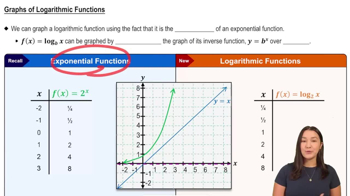
A logarithmic function, such as f(x) = ln x, is the inverse of an exponential function. Its graph passes through (1,0) and is defined only for x > 0. Understanding the shape and behavior of the natural logarithm graph is essential for applying transformations.
추천 영상:
가이드 코스
5:26
Graphs of Logarithmic Functions

Transformations of Functions

Transformations include vertical stretches, compressions, shifts, and reflections applied to a base graph. For g(x) = 2 ln x, the factor 2 vertically stretches the graph of ln x by a factor of 2, affecting the steepness but not the domain or asymptote location.
추천 영상:
가이드 코스
4:22
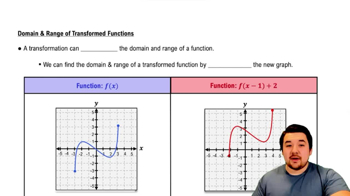
Domain & Range of Transformed Functions

Asymptotes, Domain, and Range of Logarithmic Functions

The vertical asymptote of ln x is the y-axis (x=0), where the function is undefined. The domain of ln x and its transformations is x > 0, while the range is all real numbers. Recognizing how transformations affect these properties is key to graphing and describing the function.
추천 영상:
가이드 코스
5:26
Graphs of Logarithmic Functions
관련 실천
교과서 질문

Solve each logarithmic equation in Exercises 49–92. Be sure to reject any value of x that is not in the domain of the original logarithmic expressions. Give the exact answer. Then, where necessary, use a calculator to obtain a decimal approximation, correct to two decimal places, for the solution. log2(x+2)−log2(x−5)=3

839
views
교과서 질문

In Exercises 64–73, solve each exponential equation. Where necessary, express the solution set in terms of natural or common logarithms and use a calculator to obtain a decimal approximation, correct to two decimal places, for the solution. 8x=121438^x = 12143

832
views
교과서 질문

Solve each logarithmic equation in Exercises 49–92. Be sure to reject any value of x that is not in the domain of the original logarithmic expressions. Give the exact answer. Then, where necessary, use a calculator to obtain a decimal approximation, correct to two decimal places, for the solution. log5 x+log5(4x−1)=1

861
views
교과서 질문

Solve each logarithmic equation in Exercises 49–92. Be sure to reject any value of x that is not in the domain of the original logarithmic expressions. Give the exact answer. Then, where necessary, use a calculator to obtain a decimal approximation, correct to two decimal places, for the solution. log3(x+6)+log3(x+4)=1

1102
views
교과서 질문

The figure shows the graph of f(x) = ln x. In Exercises 65–74, use transformations of this graph to graph each function. Graph and give equations of the asymptotes. Use the graphs to determine each function's domain and range. h(x) = ln(x/2)

735
views
교과서 질문

Use properties of logarithms to condense each logarithmic expression. Write the expression as a single logarithm whose coefficient is 1. Where possible, evaluate logarithmic expressions without using a calculator. logx+log(x2−1)−log7−log(x+1)\(\log\) x + \(\log\)(x^2 - 1) - \(\log\) 7 - \(\log\)(x + 1)

1275
views