Solve each system for x and y, expressing either value in terms of a or b, if necessary. Assume that a ≠ 0 and b ≠ 0. For the linear function f(x) = mx + b, f(−2) = 11 and ƒ(3) = -9. Find m and b.
Ch. 5 - Systems of Equations and Inequalities

6장, 문제 51
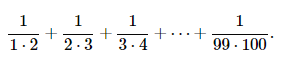
Find the partial fraction decomposition for 1/x(x+1) and use the result to find the following sum:

검증된 단계별 안내1
Start by expressing the general term of the series as a partial fraction. The general term is \( \frac{1}{n(n+1)} \). Set up the partial fraction decomposition as \( \frac{1}{n(n+1)} = \frac{A}{n} + \frac{B}{n+1} \).
Multiply both sides of the equation by \( n(n+1) \) to clear the denominators: \( 1 = A(n+1) + Bn \).
Expand the right side: \( 1 = An + A + Bn = (A + B)n + A \).
Equate the coefficients of like terms on both sides. Since the left side is a constant 1, the coefficient of \( n \) on the right must be 0, and the constant term must be 1. This gives the system: \( A + B = 0 \) and \( A = 1 \).
Solve the system to find \( A = 1 \) and \( B = -1 \). Therefore, the partial fraction decomposition is \( \frac{1}{n(n+1)} = \frac{1}{n} - \frac{1}{n+1} \). Use this to rewrite each term in the sum and observe the telescoping pattern to simplify the sum.

비슷한 문제에 대한 검증된 영상 답변:
이 영상 해법은 위 문제에 도움이 된다고 튜터들이 추천한 것입니다.
영상 길이:
7m주요 개념
질문에 올바르게 답하기 위해 반드시 이해해야 하는 핵심 개념들은 다음과 같습니다.
Partial Fraction Decomposition
Partial fraction decomposition is a method used to express a rational function as a sum of simpler fractions. For example, the fraction 1/[x(x+1)] can be decomposed into A/x + B/(x+1), where A and B are constants found by solving equations. This technique simplifies complex fractions and is useful for summation and integration.
추천 영상:
가이드 코스
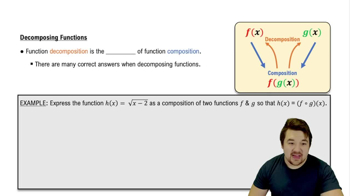
Decomposition of Functions
Telescoping Series
A telescoping series is a series whose partial sums simplify by canceling intermediate terms, leaving only the first and last terms. When partial fractions are applied to terms like 1/(n(n+1)), the series often telescopes, making it easier to find the sum of many terms without adding each individually.
추천 영상:
가이드 코스
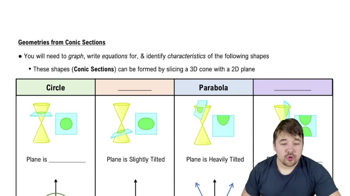
Geometries from Conic Sections
Summation of Series
Summation of series involves finding the total sum of a sequence of terms. Using partial fraction decomposition and recognizing telescoping behavior allows for efficient calculation of sums like 1/(1·2) + 1/(2·3) + ... + 1/(99·100), by reducing the problem to evaluating a few terms rather than all 99.
추천 영상:
가이드 코스
Geometries from Conic Sections
관련 실천
교과서 질문
143
views
1
rank
교과서 질문
Graph the solution set of each system of inequalities or indicate that the system has no solution.
521
views
교과서 질문
In Exercises 49–50, solve each system for x and y, expressing either value in terms of a or b, if necessary. Assume that a ≠ 0, b ≠ 0 5ax + 4y = 17 ax + 7y = 22
910
views
교과서 질문
In Exercises 27–62, graph the solution set of each system of inequalities or indicate that the system has no solution. x2+y2<16, y≥2x
488
views
교과서 질문
In Exercises 47–52, solve each system by the method of your choice.
530
views
교과서 질문
In Exercises 27–62, graph the solution set of each system of inequalities or indicate that the system has no solution. x2+y2≤1, y−x2>0
-4.">
511
views