Ch. 5 - Systems of Equations and Inequalities
Blitzer - College Algebra 8th Edition
Blitzer8th EditionCollege AlgebraISBN: 9780136970514당신이 사용하는 게 아니라요?교과서 변경
6장, 문제 1

Write the form of the partial fraction decomposition of the rational expression. It is not necessary to solve for the constants.(11x - 10)/(x − 2) (x + 1)

검증된 단계별 안내
1
Identify the denominator factors of the rational expression. Here, the denominator is \( (x - 2)(x + 1) \), which consists of two distinct linear factors.
Since the denominator factors are linear and distinct, set up the partial fraction decomposition as a sum of fractions with unknown constants in the numerators over each linear factor:
\[ \frac{11x - 10}{(x - 2)(x + 1)} = \frac{A}{x - 2} + \frac{B}{x + 1} \]
Here, \( A \) and \( B \) are constants that would be determined if solving the decomposition completely, but for this problem, only the form is required.
This form expresses the original rational expression as a sum of simpler rational expressions, each with a single linear denominator.

비슷한 문제에 대한 검증된 영상 답변:

이 영상 해법은 위 문제에 도움이 된다고 튜터들이 추천한 것입니다.
영상 길이:
2m

주요 개념

질문에 올바르게 답하기 위해 반드시 이해해야 하는 핵심 개념들은 다음과 같습니다.

Partial Fraction Decomposition

Partial fraction decomposition is a method used to express a rational function as a sum of simpler fractions with linear or quadratic denominators. This technique simplifies integration and other algebraic operations by breaking down complex fractions into manageable parts.
추천 영상:
가이드 코스
4:07
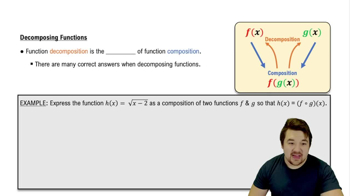
Decomposition of Functions

Factorization of Denominators

Understanding how to factor the denominator into linear or irreducible quadratic factors is essential for setting up the correct form of partial fractions. Each factor determines the structure of the terms in the decomposition, such as constants over linear factors or linear expressions over quadratic factors.
추천 영상:
가이드 코스
02:58
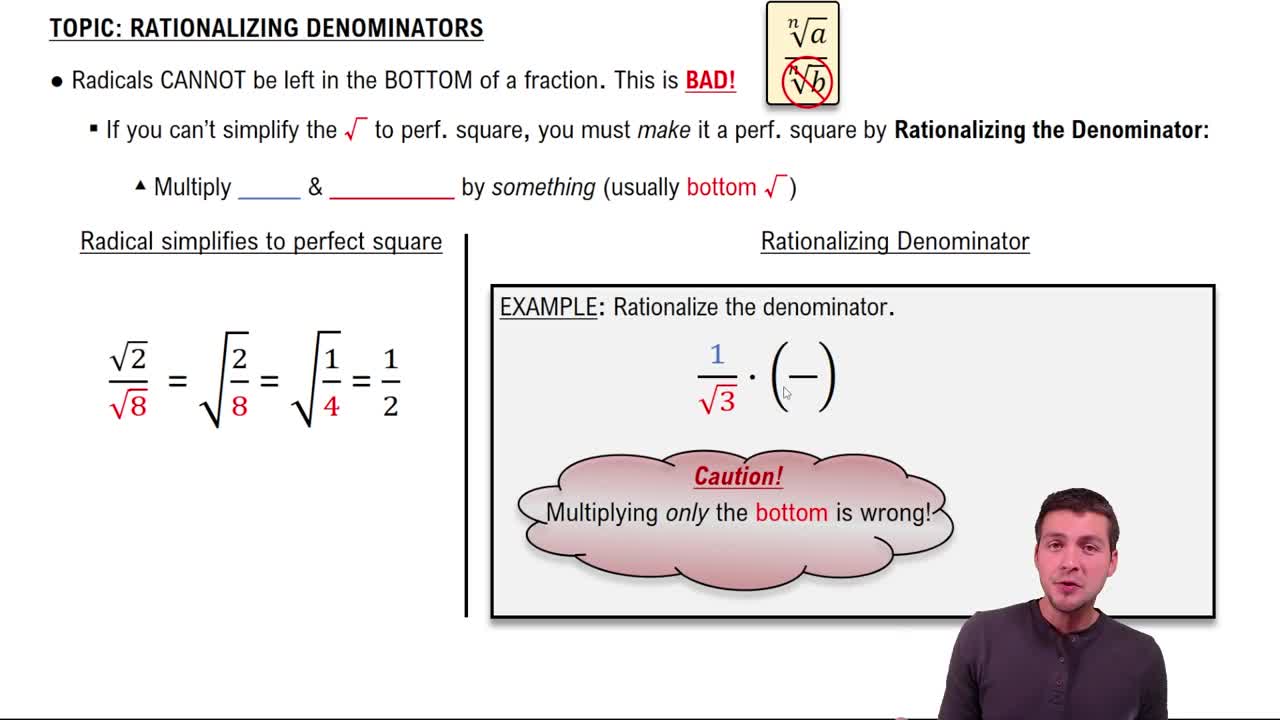
Rationalizing Denominators

Form of Partial Fractions for Distinct Linear Factors

When the denominator consists of distinct linear factors, the partial fraction decomposition is written as a sum of fractions with unknown constants in the numerators over each linear factor. For example, for (x−2)(x+1), the form is A/(x−2) + B/(x+1), where A and B are constants to be determined.
추천 영상:
가이드 코스
04:02
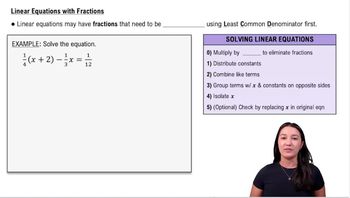
Solving Linear Equations with Fractions