Graph each inequality. y≤(1/3)x
Ch. 5 - Systems of Equations and Inequalities

6장, 문제 5
Write the form of the partial fraction decomposition of the rational expression. It is not necessary to solve for the constants.
검증된 단계별 안내1
Identify the denominator factors: here, the denominator is \( (x - 1)(x^2 + 1) \). The first factor \( (x - 1) \) is linear, and the second factor \( (x^2 + 1) \) is an irreducible quadratic.
For the linear factor \( (x - 1) \), assign a constant numerator: \( \frac{A}{x - 1} \), where \( A \) is a constant to be determined.
For the irreducible quadratic factor \( (x^2 + 1) \), assign a linear numerator: \( \frac{Bx + C}{x^2 + 1} \), where \( B \) and \( C \) are constants to be determined.
Write the partial fraction decomposition as the sum of these two fractions: \[ \frac{5x^2 - 6x + 7}{(x - 1)(x^2 + 1)} = \frac{A}{x - 1} + \frac{Bx + C}{x^2 + 1} \]
This is the form of the partial fraction decomposition. The next step (not required here) would be to multiply both sides by the denominator and solve for \( A \), \( B \), and \( C \).

비슷한 문제에 대한 검증된 영상 답변:
이 영상 해법은 위 문제에 도움이 된다고 튜터들이 추천한 것입니다.
영상 길이:
2m주요 개념
질문에 올바르게 답하기 위해 반드시 이해해야 하는 핵심 개념들은 다음과 같습니다.
Partial Fraction Decomposition
Partial fraction decomposition is a method used to express a rational function as a sum of simpler fractions with denominators that are factors of the original denominator. This technique simplifies integration and other algebraic operations by breaking down complex fractions into manageable parts.
추천 영상:
가이드 코스
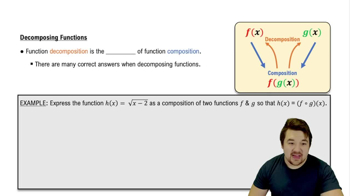
Decomposition of Functions
Types of Factors in Denominators
Denominators can have linear factors (like x - 1) or irreducible quadratic factors (like x² + 1). Each type requires a different form in the decomposition: linear factors correspond to constants in the numerator, while irreducible quadratics require linear expressions in the numerator.
추천 영상:
가이드 코스
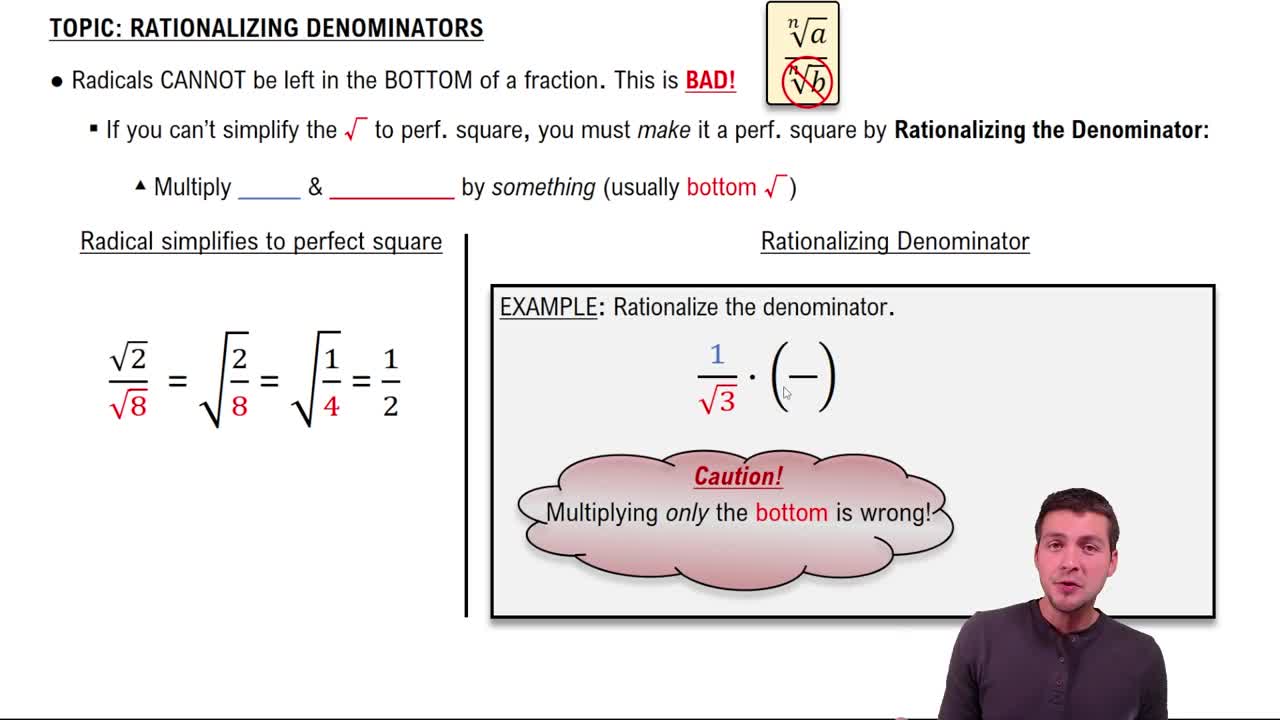
Rationalizing Denominators
Formulating the Decomposition Without Solving Constants
When asked to write the form of the partial fraction decomposition without solving for constants, you set up the sum of fractions with unknown coefficients in the numerators according to the factor types. This step focuses on structure rather than finding specific values.
추천 영상:
가이드 코스
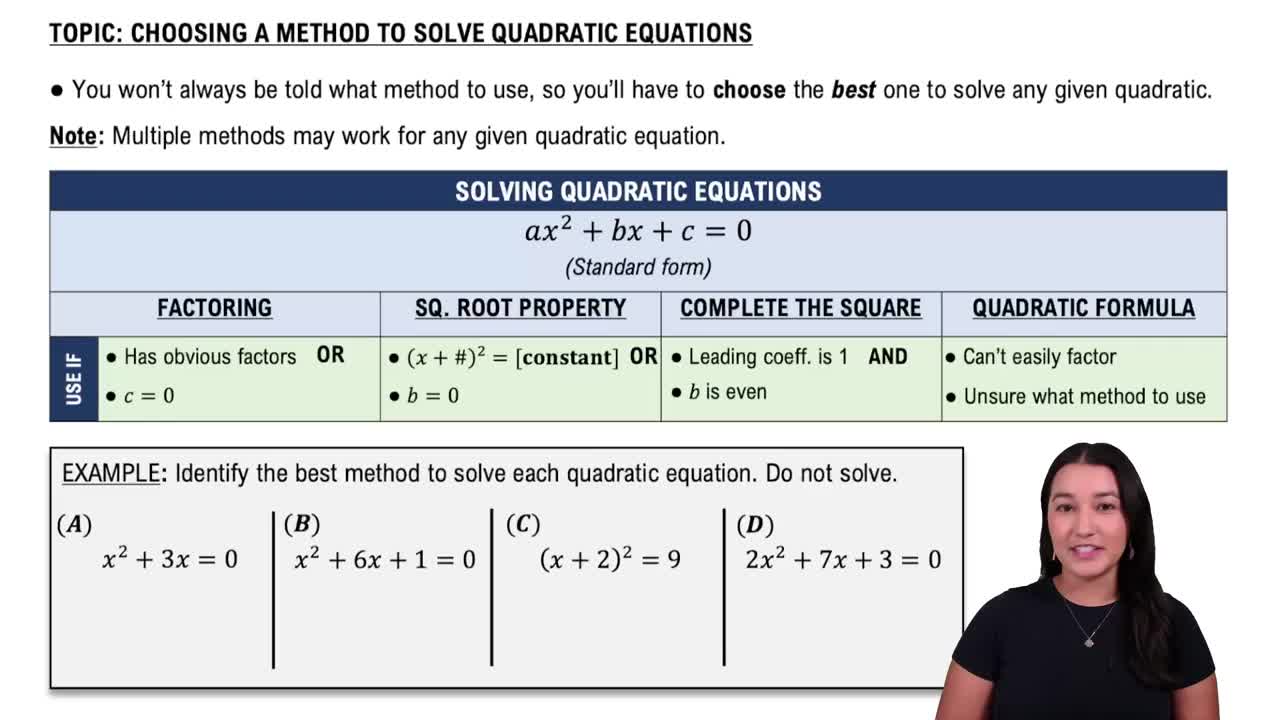
Choosing a Method to Solve Quadratics
관련 실천
교과서 질문
618
views
교과서 질문
An objective function and a system of linear inequalities representing constraints are given. a. Graph the system of inequalities representing the constraints. b. Find the value of the objective function at each corner of the graphed region. c. Use the values in part (b) to determine the maximum value of the objective function and the values of x and y for which the maximum occurs.
626
views
교과서 질문
In Exercises 5–18, solve each system by the substitution method. x + y = 4 y = 3x
831
views
교과서 질문
Solve each system in Exercises 5–18.
629
views
교과서 질문
In Exercises 1–8, write the form of the partial fraction decomposition of the rational expression. It is not necessary to solve for the constants. (3x+16)/(x + 1) (x − 2)²
736
views
교과서 질문
In Exercises 1–18, solve each system by the substitution method.
546
views