Ch. 8 - Sequences, Induction, and Probability
Blitzer - College Algebra 8th Edition
Blitzer8th EditionCollege AlgebraISBN: 9780136970514당신이 사용하는 게 아니라요?교과서 변경
9장, 문제 11

In Exercises 11–16, a die is rolled. Find the probability of getting a 4.

검증된 단계별 안내
1
Step 1: Understand the problem context. A standard die has 6 faces, numbered from 1 to 6, and each face is equally likely to appear when rolled.
Step 2: Identify the total number of possible outcomes. Since the die has 6 faces, the total number of outcomes is \(6\).
Step 3: Determine the number of favorable outcomes. We want the probability of rolling a 4, so there is only 1 favorable outcome (the face showing 4).
Step 4: Use the probability formula: \(\text{Probability} = \frac{\text{Number of favorable outcomes}}{\text{Total number of possible outcomes}}\).
Step 5: Substitute the values into the formula: \(\text{Probability of getting a 4} = \frac{1}{6}\).

비슷한 문제에 대한 검증된 영상 답변:

이 영상 해법은 위 문제에 도움이 된다고 튜터들이 추천한 것입니다.
영상 길이:
1m

주요 개념

질문에 올바르게 답하기 위해 반드시 이해해야 하는 핵심 개념들은 다음과 같습니다.

Sample Space

The sample space is the set of all possible outcomes of an experiment. For a single roll of a standard die, the sample space consists of six outcomes: {1, 2, 3, 4, 5, 6}. Understanding the sample space is essential to calculate probabilities accurately.
추천 영상:
5:37
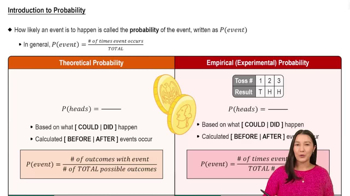
Introduction to Probability

Event

An event is a specific outcome or a set of outcomes from the sample space. In this question, the event is rolling a 4, which is a single outcome within the sample space. Identifying the event helps in determining the favorable outcomes.
추천 영상:
4:23
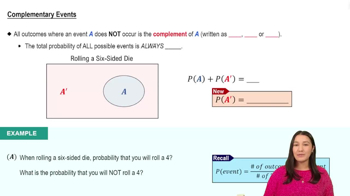
Complementary Events

Probability Calculation

Probability is calculated as the ratio of favorable outcomes to the total number of possible outcomes. For rolling a 4 on a die, the probability is 1 favorable outcome divided by 6 total outcomes, resulting in a probability of 1/6.
추천 영상:
5:37
Introduction to Probability