Ch. P - Fundamental Concepts of Algebra
Blitzer - College Algebra 8th Edition
Blitzer8th EditionCollege AlgebraISBN: 9780136970514당신이 사용하는 게 아니라요?교과서 변경
1장, 문제 83

State the name of the property illustrated. 1/(x+3) (x+3)=1, x≠−3

검증된 단계별 안내
1
Identify the expression given: \(\frac{1}{x+3} \cdot (x+3) = 1\), with the restriction \(x \neq -3\) to avoid division by zero.
Recognize that multiplying a number by its reciprocal results in 1. Here, \(\frac{1}{x+3}\) is the reciprocal of \((x+3)\).
This illustrates the property that any nonzero number multiplied by its multiplicative inverse (reciprocal) equals 1.
State the property name: This is the Multiplicative Inverse Property.
Note the importance of the restriction \(x \neq -3\) to ensure the denominator is not zero, which is necessary for the property to hold.

비슷한 문제에 대한 검증된 영상 답변:

이 영상 해법은 위 문제에 도움이 된다고 튜터들이 추천한 것입니다.
영상 길이:
1m

주요 개념

질문에 올바르게 답하기 위해 반드시 이해해야 하는 핵심 개념들은 다음과 같습니다.

Multiplicative Inverse Property

This property states that for any nonzero number a, multiplying it by its reciprocal (1/a) results in 1. In the given expression, (1/(x+3)) multiplied by (x+3) equals 1, illustrating that (x+3) and its reciprocal are multiplicative inverses, provided x ≠ -3 to avoid division by zero.
추천 영상:
가이드 코스
5:36
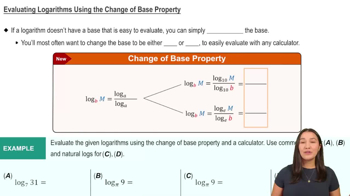
Change of Base Property

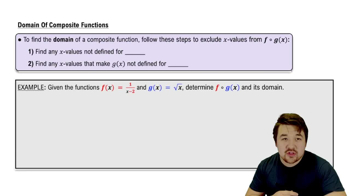
Domain Restrictions

Domain restrictions specify values that variables cannot take to avoid undefined expressions. Here, x ≠ -3 because substituting -3 would make the denominator zero, which is undefined in algebra. Recognizing these restrictions is essential to correctly apply properties and solve equations.
추천 영상:
가이드 코스
3:51
Domain Restrictions of Composed Functions

Properties of Rational Expressions

Rational expressions are fractions involving polynomials. Understanding how to simplify, multiply, and identify restrictions in rational expressions is key. The problem demonstrates multiplying a rational expression by its denominator, simplifying to 1, which relies on these properties.
추천 영상:
가이드 코스
02:58
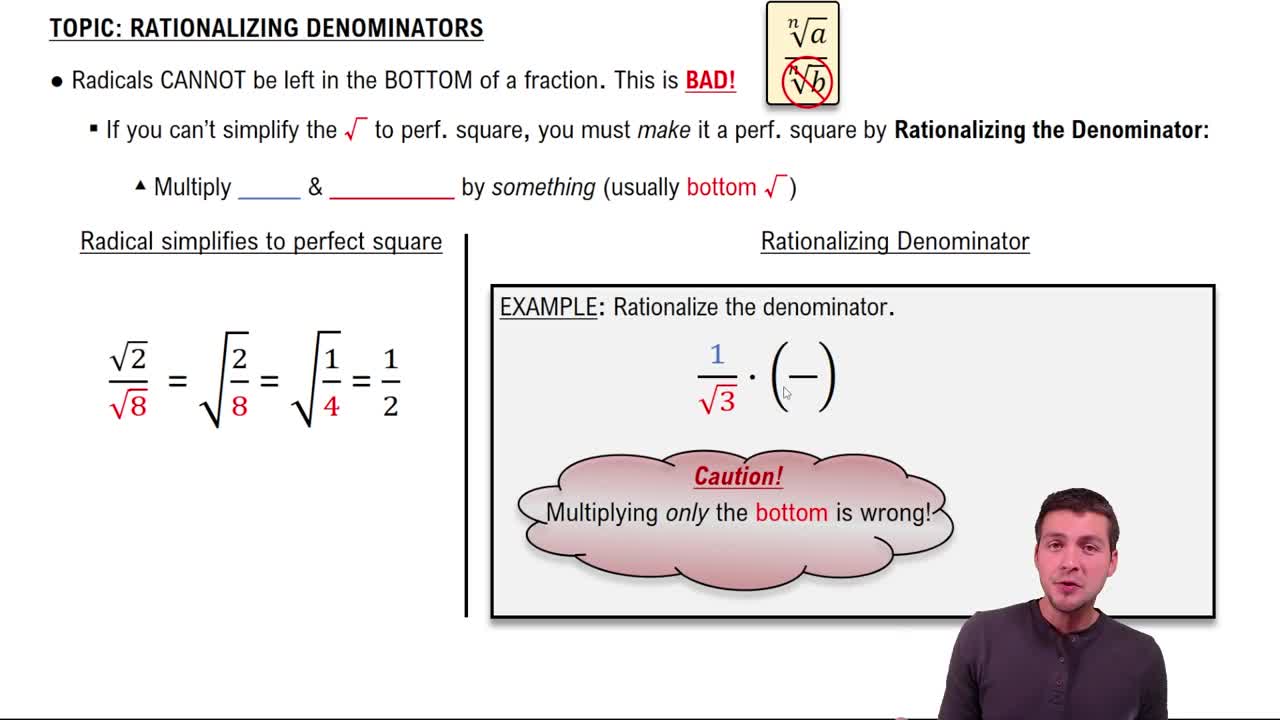
Rationalizing Denominators