Skip to main content
General Chemistry
나의 코스
배우기
시험 준비
AI 튜터
학습 가이드
교과서적 해결책
플래시카드
탐험해 보세요
앱을 사용해 보세요
나의 코스
배우기
시험 준비
AI 튜터
학습 가이드
교과서적 해결책
플래시카드
탐험해 보세요
앱을 사용해 보세요
뒤로
Cell Potential and Gibbs Free Energy quiz
카드를 뒤집기 위해 탭할 수 있습니다.
What does standard Gibbs free energy (ΔG°) represent in an electrochemical cell?
카드를 뒤집기 위해 탭할 수 있습니다.
👆
What does standard Gibbs free energy (ΔG°) represent in an electrochemical cell?
It represents the maximum electrical work that can be created by the cell.
진행 상황 추적
컨트롤 버튼이 '내비게이션' 모드로 변경되었습니다.
1/15
관련 플래시카드
관련 실천
추천 영상
Cell Potential and Gibbs Free Energy definitions
Cell Potential and Gibbs Free Energy
10 용어
Cell Potential and Gibbs Free Energy
20. Electrochemistry
4 문제점
주제
ErnestBlazevic
Cell Potential and Equilibrium
20. Electrochemistry
6 문제점
주제
Jules
20. Electrochemistry - Part 1 of 3
4 주제
11 문제점
장
Jules
20. Electrochemistry - Part 2 of 3
4 주제
11 문제점
장
Jules
20. Electrochemistry - Part 3 of 3
5 주제
11 문제점
장
Jules
02:11
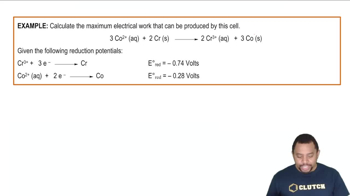
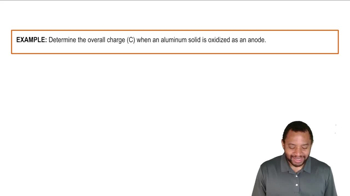
Faraday's Constant in Electrochemistry Example
2676
views
11
rank
2
comments
03:18
Cell Potential and Gibbs Free Energy Example
3042
views
16
rank
01:40
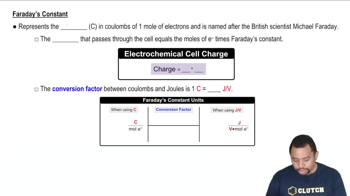
Faraday's Constant in Electrochemistry
3258
views
7
rank
이 집합의 용어 (15)
하이드의 정의
What does standard Gibbs free energy (ΔG°) represent in an electrochemical cell?
It represents the maximum electrical work that can be created by the cell.
What is the equation that connects ΔG°, n, F, and E°cell?
ΔG° = -nFE°cell.
What does 'n' stand for in the equation ΔG° = -nFE°cell?
'n' is the number of moles of electrons transferred during the redox reaction.
What is the value and unit of Faraday's constant (F)?
Faraday's constant is 96,485 coulombs per mole of electrons.
What does E°cell represent in the context of electrochemical cells?
E°cell is the standard cell potential, measured in volts (V).
Who is Faraday's constant named after?
It is named after the British scientist Michael Faraday.
How is the charge that passes through an electrochemical cell calculated?
Charge equals the moles of electrons (n) times Faraday's constant (F).
What is the conversion factor between coulombs and joules?
1 coulomb equals 1 joule per volt.
Why is the conversion between coulombs and joules important in electrochemistry?
It allows us to interchange between electrical charge and energy units in calculations.
What does a negative ΔG° indicate about a reaction's spontaneity?
A negative ΔG° means the reaction is spontaneous.
In the equation ΔG° = -nFE°cell, what are the units for ΔG°?
ΔG° is usually measured in kilojoules (kJ).
What happens to the units when you multiply Faraday's constant by volts?
Multiplying coulombs (F) by volts (E°cell) gives joules, the unit of energy.
What is the significance of the negative sign in ΔG° = -nFE°cell?
The negative sign indicates that a positive cell potential (E°cell) leads to a negative ΔG°, signifying a spontaneous reaction.
How can you convert from coulombs to joules using Faraday's constant?
Multiply the number of coulombs by the voltage to get joules.
What does the standard cell potential (E°cell) tell us about an electrochemical cell?
It tells us the voltage or electrical potential difference the cell can produce under standard conditions.
 뒤로뒤로


 02:11