Skip to main content
General Chemistry
나의 코스
배우기
시험 준비
AI 튜터
학습 가이드
교과서적 해결책
플래시카드
탐험해 보세요
앱을 사용해 보세요
나의 코스
배우기
시험 준비
AI 튜터
학습 가이드
교과서적 해결책
플래시카드
탐험해 보세요
앱을 사용해 보세요
뒤로
Chemistry Gas Laws: Combined Gas Law quiz #1
카드를 뒤집기 위해 탭할 수 있습니다.
What is the proper form of the combined gas law equation?
카드를 뒤집기 위해 탭할 수 있습니다.
👆
What is the proper form of the combined gas law equation?
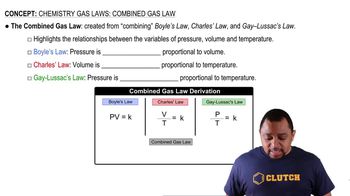
The proper form of the combined gas law is (P × V) / T = constant, or when comparing two states: (P1 × V1) / T1 = (P2 × V2) / T2.
진행 상황 추적
컨트롤 버튼이 '내비게이션' 모드로 변경되었습니다.
1/10
관련 플래시카드
관련 실천
추천 영상
Chemistry Gas Laws: Combined Gas Law definitions
Chemistry Gas Laws: Combined Gas Law
12 용어
Chemistry Gas Laws: Combined Gas Law quiz
Chemistry Gas Laws: Combined Gas Law
15 용어
Chemistry Gas Laws: Combined Gas Law
7. Gases
4 문제점
주제
Jules
Mole Fraction
7. Gases
5 문제점
주제
Jules
7. Gases - Part 1 of 4
5 주제
14 문제점
장
Jules
7. Gases - Part 2 of 4
5 주제
13 문제점
장
Jules
7. Gases - Part 3 of 4
5 주제
13 문제점
장
Jules
7. Gases - Part 4 of 4
5 주제
13 문제점
장
Jules
VideoThumbView.guidedCourse
03:35
Combined Gas Law Example
6180
views
53
rank
VideoThumbView.guidedCourse
01:43
Combined Gas Law
7233
views
51
rank
이 집합의 용어 (10)
하이드의 정의
What is the proper form of the combined gas law equation?
The proper form of the combined gas law is (P × V) / T = constant, or when comparing two states: (P1 × V1) / T1 = (P2 × V2) / T2.
The combined gas law relates which variables?
The combined gas law relates pressure, volume, and temperature of a gas.
Which variable is assumed to be constant in the combined gas law?
The amount of gas (number of moles) is assumed to be constant in the combined gas law.
Which equation represents the combined gas law?
The equation (P1 × V1) / T1 = (P2 × V2) / T2 represents the combined gas law.
Which equation is derived from the combined gas law?
The equation (P1 × V1) / T1 = (P2 × V2) / T2 is derived from the combined gas law.
A gas occupies 40.0 L at 150 K. What volume does it occupy at 300 K, assuming pressure and amount of gas are constant?
Using Charles's Law (V1/T1 = V2/T2): V2 = V1 × (T2/T1) = 40.0 L × (300 K / 150 K) = 80.0 L.
Which three individual gas laws are combined to form the combined gas law?
The combined gas law is formed by combining Boyle's Law, Charles's Law, and Gay-Lussac's Law.
How does Boyle's Law describe the relationship between pressure and volume?
Boyle's Law states that pressure is inversely proportional to volume for a given amount of gas at constant temperature.
What does the constant 'k' represent in the combined gas law equation?
The constant 'k' represents a fixed value for a given amount of gas, assuming no change in the number of moles.
Why is temperature placed in the denominator in the combined gas law equation?
Temperature is in the denominator because both Charles's Law and Gay-Lussac's Law relate temperature directly to volume and pressure, respectively.
 뒤로뒤로
뒤로뒤로
 03:35
03:35