 뒤로
뒤로Chapter 1 Flashcards
 01:34
01:34

이 집합의 용어 (26)
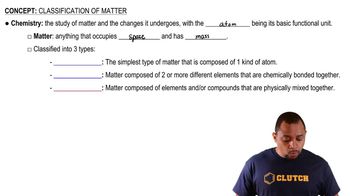
Matter is anything that has mass and occupies space (has volume).
Atoms are basic submicroscopic particles that constitute the fundamental building blocks of ordinary matter.
Molecules are substances formed when two or more atoms bond in specific geometric arrangements.
Matter is classified as solid, liquid, or gas based on particle arrangement and movement.
In solids, particles are tightly packed in fixed locations and vibrate but do not move past each other, giving solids a fixed volume and shape.
In liquids, particles are closely packed but free to move relative to each other, giving liquids a fixed volume but no fixed shape.
In gases, particles are widely spaced and move freely, making gases compressible with no fixed volume or shape.
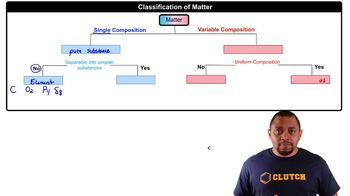
Pure substances have a fixed composition; mixtures contain two or more components with variable proportions.
Heterogeneous mixtures vary in composition throughout; homogeneous mixtures have uniform composition throughout.
Democritus proposed that matter is composed of small, indestructible particles called atoms that move randomly through empty space.
In a chemical reaction, matter is neither created nor destroyed.
All samples of a given compound have the same proportions of their constituent elements regardless of source or preparation.
When two elements form different compounds, the masses of one element that combine with a fixed mass of the other are in ratios of small whole numbers.
Atoms are tiny, indestructible particles; atoms of an element are identical; atoms combine in whole-number ratios; atoms rearrange in reactions but do not change into other atoms.
Thomson discovered the electron and proposed the plum-pudding model where electrons are embedded in a positively charged sphere.
Millikan measured the charge of a single electron as \(-1.60 \times 10^{-19}\) coulombs by balancing electric and gravitational forces on charged oil drops.
Most alpha particles passed through gold foil, but some were deflected or bounced back, showing atoms have a small, dense, positively charged nucleus surrounded by empty space.
1. Most mass and positive charge in nucleus; 2. Electrons dispersed in empty space; 3. Equal number of electrons and protons for neutrality.
Neutrons are neutral particles in the nucleus with mass similar to protons but no electrical charge.
The number of protons in the nucleus, called the atomic number (Z), defines the element.
Atoms of the same element with the same number of protons but different numbers of neutrons.
By the chemical symbol with the mass number (A) as a superscript and atomic number (Z) as a subscript, or by the element name followed by a dash and mass number.
Atomic mass is the weighted average mass of an element's isotopes based on their natural abundance.
A mole is \(6.022 \times 10^{23}\) particles, the number of atoms in exactly 12 grams of carbon-12.
Use Avogadro's number: 1 mol = \(6.022 \times 10^{23}\) atoms.
Molar mass is the mass of 1 mole of atoms of an element, numerically equal to the atomic mass in grams per mole.