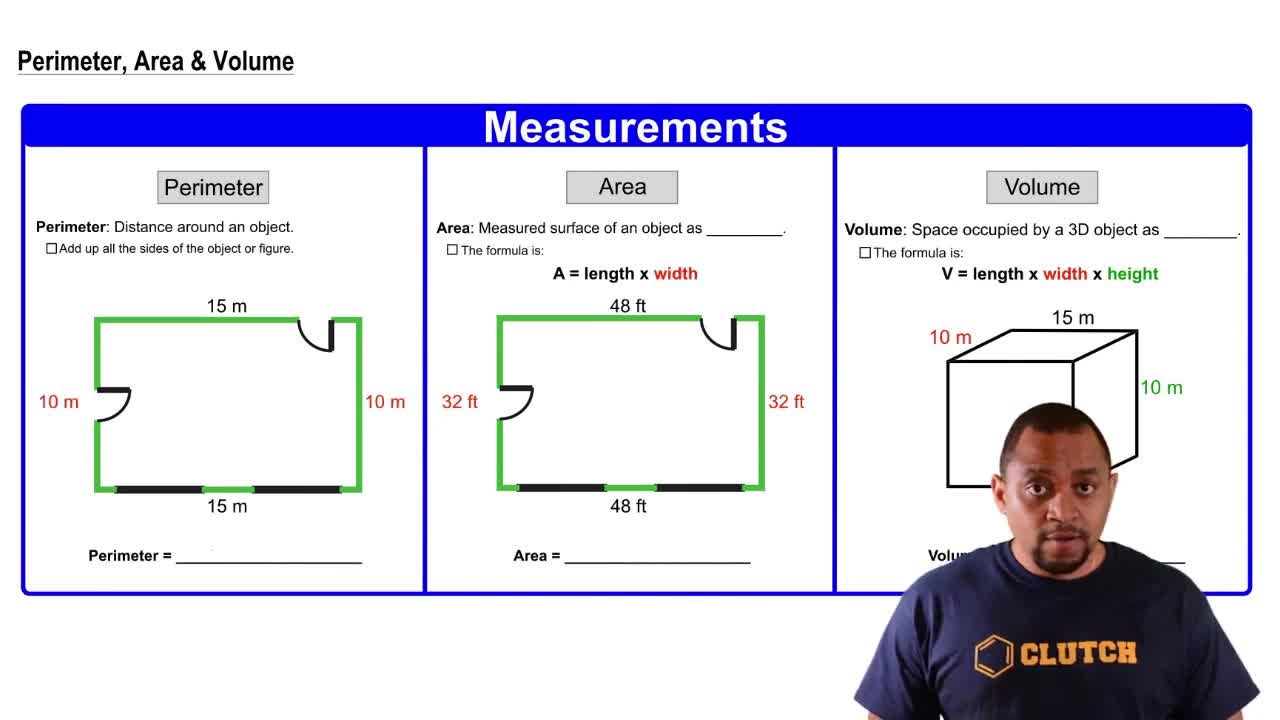
Mass is the quantity of matter in an object, measured in kilograms (kg). Weight is the gravitational force on that matter, varying with location.
What is the SI base unit for temperature?
The SI base unit for temperature is the kelvin (K).
How do you convert Fahrenheit to Celsius?
Use the formula \(\degree C=\frac{\degree F-32}{1.8}\).
What is the relationship between Celsius and Kelvin scales?
Kelvin temperature is Celsius temperature plus 273.15: \(K=\degree C+273.15\).
What are SI prefix multipliers used for?
They change the value of units by powers of 10 to represent very large or small quantities, e.g., kilo means 103.
Define density and its units.
Density is mass divided by volume, with units like grams per milliliter (g/mL) or kilograms per cubic meter (kg/m3).
What is the difference between intensive and extensive properties?
Intensive properties do not depend on amount (e.g., density). Extensive properties depend on amount (e.g., mass).
How is precision different from accuracy?
Precision is how close repeated measurements are to each other. Accuracy is how close a measurement is to the true value.
What is random error in measurements?
Random error causes measurements to be scattered high or low unpredictably and can be reduced by repeated trials.
What is systematic error?
Systematic error consistently skews measurements in one direction and cannot be reduced by repeating trials.
How do you determine the number of significant figures in a measurement?
Significant figures include all certain digits plus one estimated digit in a measurement.
What is the rule for significant figures in multiplication and division?
The result should have the same number of significant figures as the factor with the fewest significant figures.
What is the rule for significant figures in addition and subtraction?
The result should have the same number of decimal places as the quantity with the fewest decimal places.
How should rounding be done when the digit dropped is 5 or more?
Round up the last retained digit by one.
What is scientific notation used for?
Scientific notation expresses very large or very small numbers by placing one nonzero digit left of the decimal and multiplying by 10 raised to an exponent.
Define energy and work in chemistry.
Energy is the capacity to do work. Work is force applied over a distance.
What is kinetic energy?
Kinetic energy is the energy associated with the motion of an object.
What is potential energy?
Potential energy is the energy associated with the position or composition of an object.
State the law of conservation of energy.
Energy cannot be created or destroyed; total energy is conserved as the sum of kinetic and potential energy.
What is dimensional analysis in problem solving?
Dimensional analysis uses units as a guide to convert and solve problems by multiplying by conversion factors.
 뒤로
뒤로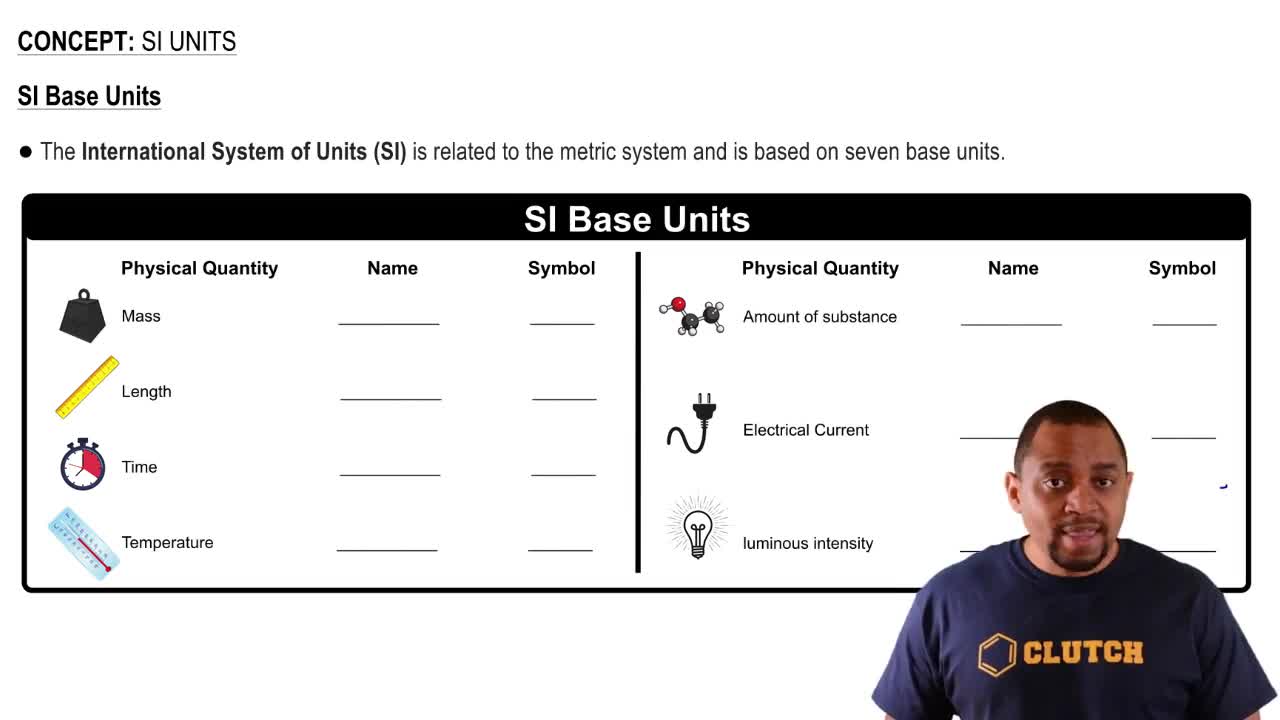
 02:13
02:13