 뒤로
뒤로General Chemistry - Acid-Base Equilibria

 02:29
02:29
이 집합의 용어 (20)
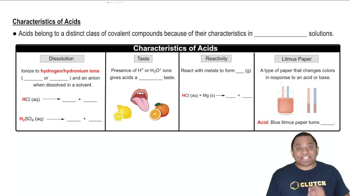
Acid: Produces H+ ions in aqueous solution.
Base: Produces OH- ions in aqueous solution.
Acid: Proton (H+) donor.
Base: Proton (H+) acceptor.
Acid: Electron pair acceptor.
Base: Electron pair donor.
Water can act as both a Brønsted-Lowry acid and base, donating or accepting protons.
Two species that differ by one proton (H+), related by proton transfer.
Water reacts with itself to form \(\mathrm{OH^-}\) and \(\mathrm{H_3O^+}\) ions.
\(K_w = [OH^-][H^+] = 1.0 \times 10^{-14}\) at 25°C.
pH = -log[H+], measures acidity of a solution.
pOH = -log[OH-], measures basicity of a solution.
pH + pOH = 14 at 25°C.
Completely dissociate in water; examples include HCl, HNO3, H2SO4.
Completely dissociate in water; examples include NaOH, KOH, Ca(OH)2.
Partially dissociate in water; equilibrium expression involves acid dissociation constant \(K_a\).
Quantifies the strength of a weak acid; larger \(K_a\) means stronger acid.
Percentage of acid molecules that ionize in solution; indicates acid strength.
Acids that can donate more than one proton, e.g., H2SO3 with two dissociation steps.
Partially accept protons in water; equilibrium constant is base dissociation constant \(K_b\).
For conjugate acid-base pairs, \(K_a \times K_b = K_w\) and \(pK_a + pK_b = 14\).
Strong acids have high \(K_a\) values and fully dissociate in water.
Strong bases have high \(K_b\) values and fully dissociate in water.