뒤로

General Chemistry: Chemical Bonding and Atomic Structure

컨트롤 버튼이 '내비게이션' 모드로 변경되었습니다.
1/28
  • What is a chemical bond?

    A chemical bond is an attractive force that holds groups of atoms together, making them function as a unit and achieving a lower energy state.
  • What is bond energy?

    Bond energy is the energy required to break a chemical bond; energy is released when a bond forms.
  • Types of chemical bonds

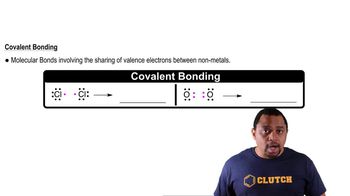
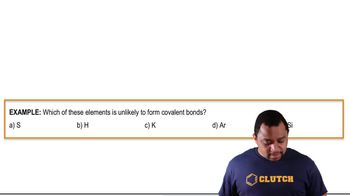
    Ionic bonds involve electrostatic attraction between ions (metal + nonmetal). Covalent bonds involve sharing electrons between nuclei.
  • What does Coulomb's Law calculate in bonding?

    Coulomb's Law calculates the energy of ionic bonds based on charges and distance: \(E = \frac{k Q_1 Q_2}{r}\).
  • What are valence electrons?

    Valence electrons are the outermost electrons (ns, np, and d for transition metals) involved in bonding.
  • What is the octet rule?

    Atoms tend to gain, lose, or share electrons to achieve a stable configuration of 8 valence electrons, like noble gases.
  • How is bond length defined?

    Bond length is the distance between two nuclei where the energy is minimized.
  • Difference between ionic and covalent bonds in terms of electron distribution

    Ionic bonds have bonding orbitals displaced toward one nucleus; covalent bonds share electrons more evenly.
  • Electronegativity and bond type

    Electronegativity difference > 1.67 indicates ionic bonds; < 1.67 indicates covalent; < 0.4 indicates nonpolar covalent.
  • What is bond polarity?

    Bond polarity arises from differences in electronegativity, causing unequal sharing of electrons and partial charges.
  • What is lattice energy?

    Lattice energy is the energy released when ions form a crystal lattice; it depends on ion charges and distance between ions.
  • What is a Lewis structure?

    A Lewis structure represents valence electrons as dots and bonds as lines to show electron arrangement in molecules.
  • Difference between single, double, and triple bonds

    Single bonds share one pair of electrons (σ bond), double bonds share two pairs (one σ and one π), triple bonds share three pairs (one σ and two π).
  • What is a coordinate covalent bond?

    A bond where one atom donates both electrons in a shared pair, often shown with an arrow from donor to acceptor.
  • Exceptions to the octet rule

    Includes molecules with fewer than 8 electrons (e.g., BeH2), expanded octets (elements in period 3 or higher), and odd-electron species.
  • What are resonance structures?

    Multiple Lewis structures differing only in electron pair placement; the actual molecule is a resonance hybrid.
  • Define bond order

    Bond order is the number of bonding electron pairs between two atoms; fractional bond orders occur in resonance.
  • Relationship between bond order, length, and energy

    Higher bond order means shorter bond length and greater bond energy.
  • How to calculate reaction enthalpy from bond energies

    ΔH°reaction = Σ(bond energies of bonds broken) − Σ(bond energies of bonds formed).
  • What is formal charge?

    Formal charge = group number − [lone electrons + ½ bonding electrons]; used to find the most stable Lewis structure.
  • What is VSEPR theory?

    Valence Shell Electron Pair Repulsion theory predicts molecular shapes by minimizing repulsions between electron pairs around a central atom.
  • Difference between electronic and molecular geometry

    Electronic geometry considers all electron pairs; molecular geometry considers only bonded atoms, ignoring lone pairs.
  • Common molecular geometries for 2 to 6 electron pairs

    2: linear; 3: trigonal planar; 4: tetrahedral; 5: trigonal bipyramidal; 6: octahedral.
  • Effect of lone pairs on bond angles

    Lone pairs repel more strongly than bonding pairs, reducing bond angles between atoms.
  • What determines molecular polarity?

    Molecular polarity depends on bond polarities and molecular geometry; symmetrical molecules can be nonpolar despite polar bonds.
  • Characteristics of ionic substances

    High melting points, crystalline solids, conduct electricity when molten or dissolved, formed from metal and nonmetal with large electronegativity difference.
  • Characteristics of covalent substances

    Lower melting points, can be solid/liquid/gas, poor electrical conductors, formed between nonmetals with small electronegativity difference.
  • Characteristics of metallic substances

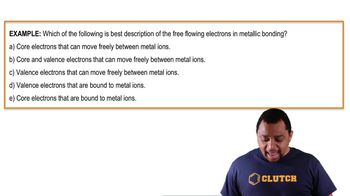
    Metal atoms with delocalized electrons, crystalline solids, good electrical conductors, variable melting points.