 뒤로
뒤로General Chemistry: Chemical Bonding & Molecular Structure
 01:04
01:04
이 집합의 용어 (29)
Chemical bonds are attractive forces that hold groups of atoms together, making them function as a unit and achieving a lower energy state.
Bond energy is the energy required to break a chemical bond; energy is released when a bond forms and required to break it.
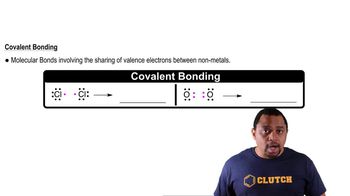
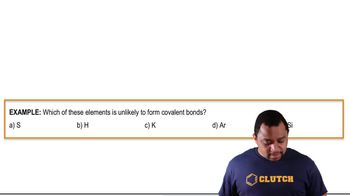
Ionic bonds are electrostatic attractions between ions (metal and nonmetal). Covalent bonds involve sharing electrons between nuclei.
Coulomb's Law calculates the energy of ionic bonds based on ion charges and distance between ions, indicating attraction or repulsion.
Valence electrons are the outermost electrons (ns, np, and d for transition metals) involved in bonding and chemical reactions.
The octet rule states atoms tend to have 8 valence electrons (s2p6) for stability, like noble gases, except for exceptions like He.
Bond forms when proton-electron attraction offsets electron-electron and proton-proton repulsions, lowering energy at an optimal bond length.
A bond orbital is a new orbital formed from atomic orbitals of bonded atoms, concentrating electron density between nuclei and lowering energy.
Electronegativity difference > 1.67 indicates ionic bonds; < 1.67 indicates covalent; < 0.4 indicates nonpolar covalent bonds.
Bond polarity arises from differences in electronegativity, causing unequal sharing of electrons and partial positive/negative poles.
A crystal lattice is a solid, regular array of cations and anions held by strong electrostatic forces in ionic compounds.
Lattice energy depends on ion charges (higher charges increase energy) and ion size (larger ions decrease energy due to distance).
Assumes molecules are atoms sharing electron pairs localized as bonding pairs or lone pairs, described by Lewis structures and VSEPR.
Single bond: one pair (σ bond); double: two pairs (σ + π); triple: three pairs (σ + 2π). Multiple bonds shorten bond length and increase strength.
A bond where one atom donates both electrons in a shared pair, common in coordination compounds and Lewis acid-base reactions.
Includes molecules with fewer than 8 electrons (H, Be, B), expanded valence (elements in period 3+ with d orbitals), and odd-electron species.
Count valence electrons, place bonds, assign lone pairs to terminal atoms, then central atom, and form multiple bonds if needed.
Multiple Lewis structures differing only in electron pair placement, representing delocalized bonding as a resonance hybrid.
Number of bonding electron pairs between two atoms; higher bond order means shorter, stronger bonds (e.g., single=1, double=2, triple=3).
ΔH° = sum of bond energies broken (reactants) minus sum of bond energies formed (products); breaking bonds requires energy.
Formal charge = group number − [lone electrons + ½ bonding electrons]; used to identify the most stable Lewis structure.
Valence Shell Electron Pair Repulsion theory predicts molecular shape by minimizing repulsions between electron pairs around a central atom.
Electronic geometry considers all electron pairs; molecular geometry considers only atom positions, ignoring lone pairs.
2 pairs: linear; 3 pairs: trigonal planar; 4 pairs: tetrahedral; 5 pairs: trigonal bipyramidal; 6 pairs: octahedral.
Lone pairs repel more strongly than bonding pairs, reducing bond angles between atoms (e.g., water's 104.5° vs tetrahedral 109.5°).
Result of bond polarities and molecular shape; molecules with polar bonds can be nonpolar if dipoles cancel out.
High electronegativity difference, metal-nonmetal composition, high melting points, crystalline solids, conduct electricity when molten or dissolved.
Small electronegativity difference, nonmetal-nonmetal, variable states, low melting points, poor electrical conductors.
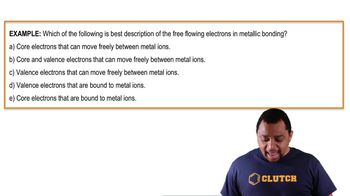
Metal atoms with delocalized electrons ('sea of electrons'), crystalline solids, variable melting points, excellent electrical conductors.