뒤로

General Chemistry: Chemical Reactions and Quantities

컨트롤 버튼이 '내비게이션' 모드로 변경되었습니다.
1/21
  • What is a chemical reaction?

    A chemical reaction is a process where one or more substances (reactants) are converted into different substances (products) by rearranging atoms.
  • What is a combustion reaction?

    A combustion reaction involves a substance reacting with oxygen to form oxygen-containing compounds, usually releasing heat.
  • How are chemical equations used?

    Chemical equations represent reactions by showing formulas, states, and relative amounts of reactants and products.
  • What do the states (s), (l), (g), and (aq) mean in chemical equations?

    (s) = solid, (l) = liquid, (g) = gas, (aq) = aqueous (dissolved in water).
  • Why must chemical equations be balanced?

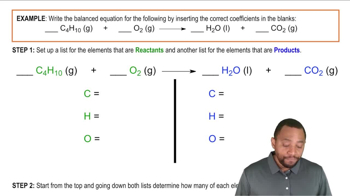
    Balancing ensures the Law of Conservation of Mass is obeyed, with equal numbers of each atom on both sides.
  • What is the rule when balancing chemical equations?

    Adjust coefficients to balance atoms; never change subscripts in chemical formulas.
  • What is stoichiometry?

    Stoichiometry studies numerical relationships between amounts of reactants and products using balanced equation coefficients.
  • How do you perform mole-to-mole conversions?

    Use coefficients from the balanced equation to convert moles of one substance to moles of another.
  • How do you perform mass-to-mass conversions?

    Convert mass to moles using molar mass, use stoichiometric ratios to find moles of product, then convert back to mass.
  • What is the limiting reactant?

    The limiting reactant is the reactant completely consumed first, limiting the amount of product formed.
  • Define theoretical yield.

    The theoretical yield is the maximum product amount possible based on the limiting reactant.
  • What is percent yield and how is it calculated?

    Percent yield = (Actual yield / Theoretical yield) × 100%.
  • Explain the pizza analogy for limiting reactant and yield.

    If crusts, cheese, and sauce limit pizzas, the smallest supply (sauce) limits total pizzas made (limiting reactant). Actual pizzas made vs. max possible gives percent yield.
  • How do combustion reactions relate to global warming?

    Combustion of fossil fuels produces CO2, a greenhouse gas that traps heat and contributes to global warming.
  • What trends have been observed in atmospheric CO2 and temperature since 1880?

    Atmospheric CO2 has risen 38% and Earth's average temperature increased about 1.0°C, linked to fossil fuel burning.
  • Describe alkali metal reactions.

    Alkali metals react vigorously with nonmetals and water, producing metal ions, hydroxide ions, and hydrogen gas; reactivity increases down the group.
  • How do halogens typically react?

    Halogens react with metals to form metal halides, with hydrogen to form hydrogen halides, and with each other to form interhalogen compounds.
  • What is the significance of coefficients in a balanced chemical equation?

    Coefficients indicate the relative moles of reactants and products involved in the reaction.
  • Why should subscripts never be changed when balancing equations?

    Changing subscripts alters the substances themselves, violating the identity of reactants or products.
  • Give an example of a balanced combustion reaction.

    Methane combustion: \(CH_4 + 2O_2 \rightarrow CO_2 + 2H_2O\).
  • What information does a chemical equation provide?

    It shows formulas, states, and relative amounts of reactants and products in a reaction.