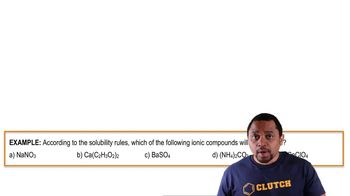
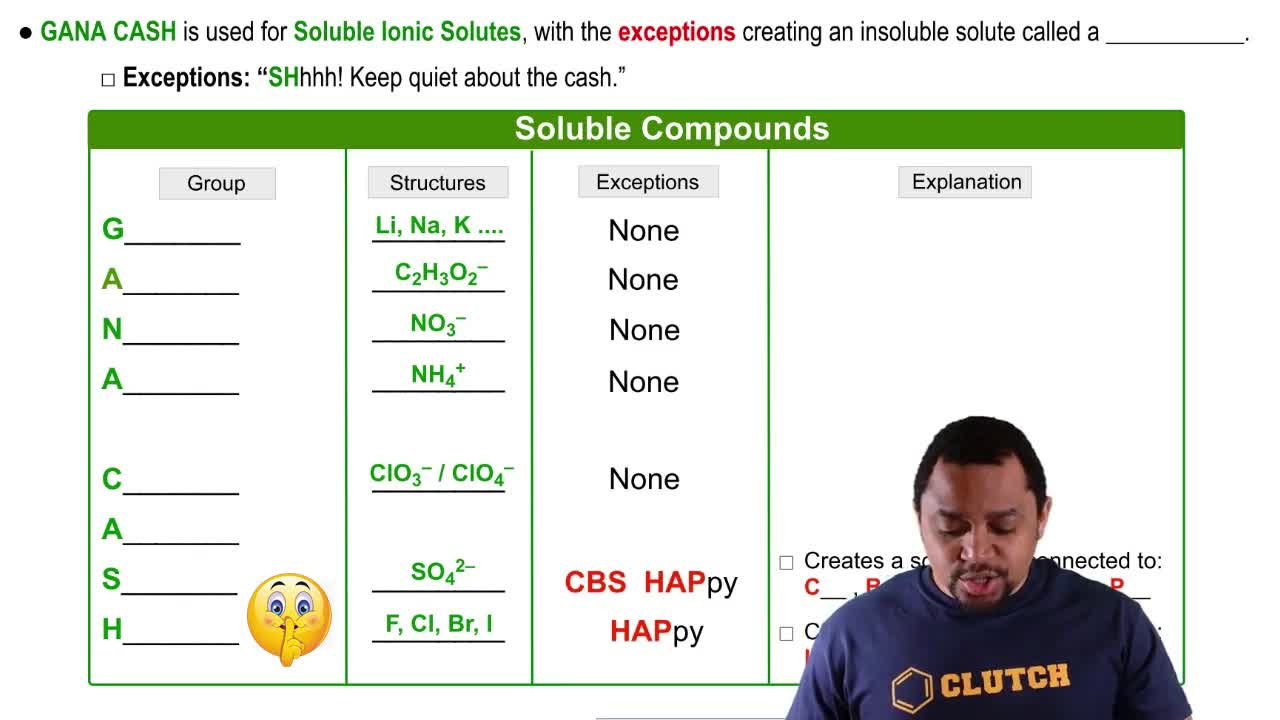
What is the precipitate formed when Sr(NO3)2 reacts with Na2SO4?
The precipitate is SrSO4.
How to calculate Na+ concentration after diluting 25.0 mL of 1.00 M Na2SO4 with 75.0 mL of 2.00 M KCl?
Use the equation: \(\frac{1.00\,M \times 2 \times 0.0250\,L}{0.0250\,L + 0.0750\,L}\).
Which solubility rules are generally obeyed?
Acetates produce soluble salts.
Chloride salts are mostly soluble.
Alkali metal salts are soluble.
Metal sulfides are mostly insoluble.
All are true.
How to prepare 0.120 M HCl from 5.00 mL of 6.00 M HCl?
Add approximately 245.0 mL of water.
Mass of CaO needed to react with 100.00 mL of 0.125 M HCl?
Mass = 0.350 g based on reaction: CaO + 2 HCl → CaCl2 + H2O.
Which 100 mL solution has the smallest number of chloride ions?
0.0750 M HCl contains the smallest number of chloride ions.
Volume of 1.50 M KOH needed to neutralize 20.00 mL of 0.500 M H3PO4?
Volume needed is 20.0 mL based on the reaction: H3PO4 + 3 KOH → K3PO4 + 3 H2O.
Net ionic equation for neutralization of Ca(OH)2 with HCl?
H+(aq) + OH–(aq) → H2O(l).
Which statement about waves is true if Wave 1 has shorter wavelength than Wave 2?
Wave 1 has higher frequency; if Wave 1 is UV and Wave 2 visible, statements (i) and (iv) are true.
Which photon beam frequency can eject electrons in photoelectric effect?
Beam with frequency 1 × 10^16 s–1 can eject electrons.
Assign regions of electromagnetic spectrum: (i) 100-400 nm, (ii) 400-750 nm, (iii) 750-1000 nm
(i) Ultraviolet, (ii) Visible, (iii) Infrared.
Where is the zero probability of finding an electron in a 2p orbital?
Zero probability is in the xy plane (nodal plane).
Wavelength of light with frequency 1.02 × 10^15 s–1?
Wavelength is approximately 294 nm.
Frequency of light emitted when hydrogen relaxes from n=7 to n=4?
Frequency is about 1.38 × 10^14 s–1.
Which hydrogen atom transition requires the smallest energy?
Transition from n=5 to n=6 requires the smallest energy.
Which quantum number statements are true? (i) 2d orbital impossible, (ii) l=3 is d orbital, (iii) n=3, l=3, ml=0 allowed, (iv) l determines shape, (v) n determines energy
True statements: (i), (iv), and (v).
deBroglie wavelength formula and wavelength for electron moving at 141 m/s?
Wavelength \(\lambda=\frac{h}{m_ev}\); wavelength ≈ 5.16 × 10^-6 m.
Why does hydrogen emission spectrum have only certain wavelengths?
Because the energy of a hydrogen atom is quantized.
Does the electron configuration violate Pauli exclusion principle?
Yes, the given configuration violates the Pauli exclusion principle.
Does the electron configuration violate Hund’s rule?
Yes, the given configuration violates Hund’s rule.
Is electron spin quantized?
Yes, electron spin is quantized.
Are there n nodes in an ns orbital?
No, an ns orbital has n-1 nodes, so this statement is false.
Are emission spectra of sodium and potassium the same?
 뒤로
뒤로
 00:28
00:28