 뒤로
뒤로General Chemistry: Matter, Energy, and Measurement
 01:34
01:34

이 집합의 용어 (30)
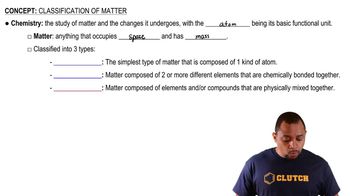
Matter is anything that has mass and volume. It is composed of atoms, the basic building blocks of all matter.
The three common states of matter are solid, liquid, and gas, differing in particle arrangement and movement.
In solids, particles are closely packed in an orderly fashion with limited movement. In liquids, particles are close but move freely. In gases, particles are far apart and move rapidly.
Plasma is a gaseous state with charged particles, found naturally in stars and lightning, and in devices like ICP spectroscopy instruments.
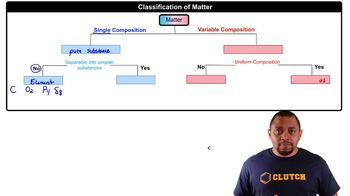
Matter is classified as pure substances (elements and compounds) or mixtures (homogeneous and heterogeneous).
A homogeneous mixture has uniform composition throughout, such as sugar solution or air.
A heterogeneous mixture has non-uniform composition with visible different components, like salt and sugar mixed together.
A pure substance has constant composition and properties, such as sucrose, with fixed ratios of elements.
An element contains only one type of atom, while a compound contains atoms of different elements chemically combined in fixed ratios.
Elements: oxygen (O), hydrogen (H), copper (Cu). Compounds: water (H2O), carbon dioxide (CO2), ammonia (NH3).
Physical properties describe matter without changing its chemical identity, e.g., density, color, melting point.
Chemical properties describe how a substance reacts to form new substances, observable only during chemical changes.
A physical change alters the state or appearance without changing chemical composition, e.g., melting, vaporization.
A chemical change produces new substances with different properties, e.g., rust formation, combustion.
Extensive properties depend on amount of matter (mass, volume). Intensive properties do not depend on amount (temperature, density).
Elements are classified as metals (good conductors), nonmetals (poor conductors), and metalloids (intermediate conductors).
Length (meter, m), mass (kilogram, kg), time (second, s), temperature (kelvin, K), electric current (ampere, A), amount of substance (mole, mol), luminous intensity (candela, cd).
\(K=\degree C+273.15\). Kelvin is Celsius plus 273.15; Kelvin cannot be negative.
Density is mass per unit volume, commonly expressed in g/cm³ or kg/m³.
Significant figures include all certain digits plus one estimated digit in a measurement, indicating precision.
Non-zero digits are significant; zeros between non-zero digits are significant; leading zeros are not; trailing zeros are significant if decimal present.
If first dropped digit <5, round down; if >5, round up; if =5, round to make preceding digit even.
Result cannot have more digits to the right of the decimal than the number with the fewest decimal places.
Result must have the same number of significant figures as the factor with the fewest significant figures.
Accuracy is closeness to true value; precision is closeness of repeated measurements to each other.
Energy is the ability to do work or cause change, existing mainly as kinetic or potential energy.
Kinetic energy is energy of motion, depending on mass and speed of an object.
Potential energy is stored energy available for use, such as chemical potential energy in bonds.
The total amount of mass and energy in the universe is conserved; energy cannot be created or destroyed, only transformed.
Energy is transferred as heat (energy flow due to temperature difference) or work (force applied over a distance).