 뒤로
뒤로General Chemistry Unit Exam #1 Concept Guide
 01:34
01:34

이 집합의 용어 (28)
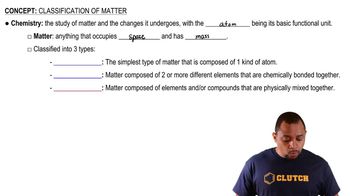
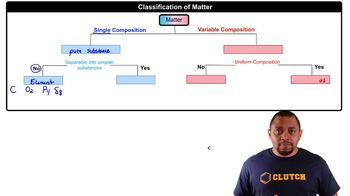
Pure substances have a fixed composition and distinct properties, while mixtures contain two or more substances physically combined with variable composition.
Elements are pure substances made of only one type of atom. Compounds are pure substances composed of two or more elements chemically combined in fixed ratios.
Homogeneous mixtures have uniform composition throughout, while heterogeneous mixtures have visibly different parts or phases.
It states that a given compound always contains the same elements in the same proportion by mass.
Physical properties can be observed without changing the substance's identity; chemical properties describe a substance's ability to undergo chemical changes.
Physical change alters appearance but not composition; chemical change results in new substances with different compositions.
Intensive properties do not depend on amount (e.g., density); extensive properties depend on amount (e.g., mass, volume).
Basic units are fundamental SI units (e.g., meter, kilogram); derived units are combinations of basic units (e.g., volume = cubic meters).
Exact numbers have no uncertainty (e.g., counted items); inexact numbers are measured and have uncertainty.
Length: meter (m), Mass: kilogram (kg), Time: second (s), Temperature: kelvin (K), Volume: cubic meter (m3), Amount: mole (mol).
Precision refers to reproducibility of measurements; accuracy refers to closeness to the true value.
Significant figures indicate the precision of a measurement and are used to reflect uncertainty in calculations.
It is a method to convert units and solve problems by using conversion factors to ensure consistent units.
Protons (+1), Neutrons (0), Electrons (-1).
The atomic number is the number of protons in the nucleus of an atom.
Mass number is the total number of protons and neutrons in an atom's nucleus.
An ion is an atom or molecule with a net charge. Cations are positively charged ions; anions are negatively charged ions.
Isotopes are atoms of the same element with the same number of protons but different numbers of neutrons.
Use \(^A_ZX\) where X is the element symbol, Z is atomic number, and A is mass number.
It is the weighted average of the masses of an element's isotopes based on their relative abundances.
Empirical formula shows the simplest whole-number ratio of atoms; molecular formula shows the actual number of atoms in a molecule.
Rows are called periods; columns are called groups.
Atomic number increases by one moving left to right across a period.
Elements in the same group have similar chemical properties and the same number of valence electrons.
Halogens, noble gases, alkali metals, alkaline earth metals, transition metals, main-group elements, lanthanides, and actinides.
Metals are on the left and center, metalloids along the zigzag line, and nonmetals on the right side.
H2, N2, O2, F2, Cl2, Br2, I2.
Molecular compounds consist of molecules formed by covalent bonds; ionic compounds consist of ions held by ionic bonds.