 뒤로
뒤로Katya electrons
 02:15
02:15
이 집합의 용어 (20)
An electron is a subatomic particle with a negative charge that orbits the nucleus of an atom.
An electron has a charge of -1 elementary charge, which is approximately \(-1.6\times10^{-19}\) coulombs.
Electrons are found in the electron cloud surrounding the nucleus, occupying energy levels or orbitals.
The electron's mass is about 1/1836 that of a proton, making it much lighter.
Chemical properties depend mainly on the arrangement and number of electrons in the outermost shell (valence electrons).
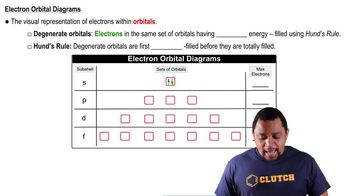
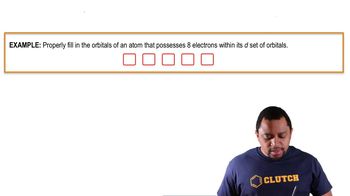
An orbital is a region around the nucleus where there is a high probability of finding an electron.
Electron spin is a quantum property with two possible values, up or down, affecting magnetic and chemical behavior.
It states that no two electrons in an atom can have the same set of four quantum numbers, so each orbital holds a maximum of two electrons with opposite spins.
Electrons absorb energy to jump to higher energy levels and emit energy as light when returning to lower levels.
The charge-to-mass ratio is approximately \(-1.76\times10^{11}\,\mathrm{C/kg}\).
The cathode ray tube experiment by J.J. Thomson in 1897 led to the discovery of the electron.
Electrons are transferred from one atom to another, creating ions that attract each other to form ionic bonds.
Electrons are shared between atoms to form covalent bonds, creating molecules.
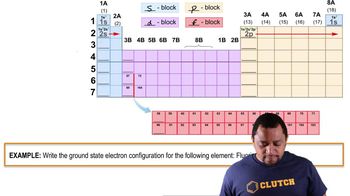
Electron configuration describes the distribution of electrons in an atom's orbitals.
Valence electrons determine an atom's chemical reactivity and bonding behavior.
Electrons farther from the nucleus have higher energy than those closer to the nucleus.
It describes electrons as wave-like particles with probabilistic locations rather than fixed orbits.
The principal quantum number (n) indicates the main energy level or shell of an electron.
Electrons have a negative charge and much smaller mass, while protons have a positive charge and are heavier.
Free or delocalized electrons allow materials to conduct electricity by moving through the structure.