 뒤로
뒤로Katya Proton
 02:53
02:53
이 집합의 용어 (20)
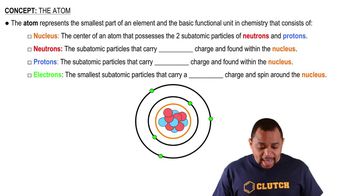
A proton is a subatomic particle with a positive electric charge found in the nucleus of an atom.
A proton has a +1 positive charge.
Protons are located in the nucleus at the center of an atom.
The number of protons defines the atomic number and determines the element's identity.
A proton has a mass of about 1 atomic mass unit (amu), roughly equal to that of a neutron.
Protons have a much greater mass than electrons and carry a positive charge, while electrons have a negative charge.
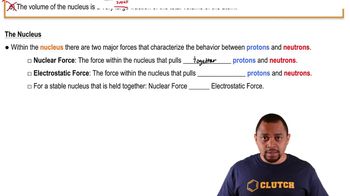
Protons contribute to the positive charge of the nucleus and help bind the nucleus together with neutrons.
The atomic number of an element equals the number of protons in its nucleus.
No, the number of protons remains constant; changing it transforms the atom into a different element.
The proton is often symbolized as p+ or simply p.
Protons provide the positive charge that balances the negative charge of electrons in a neutral atom.
Isotopes have the same number of protons but different numbers of neutrons.
Protons can be gained or lost in nuclear reactions, changing the element and its atomic number.
The strong nuclear force binds protons and neutrons together despite proton repulsion.
Elements are arranged in order of increasing proton number (atomic number) in the periodic table.
The proton number determines the element's chemical properties and behavior.
Protons contribute significantly to the atomic mass of an atom along with neutrons.
The atom becomes a different element with a different atomic number.
Protons are composite particles made of quarks, not fundamental particles.
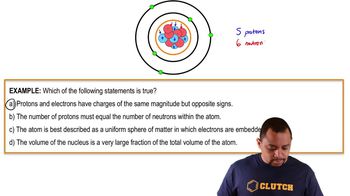
A proton has a charge of +1, which is equal in magnitude but opposite in sign to the electron's -1 charge.