Skip to main content
General Chemistry
나의 코스
배우기
시험 준비
AI 튜터
학습 가이드
교과서적 해결책
플래시카드
탐험해 보세요
앱을 사용해 보세요
나의 코스
배우기
시험 준비
AI 튜터
학습 가이드
교과서적 해결책
플래시카드
탐험해 보세요
앱을 사용해 보세요
뒤로
Limiting Reactant and Moles in General Chemistry
1 학생이 이 점이 도움이 되었다고 느꼈습니다
카드를 뒤집기 위해 탭할 수 있습니다.
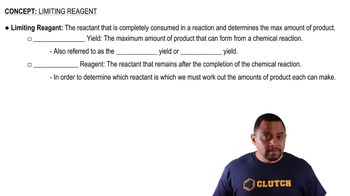
What is a limiting reactant?
카드를 뒤집기 위해 탭할 수 있습니다.
👆
What is a limiting reactant?
The
limiting reactant
is the substance that is completely consumed first in a chemical reaction, limiting the amount of product formed.
진행 상황 추적
컨트롤 버튼이 '내비게이션' 모드로 변경되었습니다.
1/20
추천 영상
VideoThumbView.guidedCourse
4:53
Limiting Reagent Example
5226
views
66
rank
2
comments
VideoThumbView.guidedCourse
01:30
Limiting Reagent Concept
11775
views
98
rank
1
comments
VideoThumbView.guidedCourse
01:34
Limiting Reagent in Reactions
10242
views
87
rank
2
comments
이 집합의 용어 (20)
하이드의 정의
What is a limiting reactant?
The
limiting reactant
is the substance that is completely consumed first in a chemical reaction, limiting the amount of product formed.
How do you identify the limiting reactant?
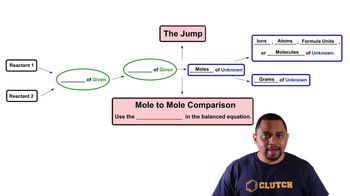
Calculate the moles of product each reactant can produce; the reactant that produces the least product is the
limiting reactant
.
What is the role of moles in stoichiometry?
Moles
allow conversion between amounts of reactants and products using the balanced chemical equation.
Why is the limiting reactant important?
It determines the maximum amount of product that can be formed in a reaction.
How do you calculate moles from mass?
Use the formula \(\text{moles} = \frac{\text{mass}}{\text{molar mass}}\).
What happens to excess reactants in a reaction?
Excess reactants remain unreacted after the limiting reactant is used up.
How do you use mole ratios in limiting reactant problems?
Use the coefficients from the balanced equation to relate moles of one reactant to another.
What is the first step in solving limiting reactant problems?
Convert all given reactant amounts to moles.
How do you find the amount of product formed?
Use the moles of the limiting reactant and mole ratios to calculate product moles, then convert to desired units.
What is the significance of the balanced chemical equation in limiting reactant problems?
It provides the mole ratios needed to compare reactants and calculate products.
Can there be more than one limiting reactant?
No, only one reactant limits the reaction; others are in excess.
What is the mole concept?
A
mole
is a unit representing 6.022 × 10
23
particles of a substance.
How do you convert moles to particles?
Multiply moles by Avogadro's number: \(6.022 \times 10^{23}\).
What is the formula to calculate mass from moles?
Mass = moles × molar mass.
Why must chemical equations be balanced before limiting reactant calculations?
Balanced equations ensure correct mole ratios for accurate calculations.
What is the theoretical yield?
The maximum amount of product predicted from the limiting reactant.
How do you calculate the amount of excess reactant left?
Subtract the amount reacted (based on limiting reactant) from the initial amount.
What is the difference between limiting reactant and excess reactant?
The limiting reactant is fully consumed; the excess reactant remains after the reaction.
How does the mole ratio affect product formation?
It determines how many moles of product form per mole of limiting reactant.
What is the importance of mole calculations in chemistry?
They allow quantitative predictions of reactants and products in chemical reactions.
 뒤로뒤로
뒤로뒤로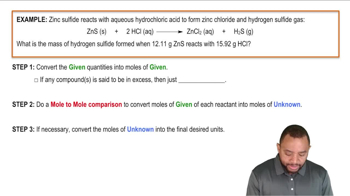
 4:53
4:53