Ch.1 - Introduction: Matter, Energy, and Measurement
Brown - Chemistry: The Central Science 14th Edition
Brown14th EditionChemistry: The Central ScienceISBN: 9780134414232당신이 사용하는 게 아니라요?교과서 변경
1장, 문제 34c,d,e

(c) During winter, the temperature of the Arctic region can drop below -50 °C, what is the temperature in degree Fahrenheit and in Kelvin? (d) The sublimation temperature of dry ice is -78.5 °C. Convert this temperature to degree Fahrenheit and Kelvin. (e) Ethanol boils at 351 K. Convert this temperature to degree Fahrenheit and degree Celsius.

검증된 단계별 안내
1
To convert from Celsius to Fahrenheit, use the formula: F = 95⁢C + 32. Apply this formula to the given temperatures in Celsius.
To convert from Celsius to Kelvin, use the formula: K = C + 273.15. Apply this formula to the given temperatures in Celsius.
For part (c), convert -50 °C to Fahrenheit using the formula from step 1, and to Kelvin using the formula from step 2.
For part (d), convert -78.5 °C to Fahrenheit using the formula from step 1, and to Kelvin using the formula from step 2.
For part (e), to convert 351 K to Celsius, use the formula: C = K - 273.15. Then, convert the result to Fahrenheit using the formula from step 1.

비슷한 문제에 대한 검증된 영상 답변:

이 영상 해법은 위 문제에 도움이 된다고 튜터들이 추천한 것입니다.
영상 길이:
5m

주요 개념

질문에 올바르게 답하기 위해 반드시 이해해야 하는 핵심 개념들은 다음과 같습니다.

Temperature Conversion

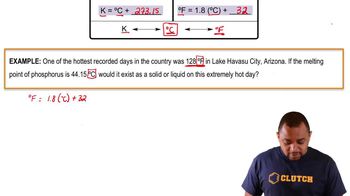
Temperature conversion involves changing a temperature value from one unit to another, commonly between Celsius, Fahrenheit, and Kelvin. The formulas used are: °F = (°C × 9/5) + 32 for Celsius to Fahrenheit, K = °C + 273.15 for Celsius to Kelvin, and °C = (°F - 32) × 5/9 for Fahrenheit to Celsius. Understanding these conversions is essential for accurately interpreting temperature data in different contexts.
추천 영상:
가이드 코스
02:10
Temperature Conversion Example

Sublimation

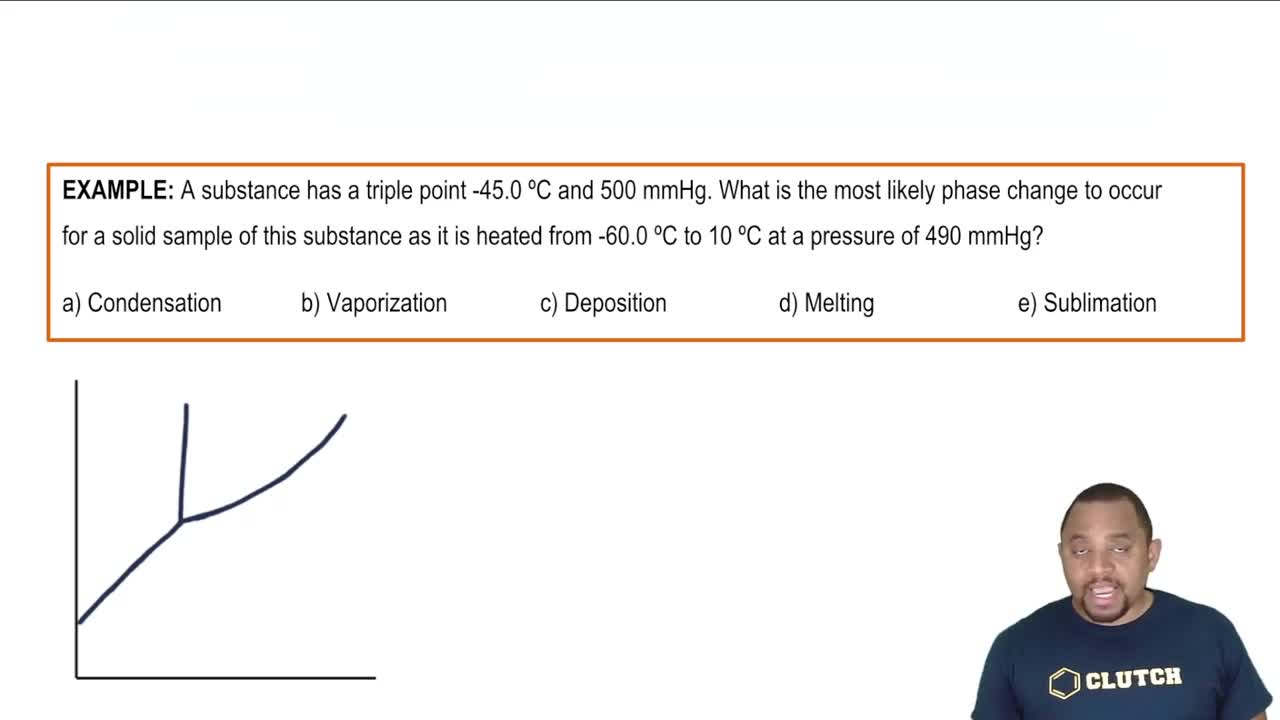
Sublimation is the process where a solid transitions directly to a gas without passing through the liquid phase. This phenomenon occurs under specific temperature and pressure conditions, such as with dry ice (solid CO2), which sublimates at -78.5 °C. Recognizing sublimation is important for understanding phase changes and the behavior of substances under varying environmental conditions.
추천 영상:
가이드 코스
01:52
Sublimation Phase Change Example

Boiling Point

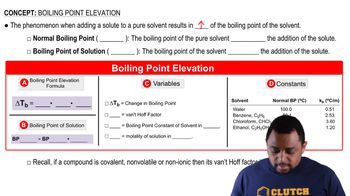
The boiling point of a substance is the temperature at which its vapor pressure equals the external pressure, causing it to change from liquid to gas. For ethanol, which boils at 351 K, this temperature can be converted to Celsius and Fahrenheit to understand its behavior in different environments. Knowing boiling points is crucial in chemistry for processes like distillation and understanding the properties of liquids.
추천 영상:
가이드 코스
03:05
Boiling Point Elevation