
Musical instruments like trumpets and trombones are made from an alloy called brass. Brass is composed of copper and zinc atoms and appears homogeneous under an optical microscope. The approximate composition of most brass objects is a 2:1 ratio of copper to zinc atoms, but the exact ratio varies somewhat from one piece of brass to another. (a) Would you classify brass as an element, a compound, a homogeneous mixture, or a heterogeneous mixture?
Ch.1 - Introduction: Matter, Energy, and Measurement
1장, 문제 4d
Consider the two spheres shown here, one made of silver and the other of aluminum. (d) If you release the spheres simultaneously, they will have the same velocity when they hit the ground. Will they have the same kinetic energy? If not, which sphere will have more kinetic energy?
검증된 단계별 안내1
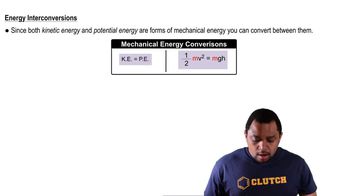
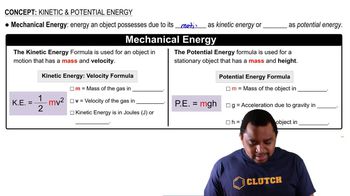
Understand that kinetic energy (KE) is given by the formula: \( KE = \frac{1}{2}mv^2 \), where \( m \) is the mass and \( v \) is the velocity.
Since both spheres are released simultaneously and fall under the influence of gravity, they will have the same velocity \( v \) when they hit the ground.
The kinetic energy of each sphere depends on both its mass and the velocity it has when it hits the ground.
To determine which sphere has more kinetic energy, compare their masses. The sphere with the greater mass will have more kinetic energy, as \( v \) is the same for both.
Consider the densities of silver and aluminum. Silver is denser than aluminum, so for spheres of the same size, the silver sphere will have a greater mass and thus more kinetic energy when they hit the ground.

비슷한 문제에 대한 검증된 영상 답변:
이 영상 해법은 위 문제에 도움이 된다고 튜터들이 추천한 것입니다.
영상 길이:
2m주요 개념
질문에 올바르게 답하기 위해 반드시 이해해야 하는 핵심 개념들은 다음과 같습니다.
Kinetic Energy
Kinetic energy is the energy an object possesses due to its motion, calculated using the formula KE = 1/2 mv², where m is mass and v is velocity. Although both spheres will have the same velocity upon hitting the ground, their kinetic energies will differ because kinetic energy is also dependent on mass.
추천 영상:
가이드 코스
Kinetic & Potential Energy
Mass and Weight
Mass is a measure of the amount of matter in an object, while weight is the force exerted by gravity on that mass. In this scenario, the silver sphere has a greater mass than the aluminum sphere, which means it will have a higher weight and, consequently, more kinetic energy when both are dropped from the same height.
추천 영상:
가이드 코스
Mass Percent Example
Acceleration due to Gravity
Acceleration due to gravity is a constant value (approximately 9.81 m/s² on Earth) that affects all objects regardless of their mass. When both spheres are released, they accelerate towards the ground at the same rate, ensuring they reach the same velocity just before impact, but this does not influence their kinetic energy, which is also dependent on their respective masses.
추천 영상:
가이드 코스
Kinetic & Potential Energy
관련 실천
교과서 질문
731
views
교과서 질문
(a) Three spheres of equal size are composed of aluminum (density = 2.70 g/cm3), silver (density = 10.49 g/cm3), and nickel (density = 8.90 g/cm3). List the spheres from lightest to heaviest.
834
views
교과서 질문
Identify each of the following as measurements of length,
area, volume, mass, density, time, or temperature: (a) 25 ps,
(b) 374.2 mg, (c) 77 K, (d) 100,000 km2, (e) 1.06 mm,
(f) 16 nm2, (g) -78 °C, (h) 2.56 g>cm3, (i) 28 cm3.
1260
views
2
rank
4
comments
교과서 질문
Is the separation method used in brewing a cup of coffee best described as distillation, filtration, or chromatography?
576
views
교과서 질문
Consider the two spheres shown here, one made of silver and the other of aluminum. (a) What is the mass of each sphere in kg?
450
views
교과서 질문
Consider the two spheres shown here, one made of silver and the other of aluminum. (a) What is the mass of each sphere in kg?
347
views
