Ch.1 - Introduction: Matter, Energy, and Measurement
Brown - Chemistry: The Central Science 14th Edition
Brown14th EditionChemistry: The Central ScienceISBN: 9780134414232당신이 사용하는 게 아니라요?교과서 변경
1장, 문제 37d

(d) A cubic piece of metal measures 5.00 cm on each edge. If the metal is nickel, whose density is 8.90 g/cm3, what is the mass of the cube?

검증된 단계별 안내
1
Calculate the volume of the cube using the formula for the volume of a cube: \( V = \text{side}^3 \). Here, the side length is 5.00 cm.
Substitute the side length into the volume formula: \( V = (5.00 \text{ cm})^3 \).
Calculate the volume in cubic centimeters.
Use the density formula to find the mass: \( \text{mass} = \text{density} \times \text{volume} \).
Substitute the known values into the density formula: \( \text{mass} = 8.90 \text{ g/cm}^3 \times \text{volume} \).

비슷한 문제에 대한 검증된 영상 답변:

이 영상 해법은 위 문제에 도움이 된다고 튜터들이 추천한 것입니다.
영상 길이:
2m

주요 개념

질문에 올바르게 답하기 위해 반드시 이해해야 하는 핵심 개념들은 다음과 같습니다.

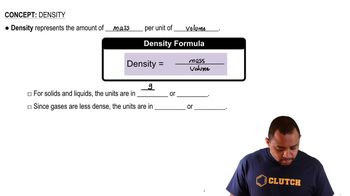
Density

Density is defined as the mass of an object divided by its volume, typically expressed in grams per cubic centimeter (g/cm³). It is a crucial property that helps identify substances and can be used to calculate mass or volume when the other is known. In this case, the density of nickel is given as 8.90 g/cm³, which will be used to find the mass of the cube.
추천 영상:
가이드 코스
01:56
Density Concepts

Volume of a Cube

The volume of a cube is calculated using the formula V = a³, where 'a' is the length of one edge of the cube. For a cube measuring 5.00 cm on each edge, the volume can be determined by cubing the edge length. This volume will be essential for calculating the mass of the nickel cube using its density.
추천 영상:
가이드 코스
02:35
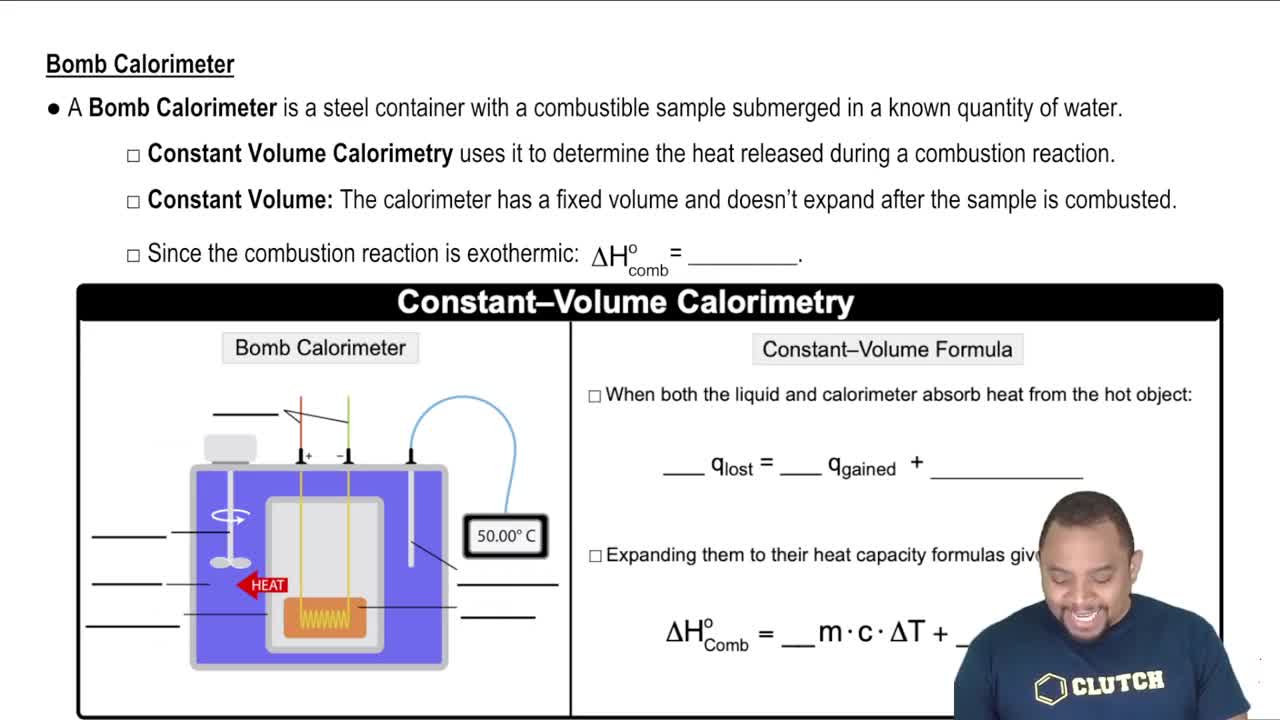
Constant-Volume Calorimetry

Mass Calculation

Mass can be calculated using the formula: mass = density × volume. Once the volume of the cube is determined, multiplying it by the density of nickel will yield the mass of the cube. This relationship is fundamental in chemistry for converting between mass, volume, and density.
추천 영상:
가이드 코스
03:12
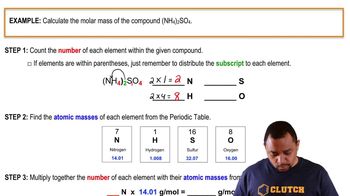
Molar Mass Calculation Example
관련 실천
교과서 질문

(c) Is a graduated cylinder such as that shown in Figure 1.21 likely to afford the accuracy of measurement needed?

635
views

교과서 질문

(c) A spherical ball of lead has a diameter of 5.0 cm. What is the mass of the sphere if lead has a density of 11.34 g>cm3? (The volume of a sphere is 14>32pr3, where r is the radius.)

737
views
교과서 질문

(a) After the label fell off a bottle containing a clear liquid believed to be benzene, a chemist measured the density of the liquid to verify its identity. A 25.0-mL portion of the liquid had a mass of 21.95 g. A chemistry handbook lists the density of benzene at 15 °C as 0.8787 g/mL. Is the calculated density in agreement with the tabulated value?

850
views
교과서 질문

(b) An experiment requires 45.0 g of ethylene glycol, a liquid whose density is 1.114 g/mL. Rather than weigh the sample on a balance, a chemist chooses to dispense the liquid using a graduated cylinder. What volume of the liquid should he use?

1037
views
교과서 질문

(b) An experiment requires 15.0 g of cyclohexane, whose density at 25 C is 0.7781 g>mL. What volume of cyclohexane should be used?

570
views
교과서 질문

(a) To identify a liquid substance, a student determined its density. Using a graduated cylinder, she measured out a 45-mL sample of the substance. She then measured the mass of the sample, finding that it weighed 38.5 g. She knew that the substance had to be either isopropyl alcohol 1density 0.785 g/mL2 or toluene (density 0.866 g/mL). What are the calculated density and the probable identity of the substance?

1320
views