Ch.1 - Introduction: Matter, Energy, and Measurement
Brown - Chemistry: The Central Science 14th Edition
Brown14th EditionChemistry: The Central ScienceISBN: 9780134414232당신이 사용하는 게 아니라요?교과서 변경
1장, 문제 70

Is the use of significant figures in each of the following statements appropriate? (a) The 2005 circulation of National Geographic was 7,812,564.

검증된 단계별 안내
1
Identify the context of the number: The circulation number is a count of items, which are whole numbers and not subject to significant figures in the same way as measured quantities.
Consider the precision of the number: Since this is a count, it is typically considered to have an infinite number of significant figures, as it is an exact number.
Evaluate the appropriateness of the number of digits: In this context, the number 7,812,564 is appropriate as it represents an exact count and not a measurement.
Discuss the difference between exact numbers and measured quantities: Exact numbers, like counts, are not limited by significant figures, unlike measurements which are subject to precision limitations.
Conclude on the appropriateness: The use of significant figures is not applicable here as the number is an exact count, not a measurement.

비슷한 문제에 대한 검증된 영상 답변:

이 영상 해법은 위 문제에 도움이 된다고 튜터들이 추천한 것입니다.
영상 길이:
2m

주요 개념

질문에 올바르게 답하기 위해 반드시 이해해야 하는 핵심 개념들은 다음과 같습니다.

Significant Figures

Significant figures are the digits in a number that contribute to its precision. This includes all non-zero digits, any zeros between significant digits, and trailing zeros in the decimal portion. Understanding significant figures is crucial for accurately reporting measurements and calculations in scientific contexts.
추천 영상:
가이드 코스
01:09
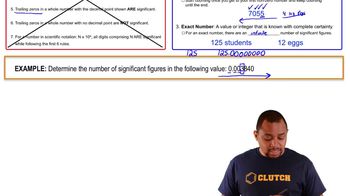
Significant Figures Example

Precision vs. Accuracy

Precision refers to the consistency of repeated measurements, while accuracy indicates how close a measurement is to the true value. In the context of significant figures, a precise measurement will have a consistent number of significant figures, reflecting the reliability of the data collected.
추천 영상:
가이드 코스
01:49
Significant Figures Precision

Rounding Rules

Rounding rules dictate how to appropriately adjust numbers to reflect the correct number of significant figures. When rounding, if the digit to be dropped is less than five, the last retained digit remains unchanged; if it is five or greater, the last retained digit is increased by one. This ensures that the reported value maintains the intended precision.
추천 영상:
가이드 코스
00:28
Solubility Rules
관련 실천
교과서 질문

What type of quantity (for example, length, volume, density) do the following units indicate? (g) Pa.

409
views

교과서 질문

Two students determine the percentage of lead in a sample as a laboratory exercise. The true percentage is 22.52%. The students’ results for three determinations are as follows: (1) 22.52, 22.48, 22.54 (2) 22.64, 22.58, 22.62 (a) Calculate the average percentage for each set of data and state which set is the more accurate based on the average.

1
views
교과서 질문

What type of quantity (for example, length, volume, density) do the following units indicate? (f) ms-1

527
views
교과서 질문

A sample of ascorbic acid (vitamin C) is synthesized in the laboratory. It contains 1.50 g of carbon and 2.00 g of oxygen. Another sample of ascorbic acid isolated from citrus fruits contains 6.35 g of carbon. According to the law of constant composition, how many grams of oxygen does it contain?

2284
views
교과서 질문

Two students determine the percentage of lead in a sample as a laboratory exercise. The true percentage is 22.52%. The students' results for three determinations are as follows: (1) 22.52, 22.48, 22.54 (2) 22.64, 22.58, 22.62 (b) Precision can be judged by examining the average of the deviations from the average value for that data set. (Calculate the average value for each data set; then calculate the average value of the absolute deviations of each measurement from the average.) Which set is more precise?

421
views
교과서 질문

What type of quantity (for example, length, volume, density) do the following units indicate? (a) m3 (b) ns (c) mm (d) g/dm3 (e) °C

437
views