Ch.1 - Introduction: Matter, Energy, and Measurement
Brown - Chemistry: The Central Science 14th Edition
Brown14th EditionChemistry: The Central ScienceISBN: 9780134414232당신이 사용하는 게 아니라요?교과서 변경
1장, 문제 81

Water has a density of 0.997 g/cm3 at 25 °C; ice has a density of 0.917 g/cm3 at -10 °C. (a) If a soft-drink bottle whose volume is 1.50 L is completely filled with water and then frozen to -10 °C, what volume does the ice occupy? (b) Can the ice be contained within the bottle?

검증된 단계별 안내
1
Convert the volume of the water from liters to cubic centimeters (cm^3) using the conversion factor: 1 L = 1000 cm^3.
Calculate the mass of the water using the density of water at 25 °C: mass = density × volume.
Determine the volume of the ice using the mass of the water and the density of ice at -10 °C: volume of ice = mass / density of ice.
Compare the volume of the ice to the original volume of the bottle to determine if the ice can be contained within the bottle.
Discuss the implications of the volume change when water freezes and how it affects the containment within the bottle.

비슷한 문제에 대한 검증된 영상 답변:

이 영상 해법은 위 문제에 도움이 된다고 튜터들이 추천한 것입니다.
영상 길이:
2m

주요 개념

질문에 올바르게 답하기 위해 반드시 이해해야 하는 핵심 개념들은 다음과 같습니다.

Density

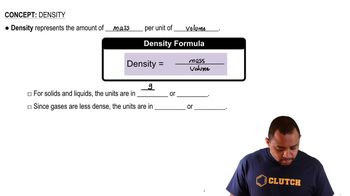
Density is defined as mass per unit volume and is a critical property of substances. It is calculated using the formula density = mass/volume. In this question, the densities of water and ice are provided, which are essential for determining how the volume changes when water freezes. Understanding density helps explain why ice floats on water, as it is less dense than liquid water.
추천 영상:
가이드 코스
01:56
Density Concepts

Volume and Volume Displacement

Volume refers to the amount of space an object occupies, measured in liters or cubic centimeters. When a substance changes state, such as water freezing into ice, its volume can change due to differences in density. The concept of volume displacement is important here, as the volume of ice formed from the water will determine whether it can fit back into the original container after freezing.
추천 영상:
가이드 코스
02:35
Constant-Volume Calorimetry

Phase Changes

Phase changes refer to the transitions between solid, liquid, and gas states of matter. When water freezes, it undergoes a phase change from liquid to solid, which involves energy transfer and changes in molecular arrangement. Understanding phase changes is crucial for predicting how the properties of substances, such as volume and density, will alter during the freezing process.
추천 영상:
가이드 코스
01:46
Entropy in Phase Changes