
Ch.1 - Introduction: Matter, Energy, and Measurement
Brown - Chemistry: The Central Science 14th Edition
Brown14th EditionChemistry: The Central ScienceISBN: 9780134414232당신이 사용하는 게 아니라요?교과서 변경
1장, 문제 18

Zirconia, an oxide of zirconium, is often used as an affordable diamond substitute. Just like diamond, it is a colorless crystal which sparkles under sunlight. Which of the following physical properties do you think would help in differentiating between diamond and Zirconia—melting point, density, or physical state?

검증된 단계별 안내
1
Step 1: Identify the physical properties of diamond and zirconia.
Step 2: Consider the melting point of both substances. Diamond has a very high melting point due to its strong covalent bonds, while zirconia also has a high melting point but is generally lower than diamond.
Step 3: Examine the density of both substances. Diamond has a density of about 3.5 g/cm³, whereas zirconia is denser, with a density around 5.6 g/cm³.
Step 4: Evaluate the physical state. Both diamond and zirconia are solid at room temperature, so this property does not help in differentiating them.
Step 5: Conclude that density is the most distinguishing physical property between diamond and zirconia, as it shows a significant difference.

비슷한 문제에 대한 검증된 영상 답변:

이 영상 해법은 위 문제에 도움이 된다고 튜터들이 추천한 것입니다.
영상 길이:
4m

주요 개념

질문에 올바르게 답하기 위해 반드시 이해해야 하는 핵심 개념들은 다음과 같습니다.

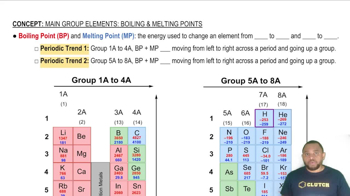
Melting Point

The melting point is the temperature at which a solid becomes a liquid. It is a critical physical property that can help distinguish between substances, as different materials have unique melting points. For example, diamond has a very high melting point (around 3550°C), while zirconia melts at a lower temperature (around 2700°C), making this property useful for differentiation.
추천 영상:
가이드 코스
04:29
Boiling Point and Melting Point

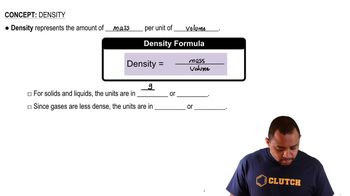
Density

Density is defined as mass per unit volume and is a key physical property that can be used to identify and differentiate materials. Diamonds have a density of about 3.5 g/cm³, whereas zirconia has a higher density of approximately 6 g/cm³. This significant difference in density can be a reliable indicator when comparing the two substances.
추천 영상:
가이드 코스
01:56
Density Concepts

Physical State

The physical state of a substance refers to its form at a given temperature and pressure, typically categorized as solid, liquid, or gas. Both diamond and zirconia are solids at room temperature, which makes this property less useful for differentiation. However, understanding the physical state can provide context for their behavior under different conditions, such as temperature changes.
추천 영상:
가이드 코스
02:54
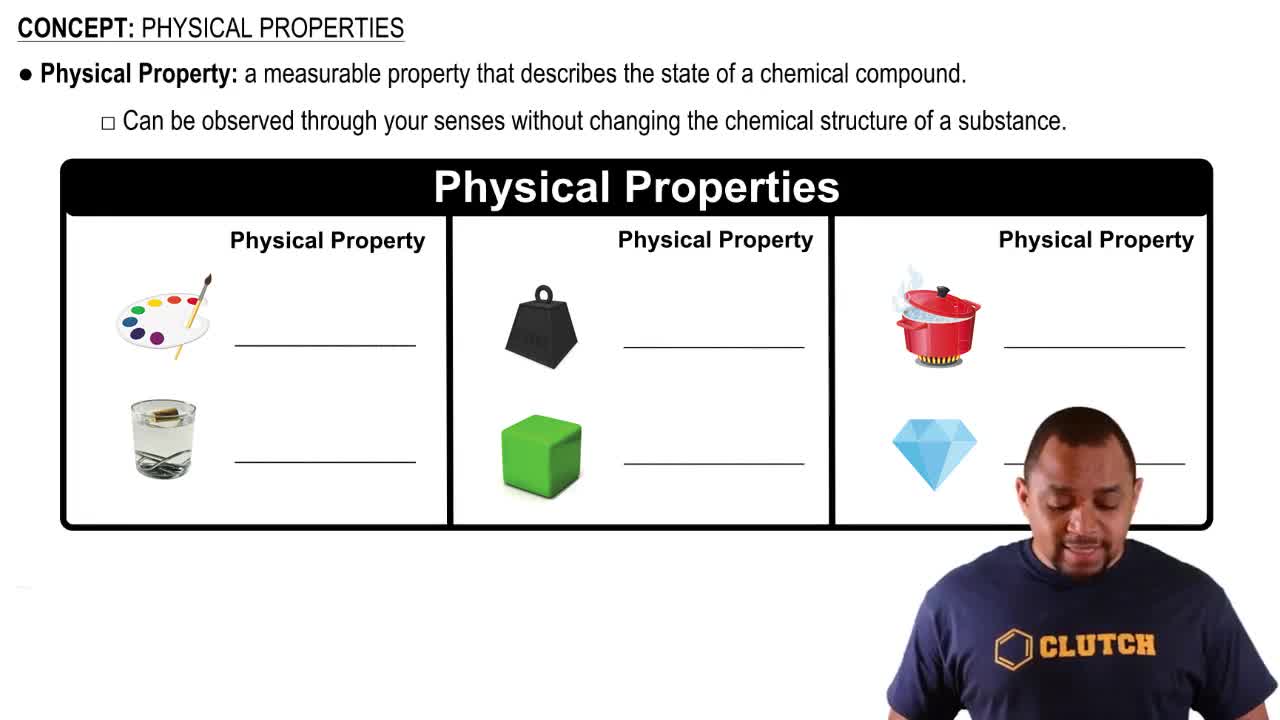
Physical Properties
관련 실천
교과서 질문

A solid white substance A is heated strongly in the absence of air. It decomposes to form a new white substance B and a gas C. The gas has exactly the same properties as the product obtained when carbon is burned in an excess of oxygen. Based on these observations, can we determine whether solids A and B and gas C are elements or compounds?

1551
views
교과서 질문

The radius of an atom of tungsten (W) is about 2.10 Å. (b) How many tungsten atoms would have to be lined up to create a wire of 2.0 mm?

809
views
교과서 질문

In the process of attempting to characterize a substance, a chemist makes the following observations: The substance is a silvery white, lustrous metal. It melts at 649 °C and boils at 1105 °C. Its density at 20 °C is 1.738 g/cm3. The substance burns in air, producing an intense white light. It reacts with chlorine to give a brittle white solid. The substance can be pounded into thin sheets or drawn into wires. It is a good conductor of electricity. Which of these characteristics are physical properties, and which are chemical properties?

1161
views
1
rank
교과서 질문

Give the chemical symbol or name for each of the following elements, as appropriate: (a) rhenium (b) tungsten (c) cesium (d) hydrogen (e) indium

928
views
교과서 질문

The radius of an atom of tungsten (W) is about 2.10 A . (a) Express this distance in nanometers (nm). Express this distance in picometers (pm).

586
views
1
rank
교과서 질문

Give the chemical symbol or name for each of the following elements, as appropriate: (f) As (g) Xe (h) Kr (i) Te (j) Ge.