

Ch.10 - Gases
Brown - Chemistry: The Central Science 14th Edition
Brown14th EditionChemistry: The Central ScienceISBN: 9780134414232당신이 사용하는 게 아니라요?교과서 변경
10장, 문제 127a

A 6.53-g sample of a mixture of magnesium carbonate and calcium carbonate is treated with excess hydrochloric acid. The resulting reaction produces 1.72 L of carbon dioxide gas at 28 °C and 99.06 kPa pressure. (a) Write balanced chemical equations for the reactions that occur between hydrochloric acid and each component of the mixture.

검증된 단계별 안내
1
Identify the chemical reactions: Magnesium carbonate (MgCO₃) and calcium carbonate (CaCO₃) react with hydrochloric acid (HCl) to produce carbon dioxide (CO₂), water (H₂O), and the respective chloride salts (MgCl₂ and CaCl₂).
Write the balanced chemical equation for the reaction of magnesium carbonate with hydrochloric acid: \( \text{MgCO}_3 (s) + 2 \text{HCl} (aq) \rightarrow \text{MgCl}_2 (aq) + \text{CO}_2 (g) + \text{H}_2\text{O} (l) \).
Write the balanced chemical equation for the reaction of calcium carbonate with hydrochloric acid: \( \text{CaCO}_3 (s) + 2 \text{HCl} (aq) \rightarrow \text{CaCl}_2 (aq) + \text{CO}_2 (g) + \text{H}_2\text{O} (l) \).
Note that both reactions produce carbon dioxide gas, which is collected and measured in the problem.
Understand that the balanced equations show a 1:1 molar ratio between the carbonates and the carbon dioxide produced, which will be useful for further calculations if needed.

비슷한 문제에 대한 검증된 영상 답변:

이 영상 해법은 위 문제에 도움이 된다고 튜터들이 추천한 것입니다.
영상 길이:
2m

주요 개념

질문에 올바르게 답하기 위해 반드시 이해해야 하는 핵심 개념들은 다음과 같습니다.

Balanced Chemical Equations

A balanced chemical equation represents a chemical reaction where the number of atoms for each element is the same on both sides of the equation. This is crucial for accurately depicting the conservation of mass during a reaction. Balancing involves adjusting coefficients to ensure that the total number of each type of atom is equal, which is essential for understanding the stoichiometry of the reaction.
추천 영상:
가이드 코스
01:32
Balancing Chemical Equations

Acid-Base Reactions

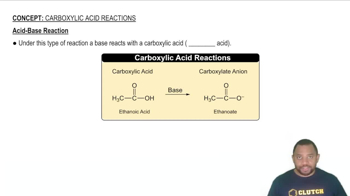
Acid-base reactions involve the transfer of protons (H⁺ ions) between reactants. In this case, hydrochloric acid (HCl) acts as an acid, reacting with magnesium carbonate (MgCO₃) and calcium carbonate (CaCO₃) to produce carbon dioxide (CO₂), water, and corresponding salts. Understanding the nature of these reactions helps in predicting the products formed and the stoichiometric relationships involved.
추천 영상:
가이드 코스
01:09
Acid-Base Reaction

Gas Laws

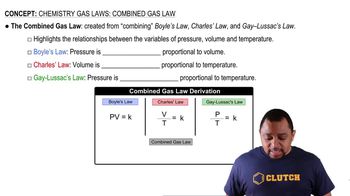
Gas laws describe the behavior of gases in relation to pressure, volume, and temperature. The ideal gas law (PV=nRT) can be used to relate the volume of carbon dioxide produced in the reaction to the number of moles of gas generated. This concept is essential for calculating the amount of reactants consumed based on the volume of gas produced under specific conditions of temperature and pressure.
추천 영상:
가이드 코스
01:43
Combined Gas Law
관련 실천
교과서 질문

Gaseous iodine pentafluoride, IF5, can be prepared by the reaction of solid iodine and gaseous fluorine: I2(s) + 5 F2(g) → 2 IF5(g) A 5.00-L flask containing 10.0 g of I2 is charged with 10.0 g of F2, and the reaction proceeds until one of the reagents is completely consumed. After the reaction is complete, the temperature in the flask is 125 °C.  (c) Draw the Lewis structure of IF5.

992
views
교과서 질문

A 6.53-g sample of a mixture of magnesium carbonate and calcium carbonate is treated with excess hydrochloric acid. The resulting reaction produces 1.72 L of carbon dioxide gas at 28 °C and 99.06 kPa pressure. (c) Assuming that the reactions are complete, calculate the percentage by mass of magnesium carbonate in the mixture.

1568
views
교과서 질문

Gaseous iodine pentafluoride, IF5, can be prepared by the reaction of solid iodine and gaseous fluorine: I2(s) + 5 F2(g) → 2 IF5(g) A 5.00-L flask containing 10.0 g of I2 is charged with 10.0 g of F2, and the reaction proceeds until one of the reagents is completely consumed. After the reaction is complete, the temperature in the flask is 125 °C. (d) What is the total mass of reactants and products in the flask?

1483
views
교과서 질문

Gaseous iodine pentafluoride, IF5, can be prepared by the reaction of solid iodine and gaseous fluorine: I2(s) + 5 F2(g) → 2 IF5(g) A 5.00-L flask containing 10.0 g of I2 is charged with 10.0 g of F2, and the reaction proceeds until one of the reagents is completely consumed. After the reaction is complete, the temperature in the flask is 125 °C. (b) What is the mole fraction of IF5 in the flask?