

Ch.10 - Gases
Brown - Chemistry: The Central Science 14th Edition
Brown14th EditionChemistry: The Central ScienceISBN: 9780134414232당신이 사용하는 게 아니라요?교과서 변경
10장, 문제 38a

(a) If the pressure exerted by ozone, O3, in the stratosphere is 304 Pa and the temperature is 250 K, how many ozone molecules are in a liter?

검증된 단계별 안내
1
Start by using the ideal gas law equation: \( PV = nRT \), where \( P \) is the pressure, \( V \) is the volume, \( n \) is the number of moles, \( R \) is the ideal gas constant, and \( T \) is the temperature.
Rearrange the ideal gas law to solve for \( n \): \( n = \frac{PV}{RT} \).
Substitute the given values into the equation: \( P = 304 \text{ Pa} \), \( V = 1 \text{ L} = 0.001 \text{ m}^3 \), \( R = 8.314 \text{ J/mol·K} \), and \( T = 250 \text{ K} \).
Calculate the number of moles \( n \) using the rearranged ideal gas law equation.
Convert the number of moles to the number of molecules using Avogadro's number \( 6.022 \times 10^{23} \text{ molecules/mol} \).

비슷한 문제에 대한 검증된 영상 답변:

이 영상 해법은 위 문제에 도움이 된다고 튜터들이 추천한 것입니다.
영상 길이:
5m

주요 개념

질문에 올바르게 답하기 위해 반드시 이해해야 하는 핵심 개념들은 다음과 같습니다.

Ideal Gas Law

The Ideal Gas Law relates the pressure, volume, temperature, and number of moles of a gas through the equation PV = nRT. In this context, P is the pressure of ozone, V is the volume (1 liter), n is the number of moles, R is the ideal gas constant, and T is the temperature in Kelvin. This law is fundamental for calculating the number of gas molecules under specific conditions.
추천 영상:
가이드 코스
01:15
Ideal Gas Law Formula

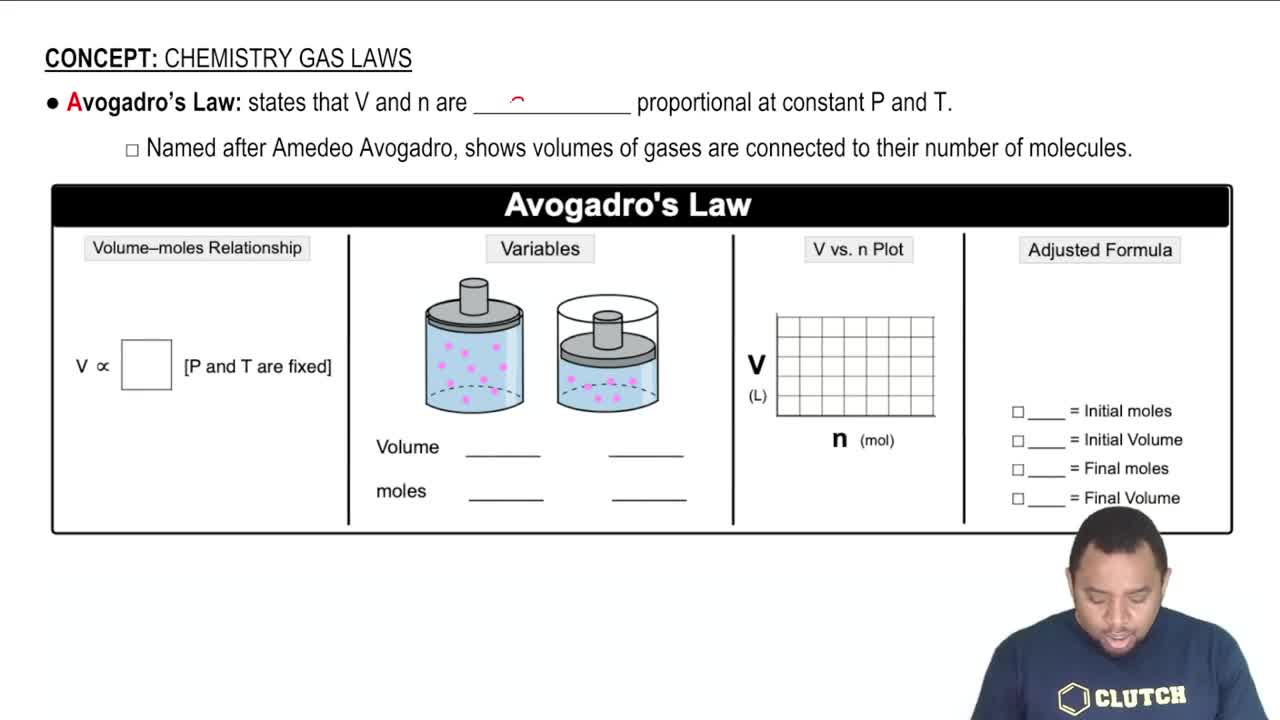
Avogadro's Number

Avogadro's Number, approximately 6.022 x 10²³, is the number of particles (atoms, molecules, etc.) in one mole of a substance. This concept is crucial for converting between moles of a gas and the actual number of molecules, allowing us to determine how many ozone molecules are present in a given volume when using the Ideal Gas Law.
추천 영상:

Gas Pressure and Temperature Relationship

The relationship between gas pressure and temperature is described by Gay-Lussac's Law, which states that the pressure of a gas is directly proportional to its absolute temperature when volume is held constant. Understanding this relationship helps in analyzing how changes in temperature affect the pressure and, consequently, the number of gas molecules in a specified volume.
추천 영상:
가이드 코스
01:08
Standard Temperature and Pressure