Ch.10 - Gases
Brown - Chemistry: The Central Science 14th Edition
Brown14th EditionChemistry: The Central ScienceISBN: 9780134414232당신이 사용하는 게 아니라요?교과서 변경
10장, 문제 107a

Assume that an exhaled breath of air consists of 74.8% N2, 15.3% O2, 3.7% CO2, and 6.2% water vapor. (a) If the total pressure of the gases is 99.8 kPa, calculate the partial pressure of each component of the mixture.

검증된 단계별 안내
1
Step 1: Understand that the total pressure of a gas mixture is the sum of the partial pressures of each individual gas. This is known as Dalton's Law of Partial Pressures.
Step 2: Identify the percentage of water vapor in the mixture, which is 6.2%.
Step 3: Convert this percentage to a decimal by dividing by 100. So, 6.2% becomes 0.062.
Step 4: Multiply the total pressure of the gas mixture by the decimal equivalent of the percentage of water vapor. This will give you the partial pressure of the water vapor.
Step 5: The result from step 4 is the partial pressure of water vapor in the exhaled breath of air. Remember to keep the units consistent, so the partial pressure should be in kPa.

비슷한 문제에 대한 검증된 영상 답변:

이 영상 해법은 위 문제에 도움이 된다고 튜터들이 추천한 것입니다.
영상 길이:
1m

주요 개념

질문에 올바르게 답하기 위해 반드시 이해해야 하는 핵심 개념들은 다음과 같습니다.

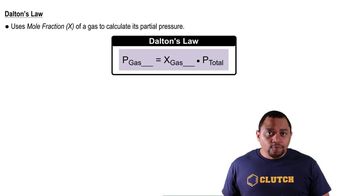
Dalton's Law of Partial Pressures

Dalton's Law states that in a mixture of gases, the total pressure exerted is equal to the sum of the partial pressures of each individual gas. Each gas in the mixture behaves independently, contributing to the total pressure based on its mole fraction. This principle is essential for calculating the partial pressure of a specific gas when the total pressure and the composition of the gas mixture are known.
추천 영상:
가이드 코스
00:27
Dalton's Law and Partial Pressure

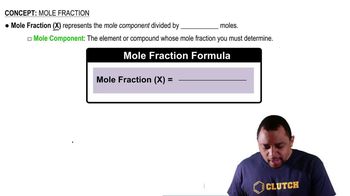
Mole Fraction

The mole fraction of a component in a gas mixture is defined as the ratio of the number of moles of that component to the total number of moles of all components in the mixture. It is a dimensionless quantity that helps in determining the contribution of each gas to the total pressure. In this context, the mole fraction of water vapor can be calculated from its percentage in the mixture.
추천 영상:
가이드 코스
00:36
Mole Fraction Formula

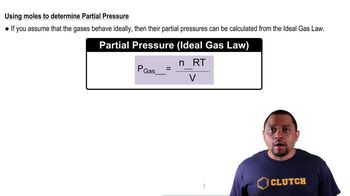
Calculating Partial Pressure

To find the partial pressure of a gas in a mixture, you can multiply the total pressure by the mole fraction of that gas. For example, if the mole fraction of water vapor is known, the partial pressure can be calculated using the formula: Partial Pressure = Total Pressure × Mole Fraction. This calculation allows for the determination of the specific pressure exerted by water vapor in the exhaled breath.
추천 영상:
가이드 코스
00:48
Partial Pressure Calculation
관련 실천
교과서 질문
Nickel carbonyl, Ni1CO24, is one of the most toxic substances known. The present maximum allowable concentration in laboratory air during an 8-hr workday is 1 ppb (parts per billion) by volume, which means that there is one mole of Ni1CO24 for every 109 moles of gas. Assume 24 C and 101.3 kPa pressure. What mass of Ni1CO24 is allowable in a laboratory room that is 3.5 m * 6.0 m * 2.5 m?
713
views
교과서 질문

Assume that an exhaled breath of air consists of 74.8% N2, 15.3% O2, 3.7% CO2, and 6.2% water vapor. (b) If the volume of the exhaled gas is 455 mL and its temperature is 37 °C, calculate the number of moles of CO2 exhaled.

1
views
교과서 질문

Assume that an exhaled breath of air consists of 74.8% N2, 15.3% O2, 3.7% CO2, and 6.2% water vapor. (c) How many grams of glucose (C6H12O6) would need to be metabolized to produce this quantity of CO2? (The chemical reaction is the same as that for combustion of C6H12O6. See Section 3.2 and Problem 10.57.)

518
views
교과서 질문

Assume that a single cylinder of an automobile engine has a volume of 524 cm3. (a) If the cylinder is full of air at 74 C and 99.3 kPa, how many moles of O2 are present? (The mole fraction of O2 in dry air is 0.2095.) (b) How many grams of C8H18 could be combusted by this quantity of O2, assuming complete combustion with formation of CO2 and H2O?

532
views
교과서 질문
An 8.40-g sample of argon and an unknown mass of H2 are mixed in a flask at room temperature. The partial pressure of the argon is 44.0 kPa, and that of the hydrogen is 57.33 kPa. What is the mass of the hydrogen?
608
views
교과서 질문

Consider the arrangement of bulbs shown in the drawing. Each of the bulbs contains a gas at the pressure shown. What is the pressure of the system when all the stopcocks are opened, assuming that the temperature remains constant? (We can neglect the volume of the capillary tubing connecting the bulbs.)

1529
views