Ch.10 - Gases
Brown - Chemistry: The Central Science 14th Edition
Brown14th EditionChemistry: The Central ScienceISBN: 9780134414232당신이 사용하는 게 아니라요?교과서 변경
10장, 문제 22a

Hurricane Wilma of 2005 is the most intense hurricane on record in the Atlantic basin, with a low-pressure reading of 882 mbar (millibars). Convert this reading into (a) atmospheres.

검증된 단계별 안내
1
Identify the conversion factor between millibars and atmospheres. 1 atmosphere is equivalent to 1013.25 millibars.
Set up the conversion equation using the given pressure in millibars (882 mbar) and the conversion factor.
Divide the pressure in millibars by the conversion factor to convert it to atmospheres: \( \text{Pressure in atmospheres} = \frac{882 \text{ mbar}}{1013.25 \text{ mbar/atm}} \).
Simplify the expression to find the pressure in atmospheres.
Ensure the units cancel appropriately, leaving the result in atmospheres.

비슷한 문제에 대한 검증된 영상 답변:

이 영상 해법은 위 문제에 도움이 된다고 튜터들이 추천한 것입니다.
영상 길이:
1m

주요 개념

질문에 올바르게 답하기 위해 반드시 이해해야 하는 핵심 개념들은 다음과 같습니다.

Pressure Units

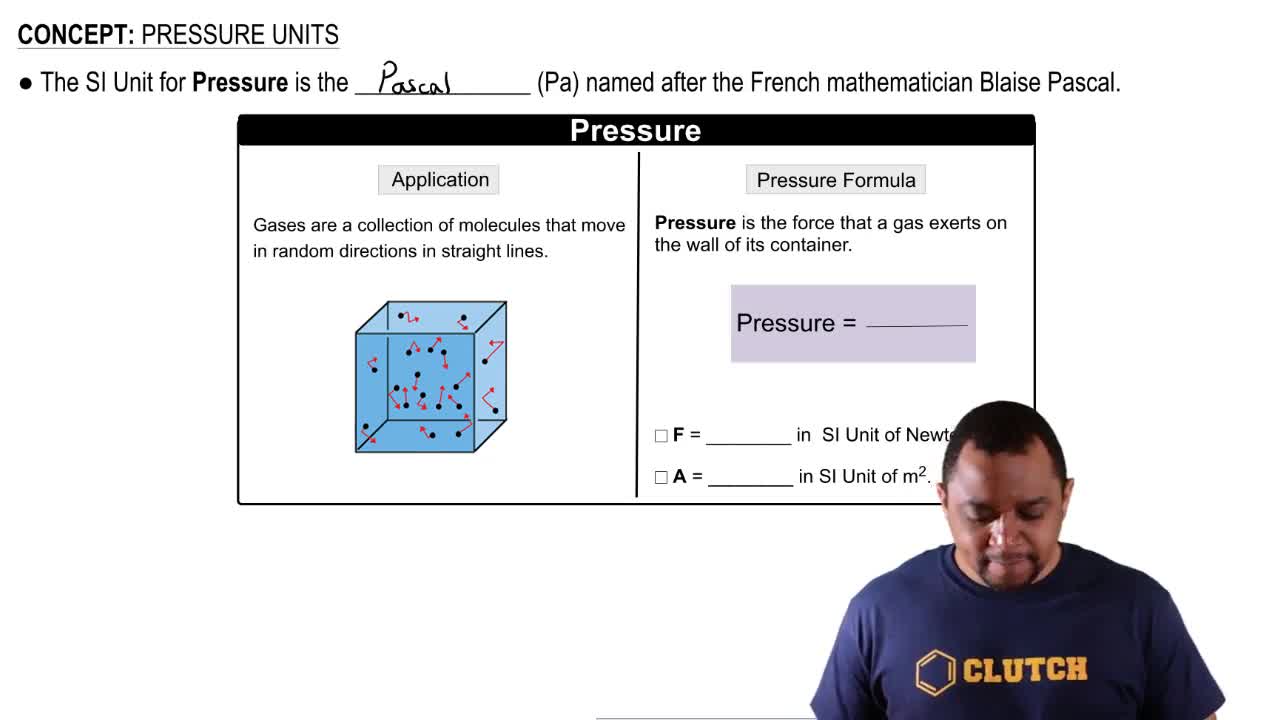
Pressure is a measure of force applied per unit area and can be expressed in various units, including millibars (mbar) and atmospheres (atm). One atmosphere is defined as 1013.25 mbar, which serves as a standard reference for atmospheric pressure at sea level.
추천 영상:

Unit Conversion

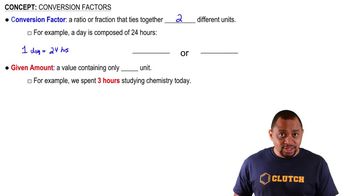
Unit conversion involves changing a measurement from one unit to another while maintaining the same quantity. To convert from millibars to atmospheres, one must use the conversion factor that relates the two units, specifically that 1 atm equals 1013.25 mbar.
추천 영상:
가이드 코스
01:56
Conversion Factors

Scientific Notation

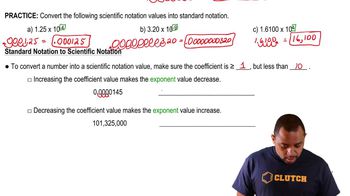
Scientific notation is a way of expressing numbers that are too large or too small in a compact form. It is often used in scientific contexts to simplify calculations and comparisons, especially when dealing with measurements like pressure, which can vary widely.
추천 영상:
가이드 코스
02:50
Standard Notation to Scientific Notation