
Ch.10 - Gases
Brown - Chemistry: The Central Science 14th Edition
Brown14th EditionChemistry: The Central ScienceISBN: 9780134414232당신이 사용하는 게 아니라요?교과서 변경
10장, 문제 117c

Large amounts of nitrogen gas are used in the manufacture of ammonia, principally for use in fertilizers. Suppose 120.00 kg of N2(g) is stored in a 1100.0-L metal cylinder at 280 °C. (c) Under the conditions of this problem, which correction dominates, the one for finite volume of gas molecules or the one for attractive interactions?

검증된 단계별 안내
1
First, understand the context of the problem. We are dealing with real gases, which deviate from ideal behavior due to finite volume of gas molecules and attractive interactions between them. The Van der Waals equation accounts for these deviations.
The Van der Waals equation is given by: (P+an2V2)(V-nb)=nRT, where P is pressure, V is volume, n is moles, R is the gas constant, T is temperature, and a and b are Van der Waals constants specific to the gas.
Calculate the number of moles of nitrogen gas using the formula: n=massmolar mass. The molar mass of nitrogen gas N2 is approximately 28.02 g/mol.
Determine the significance of the Van der Waals constants a and b for nitrogen. The constant a accounts for attractive forces, while b accounts for the finite volume of molecules.
Compare the magnitude of the corrections. If the correction term involving a is larger, attractive interactions dominate. If the correction term involving b is larger, the finite volume of gas molecules dominates. This can be assessed by calculating the terms an2V2 and nb.

비슷한 문제에 대한 검증된 영상 답변:

이 영상 해법은 위 문제에 도움이 된다고 튜터들이 추천한 것입니다.

주요 개념

질문에 올바르게 답하기 위해 반드시 이해해야 하는 핵심 개념들은 다음과 같습니다.

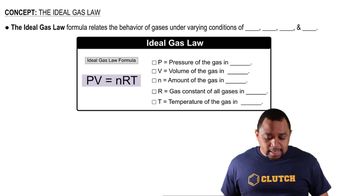
Ideal Gas Law

The Ideal Gas Law relates the pressure, volume, temperature, and number of moles of a gas through the equation PV = nRT. This law assumes that gas molecules do not occupy space and do not interact with each other, which is a simplification. In real-world scenarios, especially at high pressures or low temperatures, deviations from this law occur, necessitating corrections for molecular volume and intermolecular forces.
추천 영상:
가이드 코스
01:15
Ideal Gas Law Formula

Real Gas Behavior

Real gases deviate from ideal behavior due to the finite volume of gas molecules and intermolecular forces. At high pressures, the volume occupied by gas molecules becomes significant, while at low temperatures, attractive forces between molecules can lead to condensation. Understanding these deviations is crucial for accurately predicting gas behavior in various conditions, such as those described in the question.
추천 영상:
가이드 코스
01:15
Ideal Gas Law Formula

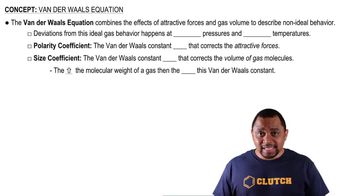
Van der Waals Equation

The Van der Waals equation is an adjustment of the Ideal Gas Law that accounts for the volume of gas molecules and the attractive forces between them. It is expressed as (P + a(n/V)²)(V - nb) = nRT, where 'a' and 'b' are constants specific to each gas. This equation helps determine which correction—volume or attraction—dominates under specific conditions, such as high pressure or low temperature.
추천 영상:
가이드 코스
01:40
Van der Waals Equation