

Ch.10 - Gases
Brown - Chemistry: The Central Science 14th Edition
Brown14th EditionChemistry: The Central ScienceISBN: 9780134414232당신이 사용하는 게 아니라요?교과서 변경
10장, 문제 77

Radon (Rn) is the heaviest (and only radioactive) member of the noble gases. How much slower is the root-mean-square speed of Rn than He at 300 K?

검증된 단계별 안내
1
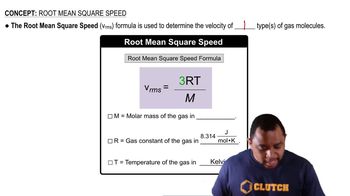
Identify the formula to calculate the root-mean-square speed (rms) of a gas, which is given by \( v_{rms} = \sqrt{\frac{3kT}{m}} \), where \( k \) is the Boltzmann constant, \( T \) is the temperature in Kelvin, and \( m \) is the molar mass of the gas in kilograms per mole.
Convert the molar masses of Radon (Rn) and Helium (He) from grams per mole to kilograms per mole, as the molar mass in the rms formula needs to be in kilograms per mole.
Plug in the values for \( T \), \( k \), and the molar mass of Rn into the rms formula to calculate the rms speed for Radon.
Similarly, calculate the rms speed for Helium using its molar mass, along with the same values for \( T \) and \( k \).
Compare the rms speeds of Radon and Helium by dividing the rms speed of Radon by the rms speed of Helium to find out how much slower Radon moves compared to Helium at the same temperature.

비슷한 문제에 대한 검증된 영상 답변:

이 영상 해법은 위 문제에 도움이 된다고 튜터들이 추천한 것입니다.
영상 길이:
3m

주요 개념

질문에 올바르게 답하기 위해 반드시 이해해야 하는 핵심 개념들은 다음과 같습니다.

Root-Mean-Square Speed

The root-mean-square (RMS) speed is a measure of the average speed of gas particles in a system. It is calculated using the formula v_rms = sqrt(3RT/M), where R is the ideal gas constant, T is the temperature in Kelvin, and M is the molar mass of the gas. This concept is crucial for comparing the speeds of different gases at the same temperature.
추천 영상:
가이드 코스
01:05
Root Mean Square Speed Formula

Molar Mass

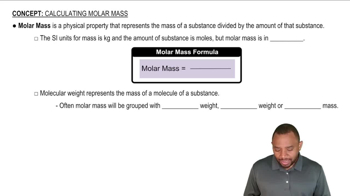
Molar mass is the mass of one mole of a substance, typically expressed in grams per mole (g/mol). It is a key factor in determining the RMS speed of a gas, as heavier gases will generally have lower RMS speeds at a given temperature. Understanding molar mass allows for the comparison of different gases, such as radon (Rn) and helium (He).
추천 영상:
가이드 코스
02:11
Molar Mass Concept

Kinetic Molecular Theory

Kinetic molecular theory explains the behavior of gases in terms of particles in constant motion. It posits that the temperature of a gas is directly related to the average kinetic energy of its particles. This theory helps to understand why lighter gases, like helium, move faster than heavier gases, like radon, at the same temperature.
추천 영상:
가이드 코스
01:19
Kinetic Molecular Theory
관련 실천
교과서 질문

A sample of 3.00 g of SO2(g) originally in a 5.00-L vessel at 21 °C is transferred to a 10.0-L vessel at 26 °C. A sample of 2.35 g of N2(g) originally in a 2.50-L vessel at 20 °C is transferred to this same 10.0-L vessel. (c) What is the total pressure in the vessel?

교과서 질문

The temperature of a 5.00-L container of N2 gas is increased from 20 °C to 250 °C. If the volume is held constant, predict qualitatively how this change affects the following: (a) the average kinetic energy of the molecules.

758
views
교과서 질문

You have an evacuated container of fixed volume and known mass and introduce a known mass of a gas sample. Measuring the pressure at constant temperature over time, you are surprised to see it slowly dropping. You measure the mass of the gas-filled container and find that the mass is what it should be—gas plus container—and the mass does not change over time, so you do not have a leak. Suggest an explanation for your observations.

673
views
교과서 질문

Indicate which of the following statements regarding the kinetic-molecular theory of gases are correct. (a) The average kinetic energy of a collection of gas molecules at a given temperature is proportional to m1/2. (b) The gas molecules are assumed to exert no forces on each other. (c) All the molecules of a gas at a given temperature have the same kinetic energy. (d) The volume of the gas molecules is negligible in comparison to the total volume in which the gas is contained. (e) All gas molecules move with the same speed if they are at the same temperature.

979
views
교과서 질문

Determine whether each of the following changes will increase, decrease, or not affect the rate with which gas molecules collide with the walls of their container: (a) increasing the volume of the container (b) increasing the temperature (c) increasing the molar mass of the gas

1076
views
교과서 질문

The temperature of a 5.00-L container of N2 gas is increased from 20 °C to 250 °C. If the volume is held constant, predict qualitatively how this change affects the following: (b) the rootmean-square speed of the molecules. (c) the strength of the impact of an average molecule with the container walls. (d) the total number of collisions of molecules with walls per second.

756
views