
Which of the following statements best explains why a closed balloon filled with helium gas rises in air? (a) Helium is a monatomic gas, whereas nearly all the molecules that make up air, such as nitrogen and oxygen, are diatomic. (b) The average speed of helium atoms is greater than the average speed of air molecules, and the greater speed of collisions with the balloon walls propels the balloon upward. (c) Because the helium atoms are of lower mass than the average air molecule, the helium gas is less dense than air. The mass of the balloon is thus less than the mass of the air displaced by its volume. (d) Because helium has a lower molar mass than the average air molecule, the helium atoms are in faster motion. This means that the temperature of the helium is greater than the air temperature. Hot gases tend to rise.

- Ch.1 - Introduction: Matter, Energy, and Measurement177
- Ch.2 - Atoms, Molecules, and Ions231
- Ch.3 - Chemical Reactions and Reaction Stoichiometry216
- Ch.4 - Reactions in Aqueous Solution189
- Ch.5 - Thermochemistry175
- Ch.6 - Electronic Structure of Atoms168
- Ch.7 - Periodic Properties of the Elements150
- Ch.8 - Basic Concepts of Chemical Bonding177
- Ch.9 - Molecular Geometry and Bonding Theories200
- Ch.10 - Gases179
- Ch.11 - Liquids and Intermolecular Forces113
- Ch.12 - Solids and Modern Materials154
- Ch.13 - Properties of Solutions157
- Ch.14 - Chemical Kinetics199
- Ch.15 - Chemical Equilibrium128
- Ch.16 - Acid-Base Equilibria164
- Ch.17 - Additional Aspects of Aqueous Equilibria163
- Ch.18 - Chemistry of the Environment105
- Ch.19 - Chemical Thermodynamics164
- Ch.20 - Electrochemistry171
- Ch.21 - Nuclear Chemistry122
- Ch.22 - Chemistry of the Nonmetals82
- Ch.23 - Transition Metals and Coordination Chemistry79
- Ch.24 - The Chemistry of Life: Organic and Biological Chemistry16
Rank the following gases and vapors from least dense to most dense at 101.33 kPa and 298 K: water vapor 1H2O1g22, nitrogen 1N22, hydrogen sulfide 1H2S2.
 검증된 단계별 안내
비슷한 문제에 대한 검증된 영상 답변:

주요 개념
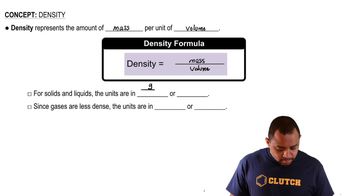
Density of Gases
 01:56

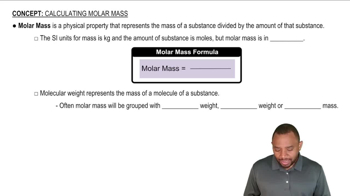
Molar Mass
 02:11
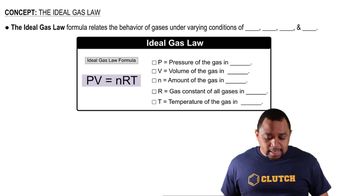
Ideal Gas Law
 01:15
(a) Calculate the density of NO2 gas at 0.970 atm and 35 °C.
The physical fitness of athletes is measured by 'VO2 max,' which is the maximum volume of oxygen consumed by an individual during incremental exercise (for example, on a treadmill). An average male has a VO2 max of 45 mL O2/kg body mass/min, but a world-class male athlete can have a VO2 max reading of 88.0 mL O2/kg body mass/min. (a) Calculate the volume of oxygen, in mL, consumed in 1 hr by an average man who weighs 85 kg and has a VO2 max reading of 47.5 mL O2/kg body mass/min. (b) If this man lost 10 kg, exercised, and increased his VO2 max to 65.0 mL O2/kg body mass/min, how many mL of oxygen would he consume in 1 hr?
In an experiment reported in the scientific literature, male cockroaches were made to run at different speeds on a miniature treadmill while their oxygen consumption was measured. In 30 minutes the average cockroach (running at 0.08 km/h) consumed 1.0 mL of O2 at 101.33 kPa pressure and 20 °C per gram of insect mass. (a) How many moles of O2 would be consumed in 1 day by a 6.3-g cockroach moving at this speed?
(b) Calculate the molar mass of a gas if 2.50 g occupies 0.875 L at 685 torr and 35 °C