

Ch.10 - Gases
Brown - Chemistry: The Central Science 14th Edition
Brown14th EditionChemistry: The Central ScienceISBN: 9780134414232당신이 사용하는 게 아니라요?교과서 변경
10장, 문제 65

The atmospheric concentration of CO2 gas is presently 407 ppm (parts per million, by volume; that is, 407 L of every 106 L of the atmosphere are CO2). What is the mole fraction of CO2 in the atmosphere?.

검증된 단계별 안내
1
Understand that ppm (parts per million) is a way of expressing very dilute concentrations of substances. In this case, 407 ppm means 407 liters of CO2 per 1,000,000 liters of air.
To find the mole fraction, we need to convert the volume ratio to a mole ratio. Assume ideal gas behavior, where the volume ratio is equivalent to the mole ratio.
The mole fraction (X) is defined as the ratio of the number of moles of the component (CO2) to the total number of moles in the mixture (air).
Since the volume ratio is equivalent to the mole ratio under ideal conditions, the mole fraction of CO2 is simply the volume of CO2 divided by the total volume of the atmosphere.
Calculate the mole fraction using the formula: X_{CO2} = \(\frac{407}{10^6}\).

비슷한 문제에 대한 검증된 영상 답변:

이 영상 해법은 위 문제에 도움이 된다고 튜터들이 추천한 것입니다.
영상 길이:
1m

주요 개념

질문에 올바르게 답하기 위해 반드시 이해해야 하는 핵심 개념들은 다음과 같습니다.

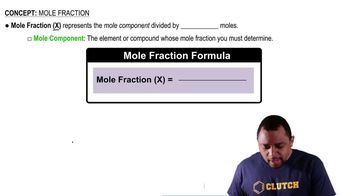
Mole Fraction

Mole fraction is a way of expressing the concentration of a component in a mixture. It is defined as the ratio of the number of moles of a specific component to the total number of moles of all components in the mixture. In this case, to find the mole fraction of CO2, you would divide the number of moles of CO2 by the total number of moles of all gases in the atmosphere.
추천 영상:
가이드 코스
00:36
Mole Fraction Formula

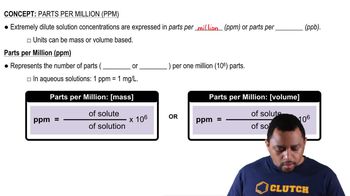
Parts Per Million (ppm)

Parts per million (ppm) is a unit of measurement used to describe the concentration of one substance in a million parts of another. In the context of gases in the atmosphere, 407 ppm of CO2 means that for every million air molecules, 407 are CO2. This measurement helps in understanding trace gas concentrations in the atmosphere.
추천 영상:
가이드 코스
01:38
Parts per Million (ppm)

Ideal Gas Law

The Ideal Gas Law is a fundamental equation in chemistry that relates the pressure, volume, temperature, and number of moles of a gas. It is expressed as PV = nRT, where P is pressure, V is volume, n is the number of moles, R is the ideal gas constant, and T is temperature. This law can be useful for converting between different units of gas concentration and understanding the behavior of gases under various conditions.
추천 영상:
가이드 코스
01:15
Ideal Gas Law Formula