
Ch.10 - Gases
Brown - Chemistry: The Central Science 14th Edition
Brown14th EditionChemistry: The Central ScienceISBN: 9780134414232당신이 사용하는 게 아니라요?교과서 변경
10장, 문제 13

Which of the following statements is false? (a) Gases are far less dense than liquids. (b) Gases are far more compressible than liquids. (c) Because liquid water and liquid carbon tetrachloride do not mix, neither do their vapors. (d) The volume occupied by a gas is determined by the volume of its container.

검증된 단계별 안내
1
Let's analyze each statement one by one to determine which one is false.
(a) Gases are far less dense than liquids. This statement is true. Gases have a much lower density than liquids because their particles are spread out and not as closely packed together.
(b) Gases are far more compressible than liquids. This statement is also true. Gases are more compressible because their particles are not as closely packed together, allowing them to be squeezed into a smaller volume.
(c) Because liquid water and liquid carbon tetrachloride do not mix, neither do their vapors. This statement is false. The fact that two liquids do not mix does not necessarily mean their vapors will not mix. In the gaseous state, the particles are much more spread out and can easily intermingle, regardless of whether or not they mix in the liquid state.
(d) The volume occupied by a gas is determined by the volume of its container. This statement is true. Gases will expand to fill the volume of their container, regardless of the size of the container.

비슷한 문제에 대한 검증된 영상 답변:

이 영상 해법은 위 문제에 도움이 된다고 튜터들이 추천한 것입니다.
영상 길이:
2m

주요 개념

질문에 올바르게 답하기 위해 반드시 이해해야 하는 핵심 개념들은 다음과 같습니다.

Density of Gases vs. Liquids

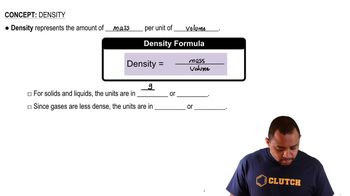
Density is a measure of mass per unit volume. Gases typically have much lower densities than liquids due to the greater distance between particles in a gas, which allows for more empty space. This fundamental difference in density is crucial for understanding the behavior of gases compared to liquids.
추천 영상:
가이드 코스
01:56
Density Concepts

Compressibility of Gases

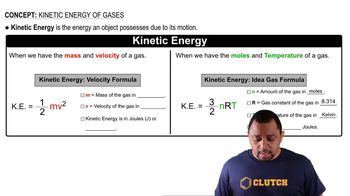
Compressibility refers to the ability of a substance to decrease in volume under pressure. Gases are highly compressible because their particles are far apart, allowing them to be pushed closer together. In contrast, liquids are much less compressible due to the closer arrangement of their particles, which limits their ability to be compressed.
추천 영상:
가이드 코스
02:27
Kinetic Energy Formulas

Vapor Behavior and Miscibility

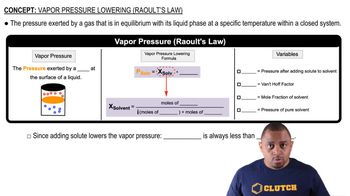
Miscibility describes the ability of two substances to mix in all proportions. The statement regarding liquid water and liquid carbon tetrachloride not mixing implies that their vapors also do not mix, which is not necessarily true. Vapor behavior can differ from liquid behavior, as gases can often mix regardless of the miscibility of their liquid forms.
추천 영상:
가이드 코스
02:40
Raoult's Law and Vapor Pressure