Ch.10 - Gases
Brown - Chemistry: The Central Science 14th Edition
Brown14th EditionChemistry: The Central ScienceISBN: 9780134414232당신이 사용하는 게 아니라요?교과서 변경
10장, 문제 83

Which one or more of the following statements are true? (a) O2 will effuse faster than Cl2. (b) Effusion and diffusion are different names for the same process. (c) Perfume molecules travel to your nose by the process of effusion. (d) The higher the density of a gas, the shorter the mean free path.

검증된 단계별 안내
1
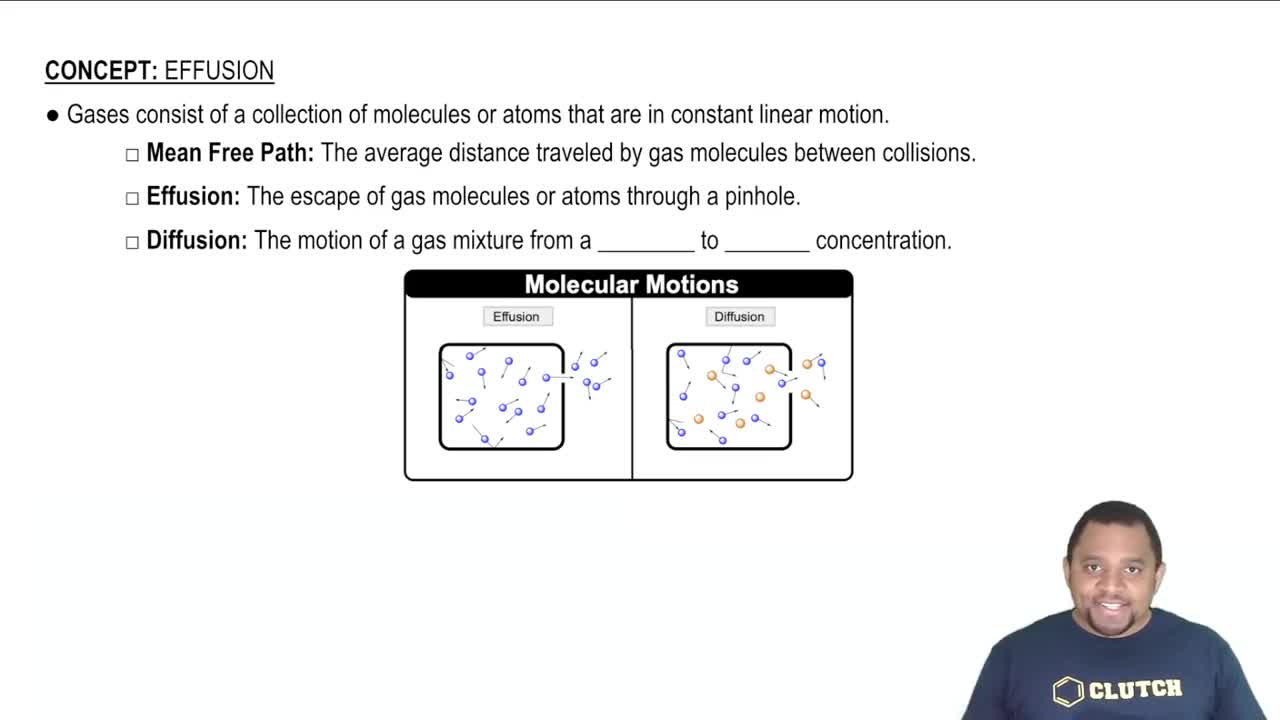
Identify the concept of effusion and diffusion: Effusion is the process by which gas molecules escape through a tiny hole into a vacuum, while diffusion is the spreading of gas molecules throughout a container or space.
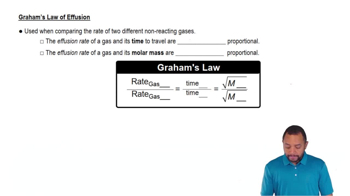
Apply Graham's Law of Effusion to statement (a): According to Graham's Law, the rate of effusion of a gas is inversely proportional to the square root of its molar mass. Compare the molar masses of O2 and Cl2 to determine which effuses faster.
Evaluate statement (b) by clarifying the difference between effusion and diffusion: Effusion involves gas molecules passing through a small opening, while diffusion involves the mixing of gases in a space.
Consider statement (c) by understanding how perfume molecules travel: Perfume molecules spread through the air by diffusion, not effusion, as they mix with air molecules and travel to your nose.
Analyze statement (d) by considering the relationship between gas density and mean free path: The mean free path is the average distance a molecule travels before colliding with another molecule. Higher density means more molecules in a given volume, leading to a shorter mean free path.

비슷한 문제에 대한 검증된 영상 답변:

이 영상 해법은 위 문제에 도움이 된다고 튜터들이 추천한 것입니다.
영상 길이:
4m

주요 개념

질문에 올바르게 답하기 위해 반드시 이해해야 하는 핵심 개념들은 다음과 같습니다.

Graham's Law of Effusion

Graham's Law states that the rate of effusion of a gas is inversely proportional to the square root of its molar mass. This means lighter gases effuse faster than heavier gases. For example, O2 (molar mass ~32 g/mol) will effuse faster than Cl2 (molar mass ~71 g/mol) because it is lighter.
추천 영상:
가이드 코스
2:03
Graham's Law of Effusion

Diffusion vs. Effusion

Diffusion is the process by which gas molecules spread out to occupy a space uniformly, while effusion is the escape of gas molecules through a tiny opening into a vacuum. Although both processes involve the movement of gas particles, they are distinct in their mechanisms and conditions.
추천 영상:
가이드 코스
02:33
Effusion vs Diffusion

Mean Free Path

The mean free path is the average distance a gas molecule travels between collisions with other molecules. It is inversely related to the density of the gas; as density increases, the mean free path decreases due to more frequent collisions. Thus, higher density gases have shorter mean free paths.
추천 영상:
가이드 코스
01:05
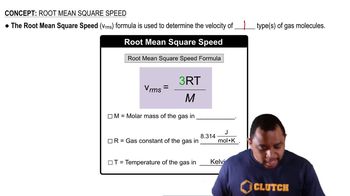
Root Mean Square Speed Formula