Ch.11 - Liquids and Intermolecular Forces
Brown - Chemistry: The Central Science 14th Edition
Brown14th EditionChemistry: The Central ScienceISBN: 9780134414232당신이 사용하는 게 아니라요?교과서 변경
11장, 문제 97

The relative humidity of air equals the ratio of the par- tial pressure of water in the air to the equilibrium vapor pressure of water at the same temperature times 100%. If the relative humidity of the air is 58% and its temperature is 68 °F, how many molecules of water are present in a room measuring12ft * 10ft * 8ft?

검증된 단계별 안내
1
Step 1: Convert the temperature from Fahrenheit to Celsius using the formula: \(C = (F - 32) * 5/9\). This is because the vapor pressure of water is usually given in Celsius.
Step 2: Use the temperature in Celsius to find the equilibrium vapor pressure of water at that temperature. You can find this information in a vapor pressure chart or use the Antoine equation.
Step 3: Calculate the partial pressure of water in the air by multiplying the relative humidity (in decimal form) by the equilibrium vapor pressure. This gives you the actual pressure exerted by the water vapor in the air.
Step 4: Use the ideal gas law, $PV = nRT$, to find the number of moles of water in the air. Here, P is the partial pressure of water, V is the volume of the room (convert the volume from cubic feet to liters), R is the ideal gas constant (use the value 0.0821 L·atm/K·mol), and T is the temperature in Kelvin (convert from Celsius to Kelvin by adding 273.15). Solve for n, the number of moles.
Step 5: Multiply the number of moles by Avogadro's number (6.022 x 10^23 molecules/mole) to find the number of water molecules in the room.

비슷한 문제에 대한 검증된 영상 답변:

이 영상 해법은 위 문제에 도움이 된다고 튜터들이 추천한 것입니다.
영상 길이:
6m

주요 개념

질문에 올바르게 답하기 위해 반드시 이해해야 하는 핵심 개념들은 다음과 같습니다.

Relative Humidity

Relative humidity is a measure of the amount of water vapor present in the air compared to the maximum amount of water vapor the air can hold at a given temperature. It is expressed as a percentage, calculated by dividing the partial pressure of water vapor by the equilibrium vapor pressure of water at that temperature, then multiplying by 100. Understanding relative humidity is crucial for determining the moisture content in the air.
추천 영상:
가이드 코스
05:19
Subatomic Particles

Partial Pressure

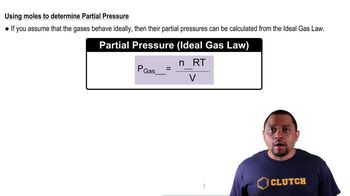
Partial pressure refers to the pressure exerted by a single component of a mixture of gases. In the context of humidity, it specifically relates to the pressure of water vapor in the air. The concept is essential for calculating relative humidity and understanding how gases behave in mixtures, as each gas contributes to the total pressure independently.
추천 영상:
가이드 코스
00:48
Partial Pressure Calculation

Ideal Gas Law

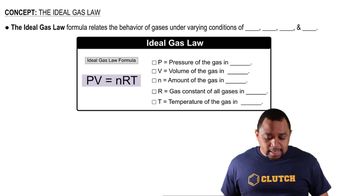
The Ideal Gas Law is a fundamental equation in chemistry that relates the pressure, volume, temperature, and number of moles of a gas. It is expressed as PV = nRT, where P is pressure, V is volume, n is the number of moles, R is the ideal gas constant, and T is temperature in Kelvin. This law is vital for calculating the number of molecules of water vapor in a given volume of air, especially when temperature and pressure conditions are known.
추천 영상:
가이드 코스
01:15
Ideal Gas Law Formula