
Ch.12 - Solids and Modern Materials
Brown - Chemistry: The Central Science 14th Edition
Brown14th EditionChemistry: The Central ScienceISBN: 9780134414232당신이 사용하는 게 아니라요?교과서 변경
12장, 문제 61a,c

A particular form of cinnabar (HgS) adopts the zinc blende structure. The length of the unit cell edge is 5.852 Å. (a) Calculate the density of HgS in this form. (c) Which of the two substances has the higher density? How do you account for the difference in densities?

검증된 단계별 안내
1
Step 1: Understand the zinc blende structure. In the zinc blende structure, each unit cell contains 4 formula units of the compound. For HgS, this means there are 4 Hg atoms and 4 S atoms per unit cell.
Step 2: Calculate the mass of the unit cell. Use the molar masses of Hg (200.59 g/mol) and S (32.07 g/mol) to find the mass of one formula unit of HgS, then multiply by 4 to find the mass of the unit cell.
Step 3: Calculate the volume of the unit cell. The volume of a cubic unit cell is given by the cube of the edge length. Convert the edge length from Å to cm (1 Å = 1 x 10^-8 cm) and calculate the volume.
Step 4: Calculate the density of HgS. Density is mass divided by volume. Use the mass of the unit cell from Step 2 and the volume from Step 3 to find the density of HgS.
Step 5: Compare the density of HgS with the other substance. If the other substance's density is known, compare it with the calculated density of HgS to determine which is higher. Discuss factors such as atomic mass and packing efficiency that could account for differences in density.

비슷한 문제에 대한 검증된 영상 답변:

이 영상 해법은 위 문제에 도움이 된다고 튜터들이 추천한 것입니다.
영상 길이:
4m

주요 개념

질문에 올바르게 답하기 위해 반드시 이해해야 하는 핵심 개념들은 다음과 같습니다.

Density

Density is defined as mass per unit volume, typically expressed in grams per cubic centimeter (g/cm³). It is a crucial property that helps compare the compactness of different substances. In this context, density can be calculated using the formula: density = mass/volume, where the mass is derived from the molar mass of the substance and the volume is determined by the unit cell dimensions.
추천 영상:
가이드 코스
01:56
Density Concepts

Unit Cell and Crystal Structure

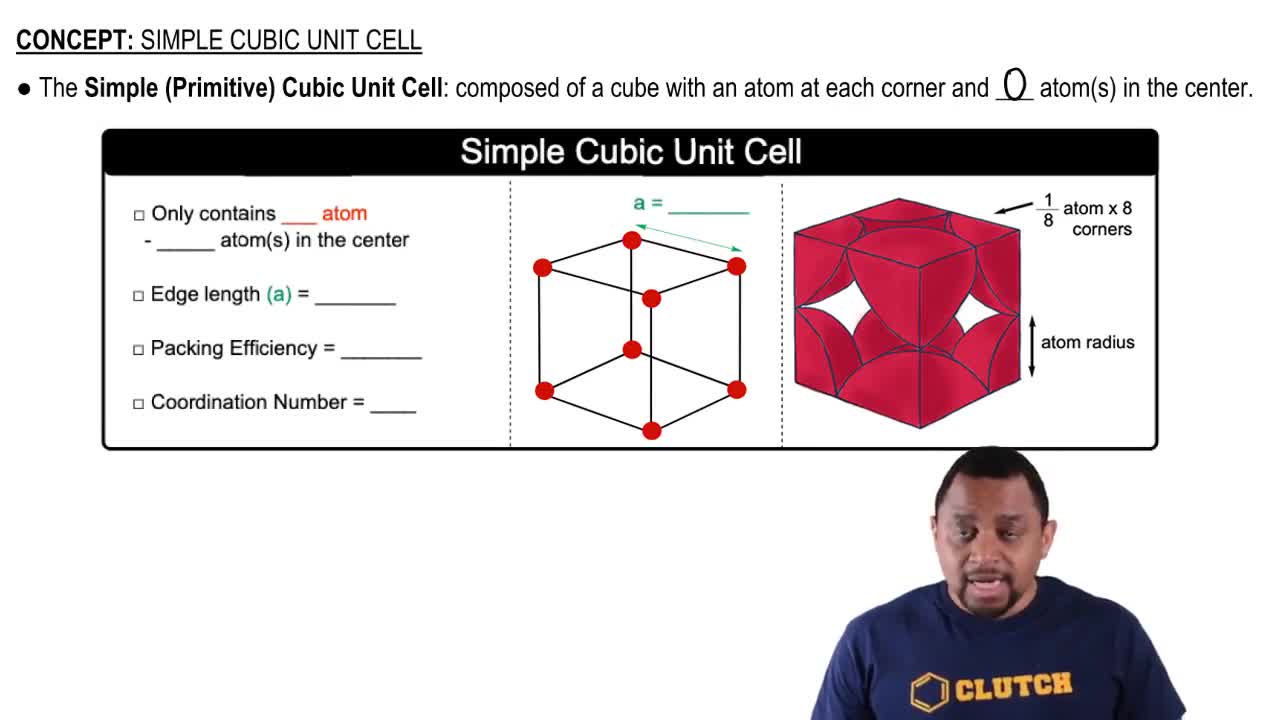
A unit cell is the smallest repeating unit in a crystal lattice that reflects the overall symmetry and structure of the crystal. The zinc blende structure, for example, is a face-centered cubic arrangement where each atom is surrounded by four others in a tetrahedral configuration. Understanding the unit cell dimensions, such as the edge length, is essential for calculating the volume of the unit cell, which is necessary for density calculations.
추천 영상:
가이드 코스
01:27
Simple Cubic Unit Cell

Molar Mass

Molar mass is the mass of one mole of a substance, typically expressed in grams per mole (g/mol). It is a critical factor in determining the mass of the unit cell when calculating density. For the substances in question, knowing the molar masses of cinnabar (HgS) and the other substance allows for a direct comparison of their densities, as the substance with the higher molar mass will generally have a higher density if the volume is similar.
추천 영상:
가이드 코스
02:11
Molar Mass Concept